
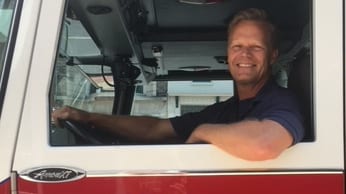
That quote pretty much sums up my life since March 22, 2018. Prior to that day, I was in a great spot in my life. I had been married to my amazing wife, Donna, for 24 years; I had two incredible children; I was in arguably the best physical shape of my life; and I was in the twentieth year of my career as a professional firefighter, working toward a promotion to captain. I was on cruise control.
After graduating from high school, I chose the traditional “college route” and earned a marketing degree from Penn State. I had decent jobs over the next eight to nine years, but none of them fulfilled me emotionally. I realized I wanted a career where I could make a difference in my community.
I tested and was accepted into the Pennsylvania State Fire Academy, where I excelled and graduated with academic honors. The York City Fire Department in York, Pa., hired me, and I hit the ground running. There was no doubt I had found my true calling. I loved being a firefighter. I loved the physical demands. I loved the equipment, the trucks, the tools … and most of all, I loved the camaraderie. Battling a structure fire is inherently dangerous, but that’s what excited me most. It was a rush like no other. It was physical, unpredictable, and challenging, but most of all it was dangerous. It triggers a dopamine release similar to that of a “runner’s high.” My family, my career, my health … I loved the life I had created.
The Day That Changed Everything
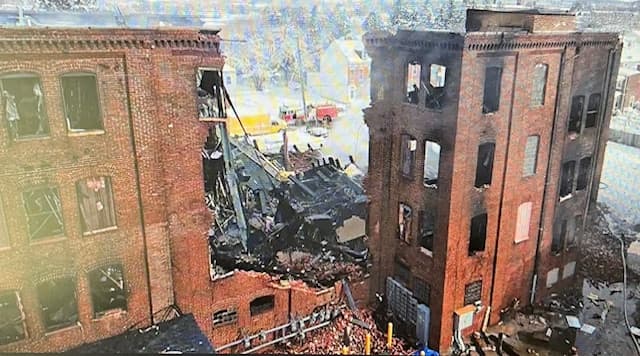
I rode that incredible wave for 20 years. Then, on March 22, 2018, at 3:17 p.m., that life was snuffed out like mob hit. Gone in an instant. I was on the fourth floor (top floor) of an expansive 1800s piano factory that was being converted into condos. We were a group of four: me, an assistant chief, and two firefighters who were also very good friends.
We were on overtime, called in to extinguish several hotspots that persisted from a massive fire in the building the night before. We had extinguished all but one hotspot and had just refilled our cylinders so we could extinguish the last, albeit stubborn, one. We had to deflect the water stream off a ceiling beam so it would reach under a thick rubber roof membrane. I was on one knee with the nozzle and was making headway. One of my buddies tapped me on the shoulder and asked to switch and let him take the nozzle. For some reason that day I said, “sure,” and I handed the nozzle over to him. I stepped back and started talking with my other buddy as we held our pike poles and watched from a few feet away. Less than a minute later, a very loud rumbling sound filled the air, and the floor began to shake violently.
I instinctively turned to run toward the basket of the bucket truck, about 30feet away, at the window on the A/D side. I only made it a half step, and the floor opened up, plunging all four of us an estimated 50 feet down.
I recall the fall with incredible clarity. I was yelling, “NO, NO, NO,” as I fell, because I was certain that when I hit, I would be dead. I can also tell you that having your life flash before your eyes is real. I had a random flurry of images: my kids, me as a kid, my parents, pets, trips, my childhood home … you name it, I saw it. It felt like five minutes, but it was likely three seconds.
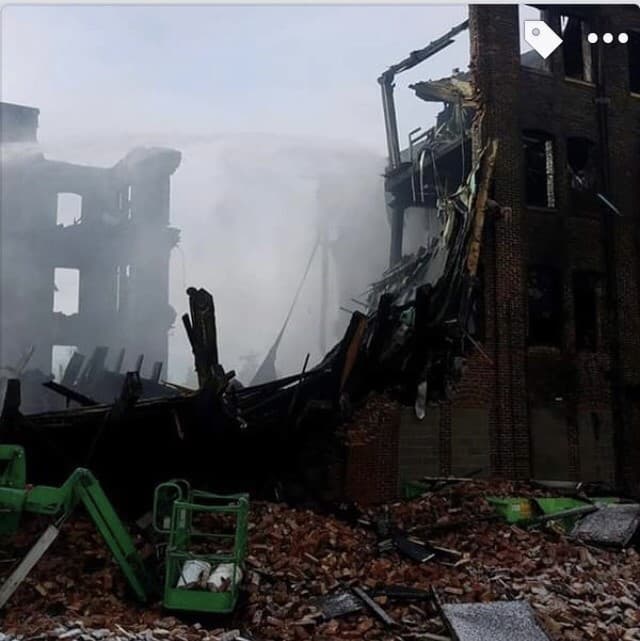
I landed on my back, and I landed hard. Debris continued to pile up, and when it finally stopped and the world got quiet, I found myself upside down and buried beneath roughly four feet of bricks, boards and twisted metal. My eyes darted around, and I was steadily realizing I was alive. Fortunately, I was able to reach my radio, and I announced to command that I was alive but trapped, and would attempt to self-extricate.
I assumed my buddies were in a similar predicament. At that moment, I heard the IC call the mayday, followed by a request for a PAR. I immediately responded. But only silence followed my transmission. All I could hear was the haunting chirps of my buddies’ PASS devices. I knew that wasn’t good, and a wave of despair engulfed me. I had to get free.
I found a loose board I could wiggle until it broke free, letting me remove even more debris. I kept at it until I could see light and eventually made a hole just large enough to fit through. I gripped a massive wooden beam just outside the hole and pulled myself up and out. Free at last. My relief was short-lived. When I reached the top of the beam, I was face-to-face with one of my buddies. His eyes were a strange shade of gray. His mouth agape. His skin was a pale ashen color. I screamed his name and shook his shoulder to try elicit a response, but I knew … I just knew.
A voice yelled at me to help move the slab of concrete off my buddy’s legs. It was a captain who was already on scene when the collapse occurred. Inundated with adrenaline, we lifted the concrete slab off our friend. He then asked where my other buddy was. I pointed to the hoseline diving into the debris pile. “He was on the nozzle. He’s got to be under there.”
More firefighters arrived, and we began digging. At that point, my captain realized I had been in the actual collapse. He yelled for me to be removed from the scene and taken to the front of the building so the paramedics could tend to me.
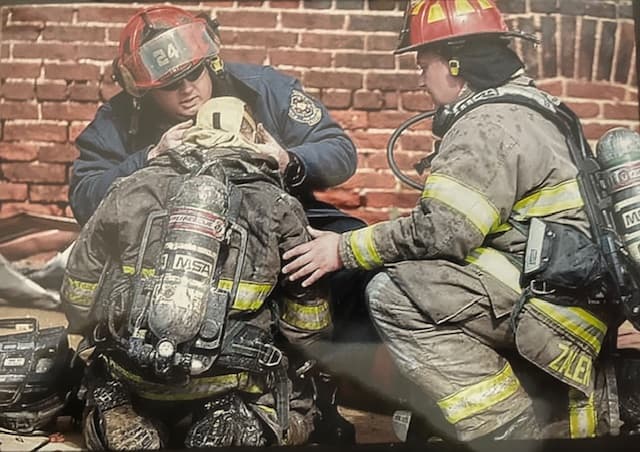
You’ve probably figured out by now that my two buddies were killed that day. Fortunately, the assistant chief survived.
I spent a few days in the hospital and was eventually released with many cuts, bruises, a tear in my shoulder, and a severe case of whiplash in my cervical spine, but otherwise I was in OK shape. A miracle of sorts. I can’t say the same for my emotional shape.
The funerals were both brutal. It was a relatively small department, and our families all knew each other well. In many cases, we would spend time together outside of work. The memorial service was a sight to behold. It was beautifully sad. Full of pomp and circumstance, tradition, and of course, more bagpipes than I could count. Department representatives from around the U.S., as well as Canada and Mexico, came to pay their respects. The president of the IAFF was there, as well, and spoke of our brothers’ heroism and sacrifice. Our community was shattered, and this memorial service began the healing process for all.
With the funerals, memorial service and fundraisers all done, it was now time to focus on me. I began seeing a counselor. He was fantastic and built a solid foundation of tools I still use to this day. Physically, I was also progressing. Long days of physical therapy eventually paid off, and I thought I was good to go. The cosmos had other ideas.
A New Challenge
A few months after I thought I was in the clear, I began to feel numbness in my hands. Over the next several days, it steadily progressed to my feet, legs, back and shoulders. Something was wrong, and I was now seeing a neurologist. He was not quite sure exactly what was happening, so he reached out to a colleague at Johns Hopkins who determined that my own immune system was attacking my spinal cord.
I was officially diagnosed with a rare condition called trauma-induced transverse myelitis, which caused my spinal cord to swell at the original injury site on my neck, basically pinching off the spinal cord like a garden hose. I literally couldn’t walk at this point and was admitted by wheelchair to the ICU.
An inner-jugular catheter was inserted into my neck, and I endured nearly three days of plasma-pheresis treatment. It worked. My immune system backed off, and the swelling subsided; however, the damage to my nerves was already done. What would be my outcome? Would I ever walk again? It was unknown, and that scared the hell out of me.
I worked hard for the next several months until I could walk fairly normally again. I was grateful for this, but I was also depressed over the thought that I would never be able to do many of the things I enjoyed. No more running, no more snowboarding, no more hiking … no more a lot of things.
So now I was getting hit from two sides. First, two of my good friends are dead. And second, I’m going to have physical disabilities likely for the rest of my life. However, we all know that “bad things come in threes.” It’s funny how true that is. For me, No. 3 was finding out that the city of York was officially forcing me to retire from the fire service because the doctors all agreed I wouldn’t be able to adequately perform the necessary physical duties of the job. In the back of my mind, I knew this was coming, but I kept putting it off. So, there you have it: the perfect storm. Three devastating events in my life at once. But the cosmos weren’t done with me just yet. PTSD was now on a train bound for Erik Swanson, U.S.A.
My PTSD was somewhat delayed because I was so focused on my own physical recovery that I initially didn’t have time to be sad. Now I had time, and sadness soon crept in. It wasn’t overwhelming, but it was there. The survivor’s guilt was the toughest to tackle, and I strategically confronted that first.
I remembered the foundation of tools my therapist had given me. I eventually expanded on those and created my own game plan/strategy to fit my particular personality because no two PTSD situations are the same. This plan I created was custom-made for me, but I do believe the three main tools can fit universally into anyone’s toolbox. I knew I needed to confront the PTSD, not try to run or hide from it. Perspective, Attitude, and Opportunity are the three tools I relied on most, and still do to this day.
PERSPECTIVE IS EVERYTHING– A traumatic experience has affected me and left me with PTSD. That sucks, but there is so much more in my life that doesn’t suck, and I needed to learn to focus my energy on those things.
ATTITUDE – I’ve conditioned myself to wake up and greet every day with a positive mindset.
TRAGEDY OFTEN CREATES OPPORTUNITY – PTSD destroyed the person I was before the tragedy. I learned to accept that, then adopted the mindset that I had an opportunity to rebuild a “new me” from scratch and create a better, stronger, happier version of my former self.
My message to anyone reading this who has suffered a trauma and is battling PTSD is that it isn’t always easy in the beginning, but with time, effort, and a positive/future-focused attitude, I believe anyone who is affected by tragedy can become a more robust version of their former self.
I am living proof of that. My life crumbled at 3:17 p.m. on March 22, 2018. I couldn’t hit a reset button or reverse time. I was faced with only two choices: I could succumb to the demons in my head and let them destroy my world, or I could attack them head-on and force their retreat so I could retain my world. I decided to go on the attack, and I won. I am in a great place now. As a result, I still have the amazing family and friends that I did before the accident. The sun seems to shine a bit brighter now, and I don’t sweat the small stuff. Life is definitely good, and if I can endure what I experienced and come through it a better person, anybody can do it. PTSD doesn’t have to be a life sentence of misery. Humans have free will to decide how they view their world, and if you train yourself to wake up and start every day with a positive attitude and perspective, you’ll have the opportunity to create a wonderful, fulfilling “rest of your life.”
It is unacceptable to me that firefighters/EMS have a suicide rate of 18 per 100,000, which is higher than the general population of 13 per 100,000 (U.S. Fire Administration and FEMA 2023). In fact, roughly 46.8% of firefighters report suicidal ideation during their careers, compared to 13.5% of the general U.S. population (FOX 13 News Utah, October 2025). This is largely driven by PTSD, trauma exposure, and stigma. We will never completely eliminate suicide, but I do believe we have the tools necessary to reduce the current rates.
I feel obligated to share my success story. I have been busy creating a presentation that I can bring to first responders everywhere to inspire hope in those who feel hopelessly tethered to PTSD. Not sharing the lessons I have learned and the strategies I developed that allowed me to conquer PTSD would be a disservice to first responders who are battling their own trauma-induced demons. I owe this to the first responder community, and I owe it to my two friends who paid the ultimate sacrifice. It’s certainly a cliché we have all heard before, but I genuinely believe that if I can reach even one person and it ends up saving their life, it will have been worth the effort.