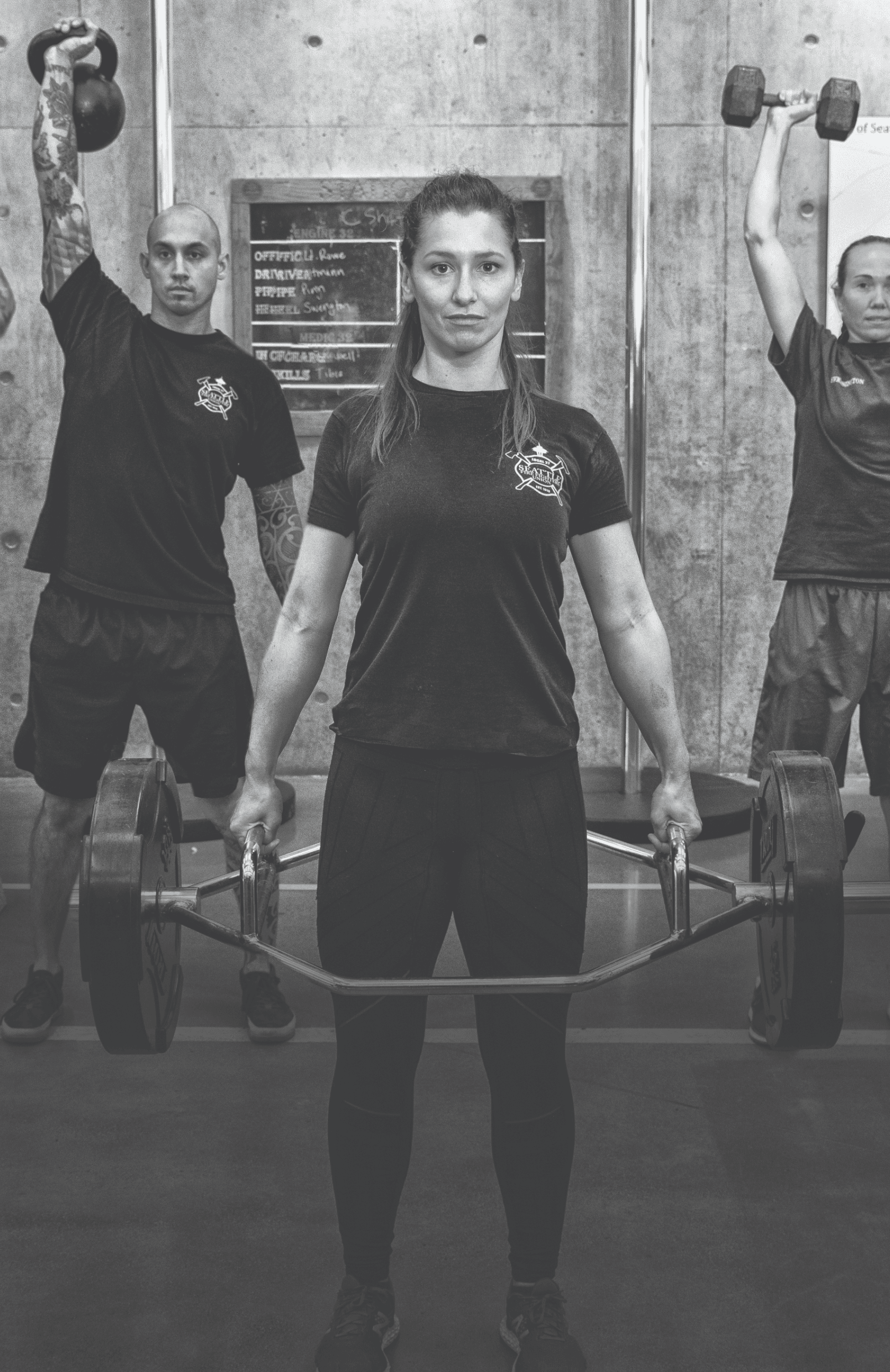

Firefighter fitness doesn’t require complex equipment or elaborate facilities. It requires intentional training grounded in sound movement patterns, appropriate workload, and energy system demands that reflect the realities of the job.
The Firefighter Tactical Fitness Series is a collaboration between Firefighter Peak Performance and CRACKYL Magazine, featuring practical, field-tested training protocols and simple tools that support firefighter readiness.
CRACKYL Workout 24-4 combines medicine balls, steel clubs, and kettlebells with a 20/10 interval protocol to develop strength, power, and repeatable work capacity.
The objective isn’t simply to move faster or complete more repetitions. It’s to maintain purposeful effort, consistent performance, and movement quality throughout the workout.
Training Tools: Medicine Balls, Steel Clubs, and Kettlebells
Simple training tools provide versatile ways to develop the physical qualities firefighters rely on during emergency operations. This workout features three tools, each offering distinct benefits.
Medicine Balls
Medicine balls develop explosive power through throwing movements that allow firefighters to accelerate and release the load, reinforcing coordinated force production through the lower body, trunk, and upper body.
Steel Clubs
Steel clubs provide offset resistance that challenges grip strength, shoulder stability, coordination, and postural control. Their leverage creates unique demands, even with relatively light resistance.
Kettlebells
Kettlebells provide compact, versatile resistance for developing strength, stability, and muscular endurance through foundational movement patterns.
Together, these tools develop strength, power, and movement control through exercises that support fireground performance.
Alternative equipment options make the workout adaptable to different training environments and capabilities.
Training Protocol: 20/10 Intervals
This workout uses a 20/10 interval training protocol, consisting of 20 seconds of work followed by 10 seconds of recovery.
Each exercise is performed for eight consecutive sets, creating a four-minute training block. A one-minute recovery period follows each exercise, including the final exercise.
With four exercises and four recovery periods, the complete training protocol takes 20 minutes.
The short work intervals emphasize purposeful movement and force production, while limited recovery challenges the ability to repeat quality efforts as fatigue builds.
Fireground operations frequently involve demanding physical tasks separated by brief opportunities to recover or transition between activities. Advancing hose lines, forcing entry, deploying ladders, and moving equipment require firefighters to generate force repeatedly while maintaining control.
Although the timing of emergency operations is unpredictable, the physical capacity to perform repeated efforts with limited recovery can be developed through structured training.
The 20/10 protocol reinforces a simple cycle:
Work. Recover. Repeat.
Importantly, the protocol determines the work and recovery intervals, not the training intensity.
This workout can be performed at moderate or high intensity depending on the training objective and how resistance, repetitions, and movement speed are managed.
Workout Timer
Click here to access The 20/10 Workout Timer.
Managing Training Intensity
The 20/10 protocol can be adapted to different fitness levels, training objectives, and recovery needs by adjusting three primary variables: load, volume, and tempo.
Load
Load refers to the external resistance used during each exercise.
Heavier resistance increases the demands on strength, stability, and movement control, but more resistance doesn’t always produce better results.
For explosive movements such as medicine ball throws, prioritize movement speed and coordinated force production over simply increasing weight.
Select resistance that allows purposeful, controlled movement throughout each interval.
Volume
Volume reflects the amount of work performed.
Although each interval remains fixed at 20 seconds, repetitions vary depending on resistance, intensity, and individual fitness.
For moderate-intensity training, maintain a sustainable pace across all eight sets. For high-intensity training, increase effort while preserving movement quality.
Track repetitions to evaluate consistency and progress.
Tempo
Tempo refers to the speed at which each movement is performed.
For explosive exercises, generate force quickly while maintaining coordination and control. For strength-oriented movements, use a deliberate, repeatable tempo that reinforces stability and movement quality.
Regardless of intensity, aim to maintain a Movement Rating of 8 out of 10 or higher throughout the workout.
If movement quality deteriorates, adjust resistance, pace, or exercise complexity before sacrificing control.
Intensity Guidelines
Moderate Intensity
- Rate of Perceived Exertion (RPE): 5–7/10
- Heart Rate: Approximately 60–80% of estimated maximum
High Intensity
- Rate of Perceived Exertion (RPE): 7–9/10
- Heart Rate: Approximately 80–95% of estimated maximum
These ranges are general guidelines. Heart rate can lag behind changes in effort during short intervals, making it less useful for evaluating individual sets.
Use perceived exertion, movement quality, and performance consistency as your primary guides, with heart rate providing additional information about the overall training response.
Workout Instructions
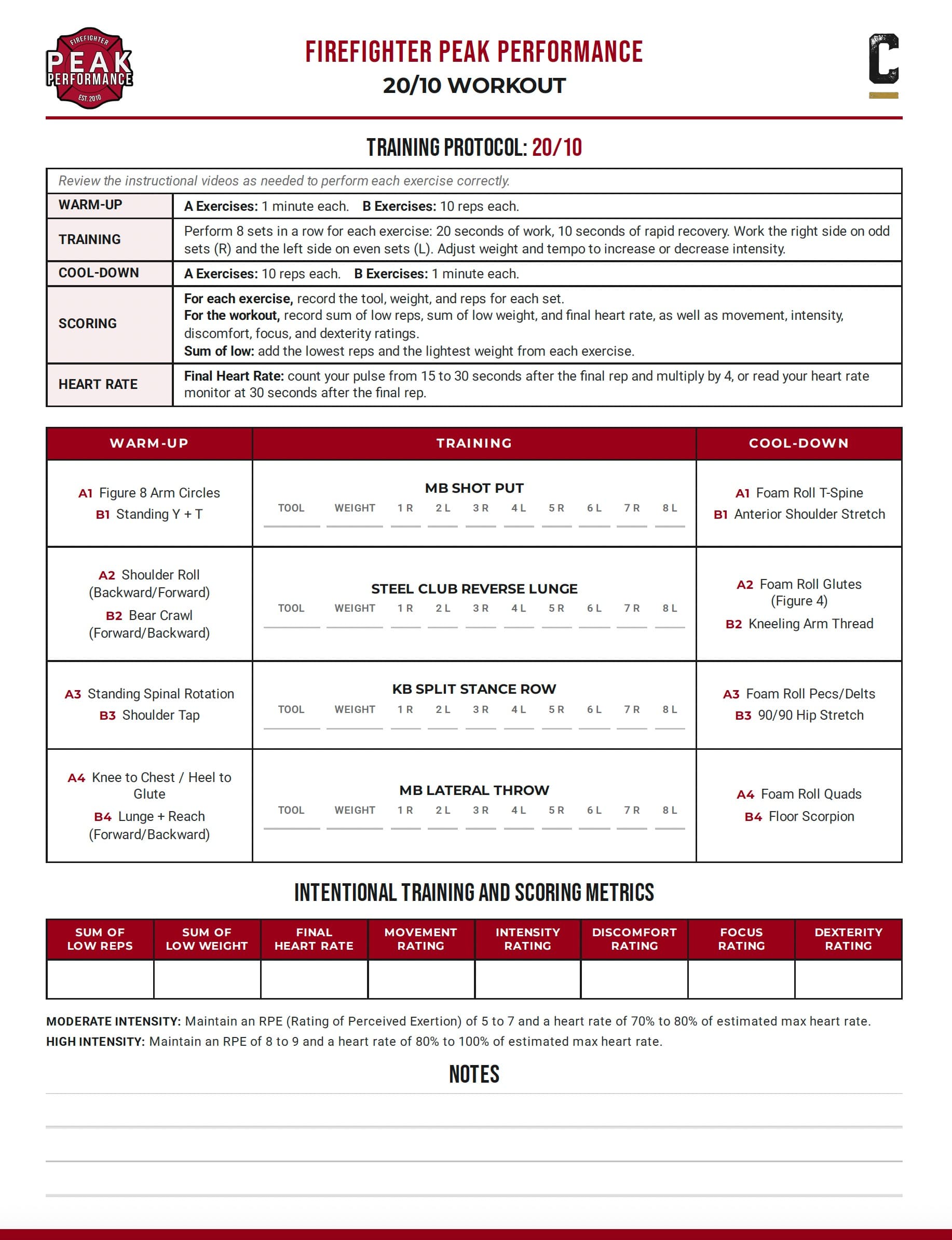
Training Protocol: 20 Seconds Work / 10 Seconds Recovery
Total Training Duration: 20 Minutes
Equipment: Medicine Ball, Steel Club, and Kettlebell
Training Intensity: Moderate or High
Warm-Up
Complete the Dynamic Warm-Up, focusing on mobility, coordination, and the movement patterns featured in the workout.
Training
Complete eight consecutive sets of each exercise:
- Work for 20 seconds.
- Recover for 10 seconds.
- Repeat for eight sets, totaling four minutes.
- Recover for one minute after each exercise, including the last.
All four exercises are unilateral. Alternate sides between sets, using odd-numbered sets for one side and even-numbered sets for the other. Each side receives four work intervals per exercise.
Adjust resistance, repetitions, and movement speed to maintain the intended training intensity and movement quality.
Cool-Down
Following the final recovery period, complete the Comprehensive Cool-Down, emphasizing controlled movement, breathing, and recovery.
Training Exercises
Each exercise reinforces a foundational movement pattern while developing physical qualities that support firefighter performance.
1. Med Ball Shot Put
Movement Pattern: Vertical Push
Training Focus: Explosive power, trunk stability, and coordinated force production.
Generate force through the lower body and trunk before transferring that force through the upper body to propel the medicine ball toward an elevated target. Reset your stance between repetitions and maintain control.
Fireground Application: Supports overhead lifting, ladder deployment, and forceful pushing movements involved in equipment handling and tool operation.
Alternative: Single-arm overhead press using a kettlebell, dumbbell, or exercise band.
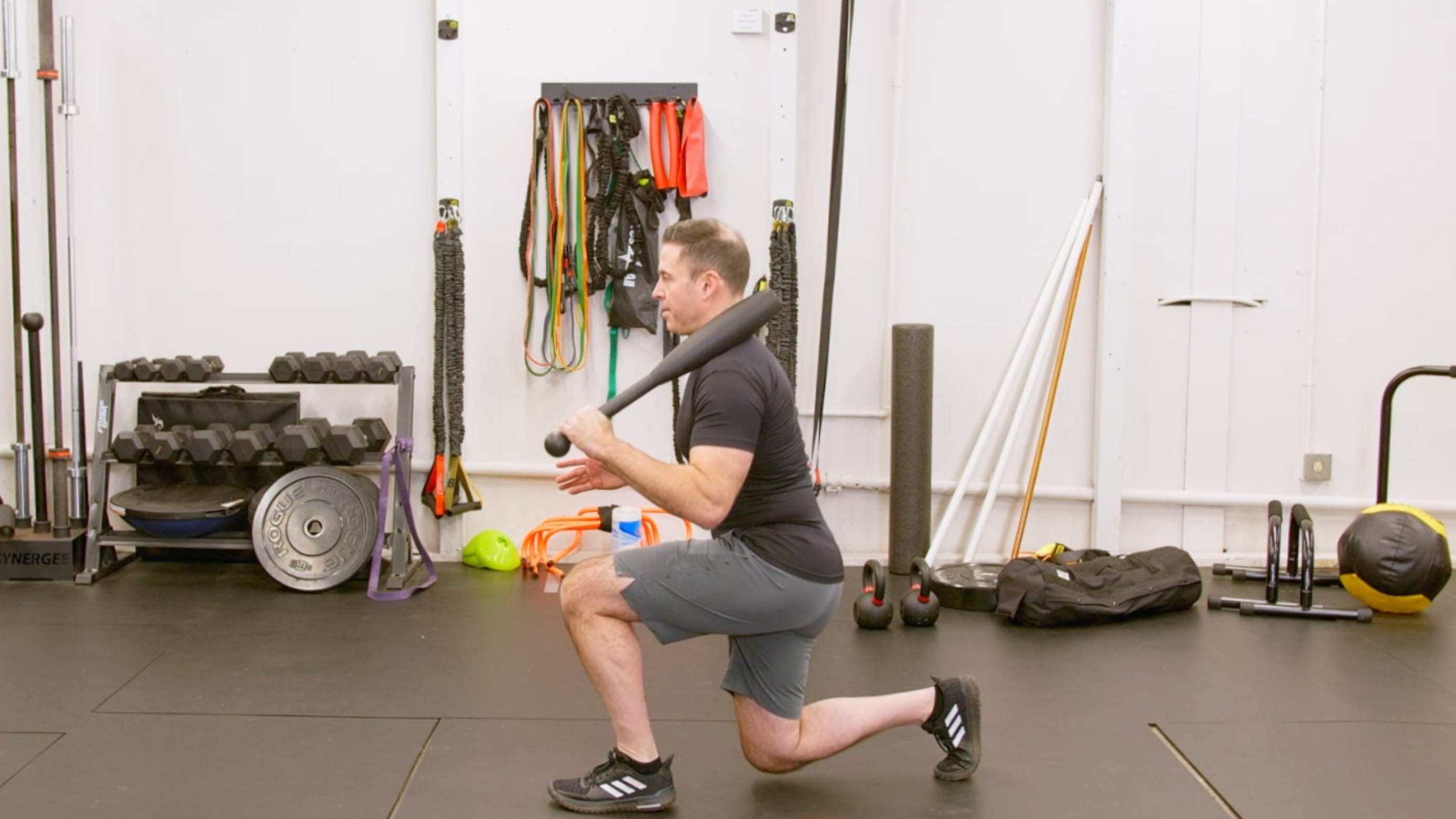
2. Steel Club Step Back Lunge
Movement Pattern: Lunge
Training Focus: Lower-body strength, balance, coordination, and postural control.
Hold the steel club securely while stepping backward into a controlled lunge. Maintain trunk stability as you lower and return to standing, mirroring the setup when changing sides.
Fireground Application: Supports stair climbing, equipment carries, and maintaining balance while navigating uneven terrain.
Alternatives: Bodyweight lunge or loaded variation using a kettlebell, dumbbell, sandbag, or hose bundle.
3. Kettlebell Split Stance Row
Movement Pattern: Horizontal Pull
Training Focus: Upper-body pulling strength, grip endurance, and trunk stability.
Establish a stable split stance and hinge forward at the hips. Pull the kettlebell toward your torso while resisting trunk rotation, then lower under control. Reverse your stance and rowing arm when changing sides.
Fireground Application: Supports hose advancement, equipment handling, and demanding pulling tasks that require strength and stability.
Alternatives: Dumbbell, sandbag, or exercise band.
4. Med Ball Lateral Throw
Movement Pattern: Rotation
Training Focus: Explosive rotational power, coordination, and force transfer.
Generate force through the hips and trunk to throw the medicine ball laterally into a suitable rebound surface. Maintain balance and control as you reset between repetitions, reversing direction when changing sides.
Fireground Application: Supports rotational movements involved in forcible entry, tool operation, and repositioning equipment.
Alternative: Rotational exercise using a weight plate, kettlebell, or exercise band.
Scoring the Workout
Scoring is an important part of firefighter tactical fitness. It builds awareness, accountability, and a measurable record of progress.
Record both objective and subjective performance metrics.
Objective Metrics
- Repetitions completed during each set
- Total repetitions
- Resistance used
- Final heart rate
Subjective Metrics
- Movement Rating
- Intensity Rating
- Discomfort Rating
- Focus Rating
- Dexterity Rating
Together, these metrics provide insight into physical performance, movement quality, and the ability to manage repeated efforts.
For the 20/10 protocol, pay particular attention to performance consistency.
- Did you maintain similar output across all eight sets?
- Did movement quality change as fatigue developed?
- Were you able to recover sufficiently between intervals to repeat quality efforts?
For unilateral exercises, compare corresponding sets performed on the same side.
Use your results to evaluate performance consistency and make informed adjustments to resistance, pace, and intensity during future sessions.
Building Firefighter Readiness
CRACKYL Workout 24-4 provides a complete training session that can be performed as a Workout of the Day or incorporated into an existing fitness plan.
However, individual workouts are only one component of firefighter tactical fitness.
Long-term readiness requires structured, progressive training that develops strength, power, aerobic capacity, and muscular endurance while accounting for the demands of firefighting, shift work, and recovery.
Some sessions emphasize sustained aerobic work. Others focus on strength, power, or repeated higher-intensity efforts. Each serves a purpose within a comprehensive training plan.
The goal isn’t to push harder every time you train. It’s to develop the physical capacity, movement quality, and durability needed to perform consistently throughout your career.
Train With Purpose. Perform With Confidence. Be Response Ready.