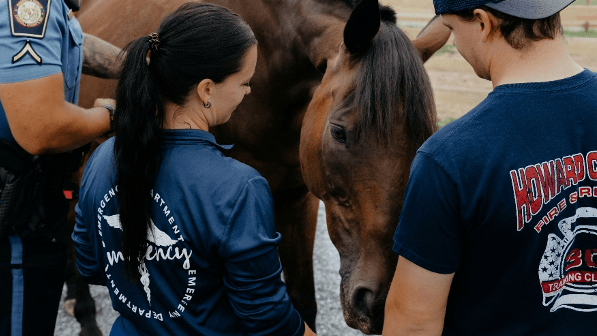
Photo by Morgan Engel – Stoked Souls Photography
How horses help first responders regulate, restore, and reconnect
“This horse didn’t know me, didn’t need to hear my story – but somehow, he understood me. For the first time in a long time, I could exhale.” – Firefighter participant
For firefighters, EMTs, law enforcement officers, and other first responders, the weight of the job can build silently over time. The calls don’t stop, the pace doesn’t slow, and the expectation to stay strong, no matter what, is constant. But the truth is, sometimes carrying the weight alone becomes too much.
At Operation Second Stride, we believe that healing doesn’t begin with correction, but with connection. That connection often begins not in words, but in rhythm, safety, and trust – sometimes for the first time in years.
Why Horses?
Our equine-assisted learning program pairs first responders and families of the fallen with retired racehorses, drawing on the science of bottom-up brain regulation. These horses – off-track thoroughbreds – carry a spirit uniquely suited for this work. Much like first responders, they have spent their lives in states of high alert, trained for speed, precision, and endurance. They know the weight of pushing forward when rest isn’t an option, and in that shared experience lies their gift: an ability to connect with those who also live under pressure, reminding us that resilience can be transformed into strength, and a relentless drive into the simple power to just breathe and reset.
This shared experience becomes the foundation for something powerful.
“Perhaps this is something the fire service had when horses were in firehouses back in the day,” reflects Chief Frank Leeb (FDNY, ret.). “Maybe there were other values besides just getting firefighters to the scene. What is old may be new again and backed by science.”
The Science of Regulation
According to neuroscientist and trauma expert Dr. Bruce Perry, trauma embeds itself in the lower regions of the brain, the brain stem and midbrain – responsible for survival responses like fight, flight, and freeze. Logical reasoning cannot pull someone out of survival mode; the brain must first be regulated through sensory, rhythmic, and relational experiences.
This is where horses excel.
As prey animals, horses live fully present, deeply attuned to the energy and emotions of those around them. When a firefighter walks into the arena carrying stress, exhaustion, or grief, the horse notices immediately. Not with judgment, but with honest feedback. Their response becomes a nonverbal invitation to slow down, regulate, and reconnect.
This is the foundation of Natural Lifemanship: relationships built on safety, consent, and mutual respect.
What It Looks Like
Our sessions are not about horsemanship. They’re about relationships.
Participants learn to:
- Become grounded in the present moment
- Track their nervous system and recognize stress signals
- Set and honor boundaries
- Experience trust and mutual respect
- Reconnect with parts of themselves long buried by trauma or chronic stress
For many, time with the horses is the first time they feel truly seen – without needing to explain. It isn’t traditional therapy, yet the impact is profoundly therapeutic.
A Place for Firefighters and Families
We serve firefighters, paramedics, EMTs, law enforcement officers, ER physicians and nurses, and the families of those who have fallen. Each finds in the horses a mirror, a partner, and a guide. One stride at a time, they move from survival toward restoration.
Why It Matters
The fire service culture is built on strength, resilience, and a commitment to serving others. But strength doesn’t mean carrying the weight alone. At Operation Second Stride, healing begins in a relationship – between human and horse, between nervous system and rhythm, between survival and safety.
Because when both firefighters and horses are honored in their shared journey, we discover something remarkable: healing doesn’t just happen in the brain – it happens in connection.
For more information, visit the Operation Second Stride website.