

How the standards we set and the ones we tolerate shape the gap between the life we’re living and the one we expect
It came up twice this week — once at the firehouse, in a conversation about the job, the pace, what we expect from it and what we expect from each other, and then again at home, watching my daughters handle school, work, and responsibility with a level of ownership that doesn’t need to be coached. You can see a standard forming in how they operate and take initiative. They go after things. That thread — expectation, effort, standard — sat underneath both conversations whether we said it directly or not. What I’m seeing in them is the pursuit of happiness in real time — not waiting for things to line up, but taking ownership of what they can control and moving.
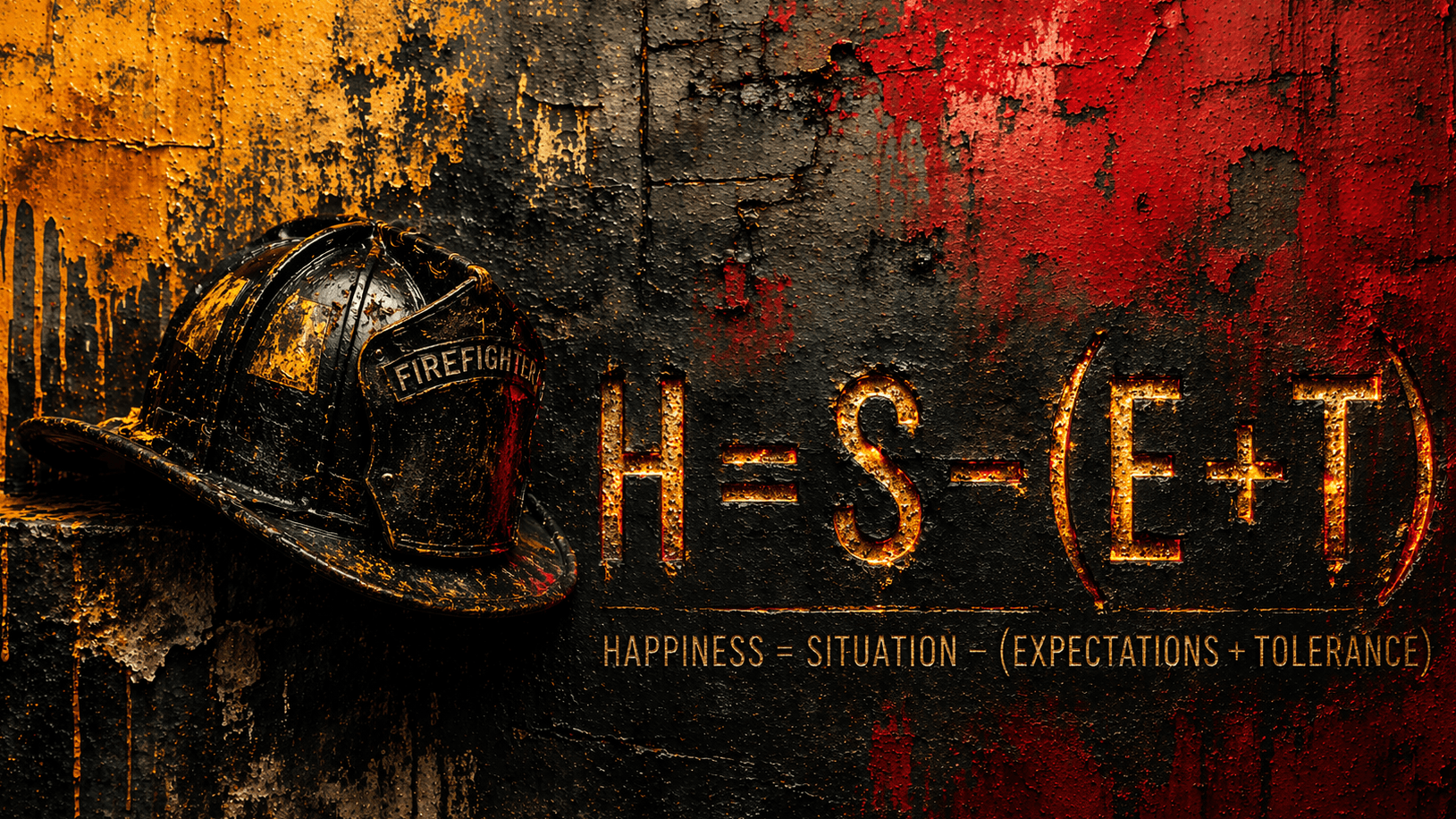
If that’s true, then the question becomes simple: how do you close that gap? Because when you strip everything else away, it comes down to this:
H = S – (E + T)
(Happiness = Situation – (Expectations + Tolerance))
The Space Between Reality and Expectation
What is starting to stand out is how much of our experience comes down to the gap between what is happening and what we believe should be happening. Close that gap, and things feel steady. Let it widen, and friction shows up. You feel it in the job. You feel it at home. You feel it in your own head even when everything around you looks like it’s moving in the right direction. The work is getting done. Progress is happening. Still, something feels off. That gap is where the disconnect lives.
There’s a part of this I’ve had to own, especially in the firehouse. I remember listening to a firefighter vent about how things had slipped — standards, effort, the way the job was being carried. As I stood there, it was hard to ignore that the very thing being called out was something they were part of, at least in my view. It felt like armchair quarterbacking — calling out what’s obvious without stepping in and carrying any of the weight, without recognizing that what’s slipping is a mirror of what’s being modeled. People don’t learn from what’s said — they learn from what’s done. And when the standard fades, it’s because it’s no longer being demonstrated. And the part that stayed with me was they didn’t see it. They were standing right in the gap — between what they wanted the job to be and what they were actively tolerating — and it never registered. They weren’t just frustrated — they were widening the gap themselves. I’ve caught myself in that same position. It’s easy to point at what’s off. It takes more to recognize where I’ve contributed to it, or where I’ve chosen to look past something that didn’t align. That’s where the gap gets built without you realizing it.
Every decision starts to fall into one of two categories: does this close the gap, or does it widen it?
Where Standards Slip, and How We Let Them
I’ve lived that. When I was sick, I adjusted to it. I kept moving, kept working, and let the standard slide just enough to make it manageable. The warning signs were there. I let them sit and take over. That’s how it happens. You reshape the standard to fit the situation instead of holding the line. There’s a quote from Jim Rohn that hits this directly: “Don’t lower your standards to meet your circumstances. Raise your circumstances to meet your standards.” That’s easy to agree with when things are good. It gets tested when they’re not.
Your standard is dictated by what you tolerate, and what you tolerate is what keeps the gap in place. What you allow to continue becomes the operating line, whether you acknowledge it or not. That applies at the firehouse, at home, and in how you carry yourself when no one is watching.
When you strip everything down — the work, the goals, the push to build something meaningful — it simplifies more than we want to admit. It’s like reducing a fraction. Something that looks heavy and complex breaks down to its base form — 50/100 reduces to 1/2. Same value, just clearer. Most of what drives us reduces the same way. Family. Identity. Forward movement. The need to build and contribute. Everything else expands from there, but that core doesn’t change. That’s the base — and that’s where the equation actually gets decided.
Closing the Gap Through Action
So the real check-in sits inside the flow of the day. You can feel it when something doesn’t line up. You can see it in how you respond to pressure, in what you accept, in what you ignore. The question follows you — am I closing the gap, or widening it?
Your internal fireground runs on the same principles as the external one. What you contain stays controlled. What you let move spreads. Ignore it and it sets your limit. Hold the line and it stabilizes. Discipline begins at the point where tolerance ends.
And the truth is — happiness doesn’t move closer on its own. You either close the gap through action, or you keep widening it by tolerating what you know should change.