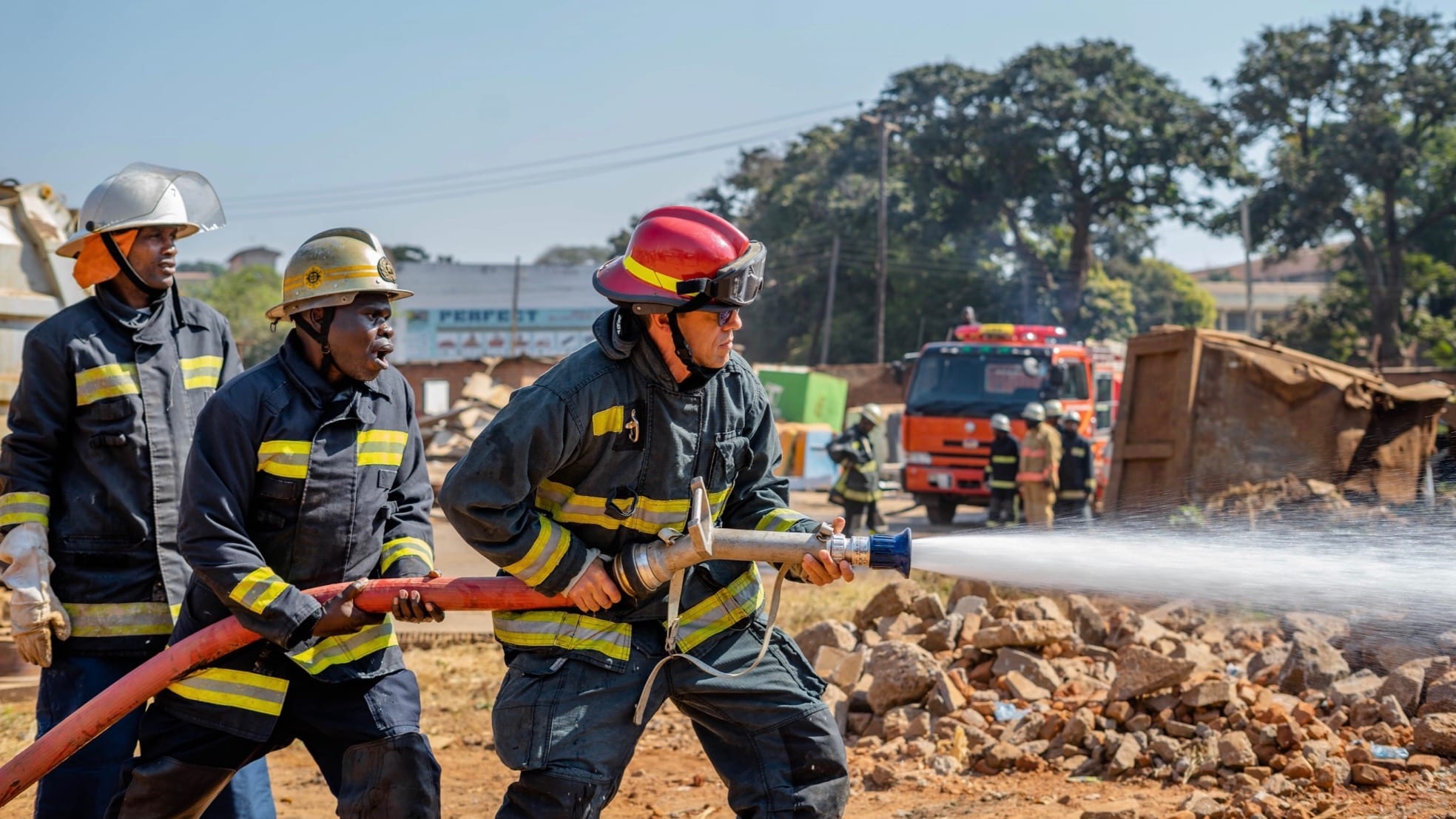
Firefighter training in Malawi. Photo by Africa Fire Mission
When I turned 62, I decided that after 20 years, it was time to end my days as a volunteer firefighter. I was in good health, and I still loved the fire service. But my term as the chief was ending. Since I firmly believed that once a chief’s term is over, they should disappear to make room for the new chief, I knew I had to retire from the department altogether.
I know many retired volunteer chiefs like to hang around to “share” their wisdom. I think this is a mistake. The new chief needs to take command without the previous chief looking over their shoulder.
Discovering Africa Fire Mission
Call it coincidence, luck, or divine providence, but around the time I announced my retirement, I saw a notice on the National Volunteer Fire Council (NVFC) list about a program training firefighters in Africa called Africa Fire Mission (AFM). Perfect, I thought. I could stay involved in the fire service by traveling to Africa and doing what I love most as a firefighter: training other firefighters and hanging out with firefighters. So, I applied to go to Zambia.
Then COVID-19 happened. My trip was cancelled. But that didn’t stop AFM from continuing its mission to train first responders. Under the guidance of Nancy Moore, AFM’s indefatigable executive director, we moved all of the training online for the year. This COVID-inspired experiment grew into ongoing weekly webinars on a wide range of first responder-related topics taught by instructors worldwide.
The Origins of AFM
AFM launched in 2012 in Kenya. The founder, Fire Chief David Moore (ret.), was on a short missionary trip there. While there, he was asked to provide basic fire safety training to teachers and social workers at Mission of Hope International schools in the slums of the Mathare Valley. One thing led to the next, and now AFM is actively involved in providing training in several East African countries.
Once COVID-19 travel restrictions relaxed, AFM began planning training trips again. Zambia wasn’t an option, so I signed up for Kenya instead. Each mission trip, as they are called, involves extensive pre-trip preparation, though in reality, nothing can truly prepare you for what you’re about to experience.
I’ve made four trips to Kenya. While every trip follows the same format, each is unique, even for veterans like me.
Every trip begins with an immersion into Kenyan society, starting with the birthplace of AFM, the Mathare Valley slum. This is followed by a visit to one of the fire stations in Nairobi. Let me say that after seeing the condition of the firefighting equipment our Kenyan brothers and sisters have to work with, you’ll never complain about your gear again.
In striking contrast to the Mathare slum, you’ll also visit very upscale neighborhoods. In fact, the Grace House, where the teams usually stay, is in a very urban and dynamic neighborhood with great restaurants, casinos, and upscale stores.
Training Firefighters in Kenya
What follows this immersion is a week-long fire school. AFM team members, in collaboration with Kenyan first responders, provide a variety of classes for more than 350 participants. This is not only the time for skills instruction, but more importantly, it is also when new friendships are formed.
Whether the first responder lives and works in a major urban area like Denver or a rural east African village, it is hard to describe our natural bond. The terminology might be different. We call them nozzles; they call them branches. But fire is fire, and smoke is smoke. The risks are the same as are firefighting tactics. What is different is the lack of training. This is why AFM’s real mission is to train the trainers.
A Life-Changing Experience
Every aspect of my experience with AFM profoundly impacted me. Spending time in Kenya with such a motivated and dedicated group of men and women was truly inspiring.
However, the most special part was getting to know the Kenyans. If you’re wondering how you will speak with them, don’t worry. They all speak English, Swahili, and often two or more additional languages. Lastly, I would be remiss not to mention that Kenyans are incredibly warm and friendly.