How’s this for a familiar story? A young girl or boy grows up near a fire station. Maybe they are playing in their yard, a nearby park or their sandbox, where they watch as rigs launch from the station with lights flashing and sirens wailing. Even for adults, that’s a show-stopper.
It’s this show that sparks and deeply seats the passion to become a firefighter in the child’s psyche.
And that passion, that fascination morphs into obsession through childhood and into the teen years. That child joins a fire explorer program in adolescence, hits 18 and joins a volunteer department, and eventually makes a career in the fire service.
And that small-child passion remains through all the stages of life that follow. Really, that describes a lot of us. It also describes Austin Weishel. He was that little boy in the sandbox near a Chicago firehouse. He was the one who, after relocating to Colorado, was an explorer and a volunteer firefighter.
Now, he’s the one making a career in the fire service – but with a twist.
Weishel had a twin, parallel passion – art. Even as a young child, his drawings and sketches were vastly more detailed than the crude circles and lines that adorn most parents’ refrigerators. At age 19, barely old enough to serve as a volunteer firefighter, he sold his first full-size bronze monument.
Those of us who find ways to pursue our passions are fortunate. More fortunate still are those who turn their passion into a career. And then there’s Weishel, who mashed his twin passions into a single career. That bronze he sold at age 19? It was a firefighter memorial sculpture. In fact, the first sculptures he did during a quasi-apprenticeship in Arizona at age 14 were of firefighters.
You may not be familiar with Weishel or may have seen him pop up on social media. There’s a good chance you’ve seen his work and not made the connection. I met him more than 10 years ago at FDIC. He says that’s the only show he can afford to buy a booth at – he’s pretty much a one-man show, doing all his own marketing, customer support and the art (though he does get a fair amount of help from his mom). And like some of you, I’ve watched his career progress over social media.
Over the years, I’ve thought about how to profile this artist working in a unique yet ancient medium. I’m glad the profile didn’t come together until now. He’s at the perfect spot in his career – established, yet still hungry to achieve more. Known, yet not a household (or firehouse) name.
Long before Weishel made a bronze cast of firefighters in Arizona, the first known bronze statue was made sometime between 2300 and 1751 B.C., known as the Dancing Girl. She stood only about 4 inches tall and was crafted by someone in the Indus Valley civilization in what is now Pakistan.
Ancient civilizations in China and Greece also took up bronze statues; going a great deal larger than Dancing Girl’s modest size. In fact, according to Artsper Magazine, many of the ancient Greek marble statues were actually copies of earlier bronze works.
And when you think that the pieces Weishel is creating right now may well last 3,000 years or more – and he has thought about that a lot – you’d forgive him for sweating the small stuff, which he does.
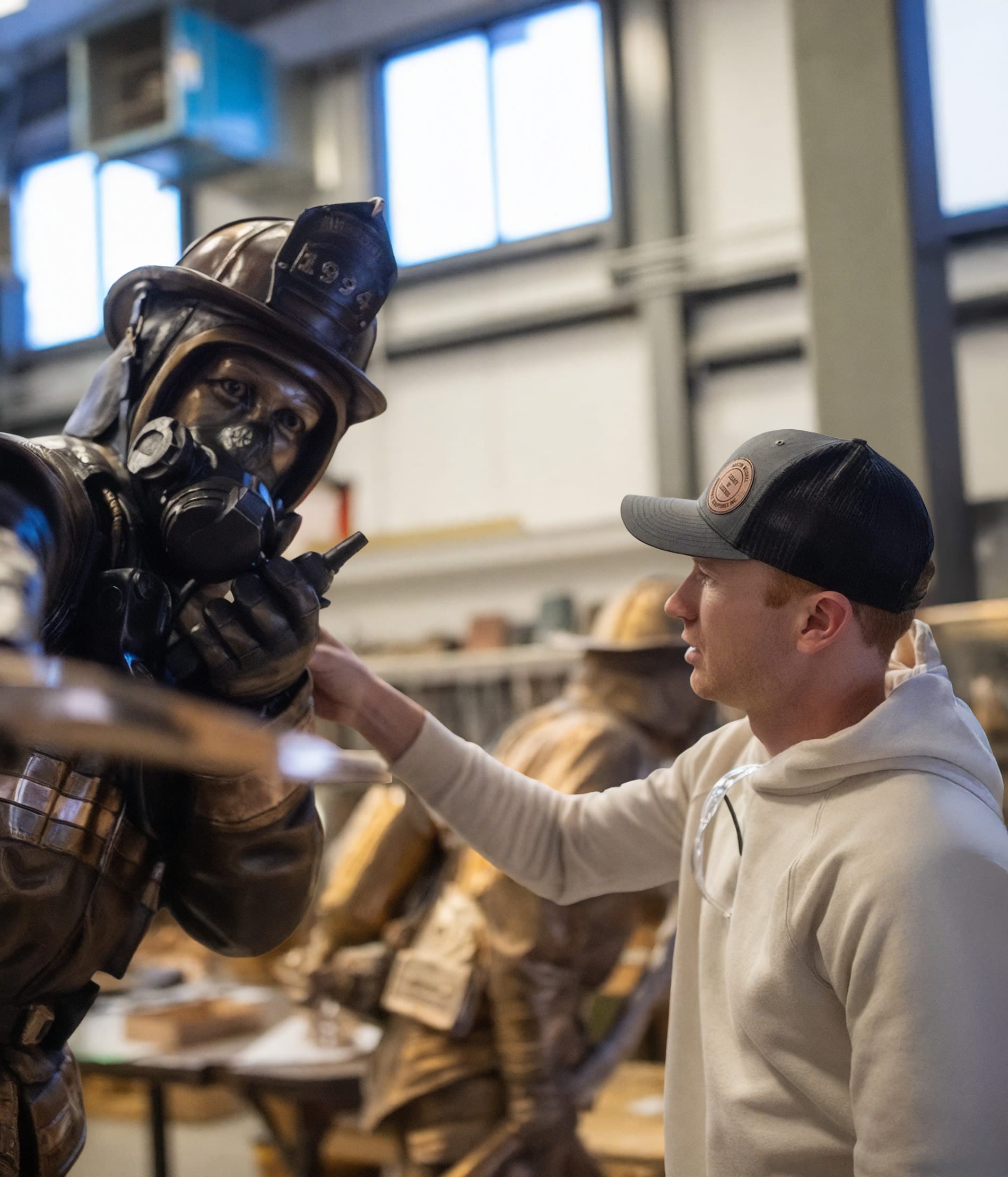
Weishel will obsess over getting the face, especially the eyes, and the folds in the turnout gear or uniform fabric, just right.
When we spoke by Google Meet, Weishel was in his studio. Off to his right was a classroom size dry-erase whiteboard divided into boxes – most were filled with deadlines. Over his left shoulder was a mold partially covered in clay of his current project, a firefighter climbing a ladder. He worked a piece of clay over in his hand while we talked.
That clay is more than a model or rough mock up. Unlike Vegas, what happens in the clay doesn’t stay in the clay – it transfers exactly to the mold and to the final bronze product. It’s why he obsesses over folds in fabric, eyes, facial expressions and room temperature (too hot, the clay loses its form; too cold, it becomes brittle). And you can hear how excited he gets about the process.
“It’s very ancient, how they cast them still,” Weishel says.
“So that 2,000-degree bronze, once everything is ready for casting; it’s just magma that’s going into this. And it cools within 30 seconds to a minute. So it cools very quickly. Which is really cool.”
He’s found his own fingerprints in some of his earlier finished works. And, for one memorial for Special Forces, he had Gold Star family members put their fingerprints in the clay so they would forever be connected to their loved ones’ memorial.
“I sculpted it,” he says of the Special Forces monument. “But they have a hand or their own energy in it in some way. It just makes sure their legacy is truly captured forever.”
Maintaining that minute detail is put to the test when the mold goes to be cast in bronze. Nearly all of his bronze monuments are larger than life – literally. So moving them from his studio to the foundry requires disassembly. Not quite Texas Chain Saw Massacre disassembly, but kind of close. Weishel uses a Sawzall to separate head, limbs and torso. Then he carefully reassembles it and smooths out any flaws before giving it over to its forever casting.
To get this good, to where fire, police and military agencies seek him out to make their memorials, he must have been formally trained. Surely, he studied in Europe or went to art school?
Nope. Self-taught for the most part. He had some innate gift for drawing and a passion to push himself, even at a young age. He also used art as a form of escape.
In about the second grade, Weishel was diagnosed with dyslexia. Schoolwork and fitting in was a struggle. There was also the internal struggle of being told he had a “handicap” and wasn’t as good as “normal” people. =
“Maybe if I didn’t know that I was dyslexic, I would be better,” he says, wondering how much he internalized the limits placed on him. He also knows he used his diagnosis as an excuse to not do some hard things early in life. “But I found that even though I have this, I still have to deal with it.”
Weishel knew a fellow student with dyslexia. That student was brilliant at mathematics, he says. And that student’s drive to overcome all obstacles to become an engineer inspired Weishel. It taught him that passion and hard work could win the day. It taught him to do hard things rather than avoid them.
So his dyslexia went from stigma and an opt-out excuse to motivator and resiliency builder. Taken a step further, he found an artistic advantage in his dyslexia.
Often those with dyslexia will see printed words and letters reversed and jumbled. Which doesn’t sound like an advantage. But, as Weishel explains, there are times he can will his brain to do that same reversing with three-dimensional objects – like, say a sculpture. He can, he says, mentally flip an image in his head and see it and work on it in reverse. That gives him a clearer view of the piece.
I know. It blew my mind when he said that. So I asked a friend with dyslexia who essentially said, “Yeah, I can see how that would work.”
At age 14, already accomplished at sketching, Weishel stayed with his grandparents in Arizona for a few weeks.
“We went to the local bronze foundry and the owner gave me a piece of clay. He said to bring this back next year.”
He set out to work on a kneeling firefighter. He learned to work with clay. He left it in the car where it melted, and he learned more lessons about working with clay. The following year, the foundry owner made good on his promise and Weishel had his first bronze firefighter sculpture. It was during that year he did a quasi-apprenticeship and learned the stages of bronze statue making.
“Just do hard things” became his self-talk when he was pushing to get into firefighting and get better at his art.
He holds tight to that mantra and offers it up as advice to anyone trying to figure out how to be more successful – how to get more out of life.
And now you can find Weishel’s art all over. He has more than 60 pieces that include the Nevada State Firefighter Memorial, a life-size Ben Franklin, the Colorado War Dog Memorial, the American Military Hero Dog Monument in Florida, the Tenth Special Forces Group Monument, the Concord (N.C.) Police Memorial, the Colorado Law Enforcement Memorial, a life-size firefighter kneeling with a child outside the Windsor Severance (Colo.) fire station, a Persian Gulf War Memorial in Pensacola, Fla., and his Tools of the Trade piece (fire turnout gear and ax) has been installed at six fire stations around the country.
He’s done busts of President Theodore Roosevelt and actor Robin Williams. He sculpted actress Betty White, which he says was his favorite.
He gave up firefighting after 12 years. The demands for his art became too great and he couldn’t risk injuring his hands.
So what’s the biggest thing on Weishel’s wish list to accomplish? Well, a big thing, a really, really big thing. He has plans to do a massive monument.
Like Statue of Liberty big?
“Larger, vastly larger,” he says. “I want to be the biggest monument maker in the world.”
In fact, he had it planned out and was moving toward a contract. Then COVID-19 came along and things went sideways. He’s not going to tell me any more about it, but he’s smirking and working the clay over in his hands. Something tells me we’ll see that massive monument at some point.
That passion to push to be better, be bigger hasn’t changed that much from the kid in the sandbox. Now, he’s learned to harness and direct all that energy.