
This article appears in the 2024 CRACKL Fire Station Design special issue. Order the* *limited-edition supplement now!
Since 1970, when the United States passed the Clean Air Act and created the Environmental Protection Agency to enforce it, significant research has been performed on indoor air quality.
In 1988, the Centers for Disease Control and Prevention issued Current Intelligence Bulletin 50. This document outlined the workplace hazards presented by diesel engine emissions, and studies confirmed the potential carcinogenicity of whole diesel exhaust. With this understanding, diesel exhaust is regarded as a potential occupational carcinogen. More than 35 years later, the occurrences of cancer and respiratory illnesses continue to be an issue due to the ingestion and absorption hazards of particulates and gasses from diesel emissions.
Opening the overhead doors before starting the apparatus will allow enough air flow to clear out the diesel exhaust, right? Wrong. Incorrect assumptions like this can cause current contamination and possible future illness.
After the Clean Air Act of 2007, diesel particulate filters were required to be installed in new apparatus. This is sufficient to make it safe to be in close proximity to the exhaust, correct? Another incorrect assumption.
It’s dangerous when we misunderstand the steps and measures the industry has taken to reduce greenhouse gas emissions. These technology advances have indeed helped reduce the air pollution. However, when it comes to the atmosphere within the station, diesel exhaust is still dangerous and requires additional engineering and systems to clean the air.
There are several types of vehicle exhaust extraction systems, each unique in its own way. As one would expect, each has pros and cons regarding the exhaust capture, treatment and filtration.
There are three primary options on the market.
- Direct source capture – hose
- Direct source capture – vehicle mounted
- Building space filtration
When considering each of these options, it is important to assess responder safety (moving parts and reliability of staff to follow protocols), system cost (initial purchase vs. maintenance costs) and building configuration (new construction vs. retrofit). Every station is unique and will present a different set of challenges.
Direct Source Capture System – Hose
This system uses a hose that captures the diesel fumes directly from the apparatus exhaust tailpipe. That is the key to direct source capture systems – the diesel exhaust does not enter the building’s atmosphere. The exhaust is removed from the building entirely via hoses, a network of ductwork and one or more exhaust fans. These systems can be designed for all apparatus, large and small, with various tailpipe locations.
With the hose is attached to the tailpipe, the system is triggered to run for a pre-set time when the vehicle is started. This run time includes a period after the hose has disengaged to ensure remaining particulates and exhaust are removed from the hose and ductwork prior to shutting down. The hose is attached to the exhaust pipe with magnetic grabbers and anchor plates.
Direct Source Capture System – Vehicle Mounted
With this system the exhaust is filtered and then released within the building atmosphere. The filtration takes place on the apparatus within a special filtration chamber along the vehicle exhaust system. The byproduct of the filtered exhaust reduces the hazards to an acceptable level for breathing within the space.
These systems are not being used only when entering and exiting the station, but even on-scene. During operations at a scene, responders are often subjected to prolonged exposure to diesel exhaust as the apparatus operates. Incorporating them can provide safer on-scene conditions, which aligns with many other current initiatives to prevent cross-contamination on scene.
Building Space Filtration
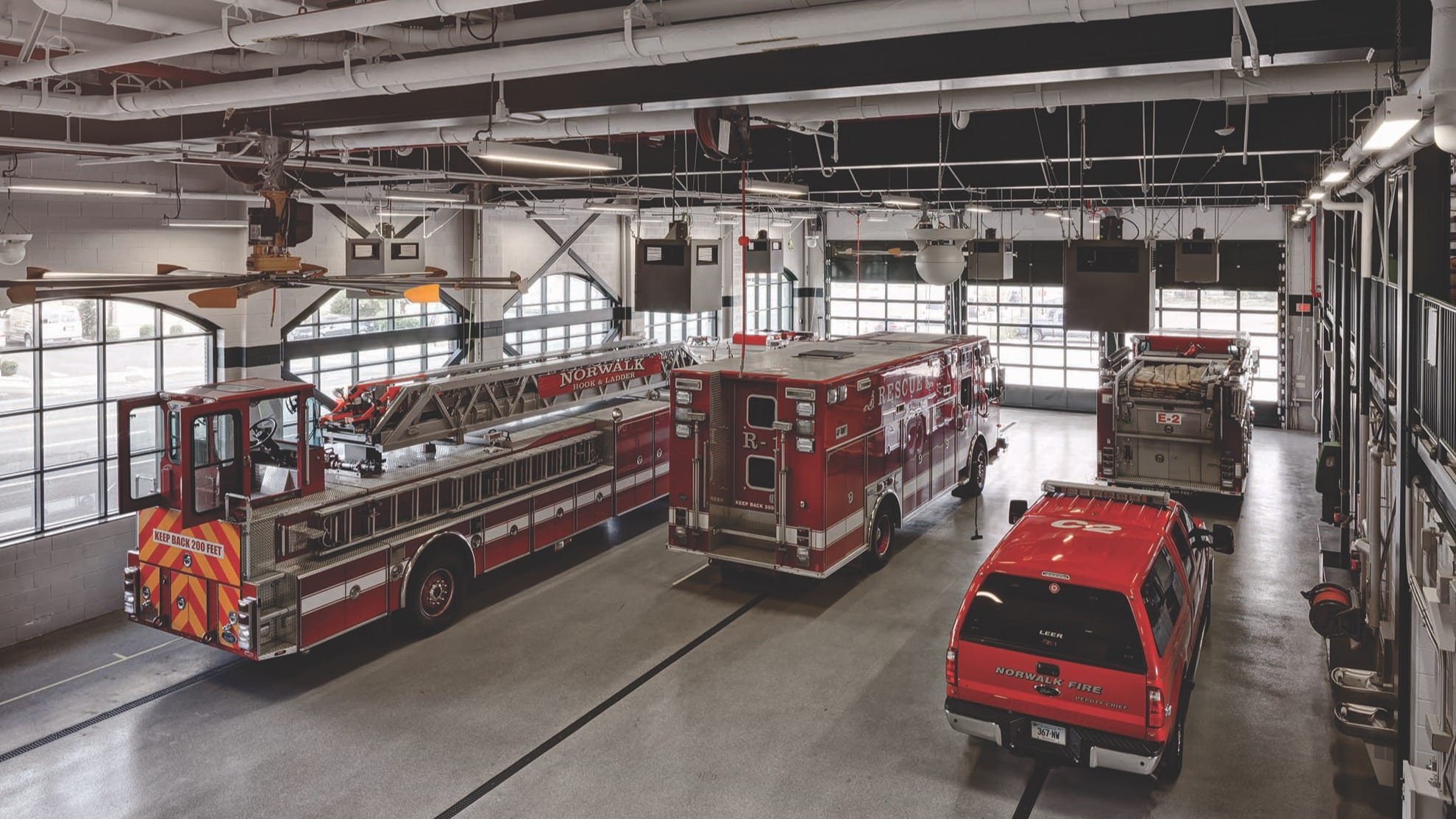
This system differs from the others in that it is not a direct source capture. These are typically ceiling units that have a fan to force air through a series of filters, effectively scrubbing the air clean of diesel particulates and absorbing other harmful exhaust components. They are automatic, self-contained and use no hoses.
These systems have adapted to address additional concerns such as airborne viruses and bacteria. This has become a huge benefit, especially in EMS stations. With the list of contaminants and dangers within the station ever growing, this is a great option to consider.
In addition to its standard operation, the filters are also scrubbing emissions from smaller engines (non-diesel). While these small engines should be operated outside the station, they often end up being run within or adjacent to the apparatus bay as a convenience. These space filtration systems will, at a minimum, help mitigate this exhaust.
Where do we go from here?
There is no “one size fits all” solution. Challenge yourself to do more than the minimum. One option is system redundancy.
An example of redundancy would be a direct source capture system combined with building space filtration. If a hose is left unconnected, or apparatus backed into a station without connecting, the building space filtration would provide coverage.
One might ask about the cost implication of employing redundant systems. Stakeholders will need to focus on the core values of the department. Identify and understand needs vs. wants. If cancer prevention, decontamination and prevention of cross contamination is determined to be high priority, allocate budget accordingly.