Catastrophic incidents rarely begin with a single poor decision. Explained in part by the Swiss Cheese Model, catastrophes usually occur through a series of ordinary judgments made under pressure, often shaped by incomplete information, organizational influence, and communication breakdowns when conditions are changing. Understanding decision-making patterns may offer lessons to enhance fire service leadership practices. Specifically, the ability to make timely, effective decisions under pressure requires skills beyond those emphasized in operational training. These skills include how leaders build and retrieve mental models, decision habits, and command assumptions during routine operations, which later shape how they interpret, manage, and respond during a crisis.
Aviation provides a useful context for examining how leaders apply these mental models to distinguish controllable from uncontrollable factors during routine and non-routine operations. The 1977 Tenerife disaster remains one of aviation’s clearest examples of how several vulnerable factors can aggregate to create devastating consequences, making it a transferable case study for the fire service. However, if we only examine incidents that end with failure, learning and action remain incomplete. Consequently, after highlighting the Tenerife disaster, we contrast it with another aviation crisis – the 2010 Qantas Flight (QF) 32 – that resulted in a save. We then turn to the fire service to explore how aviation lessons can be transformed into practical leadership behaviors to better prepare for non-routine incidents.
When Leadership Narrows the System
On March 27, 1977, off the island of Tenerife in the Canary Islands, two Boeing 747s, KLM Flight 4805 and Pan Am Flight 1736, collided on a runway that resulted in 583 deaths. Incidents are often the result of 5-12 contributing factors going sideways. These 12 factors are lack of communication, distraction, lack of resources, stress, complacency, lack of teamwork, pressure, lack of awareness, lack of knowledge, fatigue, lack of assertiveness, and norms. By themselves they are usually manageable, but when they accumulate each factor has residual impacts that can eventually contribute to missed cues.
What happened on KLM Flight 4805 illustrates the number of various decision points encountered while under pressure, what factors may be controllable versus not, and how the accumulation of conditions can cause the “holes” to line up in the Swiss Cheese Model. Previous case analyses identified similar contributing factors that aligned to reduce cognitive efficiency of KLM Flight 4805’s Captain Van Zanten and the crew to miss certain cues (e.g., poor visibility, radio ambiguity, uncertainty about other plane’s locations, etc.).
Interrupted routines increased complexity: After being re-routed from their destination airport due to unforeseen circumstances, both KLM Flight 4805 and Pan Am Flight 1736, along with other air traffic were diverted to a neighboring airport. This small regional airport did not have the infrastructure to manage the surge of aircraft and passengers. Looking more like a parking lot rather than an airport, the situation appeared perplexing for the air traffic controllers. These changes disrupted the crews’ normal flight plans, a key trigger of system vulnerability. As the day progressed, the airport, located in Canary Islands and known for constantly changing weather patterns, became much busier and more congested with poor visibility in constrained space. These physical challenges reduced buffers for even small errors.
Flawed psychological safety and breakdown of crew coordination: Capt. Van Zanten was not a normal line pilot. He was senior, seldom flew, and was revered as KLM’s top pilot; he spent his time in flight simulators teaching younger pilots. With an over-confident and periodic short-tempered personality, he belonged to an era where communication was often filtered by rank and authority where pilots made all the decisions, and no one questioned their authority. Weick also argued that the KLM crew did not function as an effective team. For example, even though the first officer and flight engineer voiced concerns, the captain’s authority and status reduced the importance of their calls for corrective action. Further, the first officer received his qualifications by Van Zanten himself, helping explain why there was reluctance to speak up from a higher-status authority figure. A recent documentary about this catastrophe alludes to these gaps in crew resource management (CRM).
Stress-induced fallback to familiar habits: Van Zanten was used to making decisions and was reportedly feeling the pressure to get his plane off the ground. In response, he prematurely commenced his take off without clearance; something he routinely practiced during training simulations. As a recent documentary noted, training simulations are artificial environments that do not have air traffic controllers, even though pilots are trained to always seek and receive take-off clearance. Van Zanten took off at full speed down the airport’s sole runway without clearance, and with less than permissible visibility. The aircraft, heavily fueled after taking on enough fuel to bypass refueling at the next stop, needed more runway and speed to lift off. This ultimately resulted in the collision with Pan Am’s 747 as it could not get off onto the nearest taxiway in time to avoid KLM’s full throttled 747.
When Leadership Widens the System
The Tenerife catastrophe spurred widespread changes to CRM and training. Although we can learn a lot when things go wrong, we can also learn from examining leadership decision making when things go right. Consequently, we use the Nov. 4, 2010, QF32 Airbus A380 incident as a complementary example of effective leadership. This aircraft experienced an uncontained engine failure shortly after takeoff when one of its engines exploded. Debris from the engine damaged multiple critical aircraft systems, including hydraulic, electrical, fuel, and flight control systems, leaving the crew with “about 100 significant errors and checklists” and a severely degraded aircraft.
Rather than rushing to land, the crew stayed airborne for nearly two hours to diagnose the situation, manage the aircraft’s remaining capabilities, and prepare for a safe return. Despite the complexity and seriousness of the emergency, all 469 people onboard survived without serious injuries. Notably, Capt. De Crespigny, the pilot on this flight, maintained his leadership role even though there were four other, more senior and experienced pilots on the flight deck. De Crespigny has reflected on his mental models while navigating the incident.
Clear command authority and role clarity under pressure: QF32 shows that outcomes in high threat conditions depend heavily on leadership behavior, team climate, and decision discipline. De Crespigny had five highly experienced pilots on the flight deck, which could have created authority diffusion or confusion about who was leading. Instead, he maintained clear command authority while acknowledging and using the expertise around him. The additional pilots became a source of collective thinking rather than competing authority. De Crespigny later described this as a “hive mind,” where expertise was recognized, organized, and applied without losing command structure.
Cognitive discipline and strategic delegation during system overload: After the engine failure, the crew faced an avalanche of Electronic Centralized Aircraft Monitor (ECAM) failure messages from the aircraft’s computer system. These alerts could have become a major distraction, especially because similar forms of fixation and overload have contributed to past crashes. De Crespigny protected the crew’s cognitive capacity by prioritizing the basics: aviate first, manage the immediate threat, diagnose the aircraft’s condition, and develop a plan using all available information. He delegated systems management while retaining strategic oversight, which preserved thinking space and allowed the crew to work through the problem without becoming consumed by every warning message.
Psychological safety and shared awareness: De Crespigny’s calmness helped regulate the emotional state of the crew. As we saw in the Tenerife catastrophe, under high workload, panic and urgency can narrow attention and increase communication ambiguity. In this case, however, the crew used trained aviation communication structures to stay coordinated. Although many systems were damaged and some information was unreliable or incomplete, the crew contributed, questioned, and cross checked in a psychologically safe environment. That allowed them to build and maintain awareness from imperfect information and make decisions without having every answer.
Decision discipline: The QF32 crew did not rush to land. They remained airborne, analyzed the aircraft’s condition, ran performance calculations, assessed controllability, and considered landing distance before returning to Singapore. This restraint showed discipline under pressure. The QF32 incident illustrates the value of leaders fostering order, clarity, and psychological stability for the team to find the answers together. Similar contributing factors were identified during this incident; however, the outcome was much different than Tenerife. The Swiss Cheese Model was put to practice, but De Crespigny effectively managed and mitigated risk.
Leadership Applications for the Fire Service
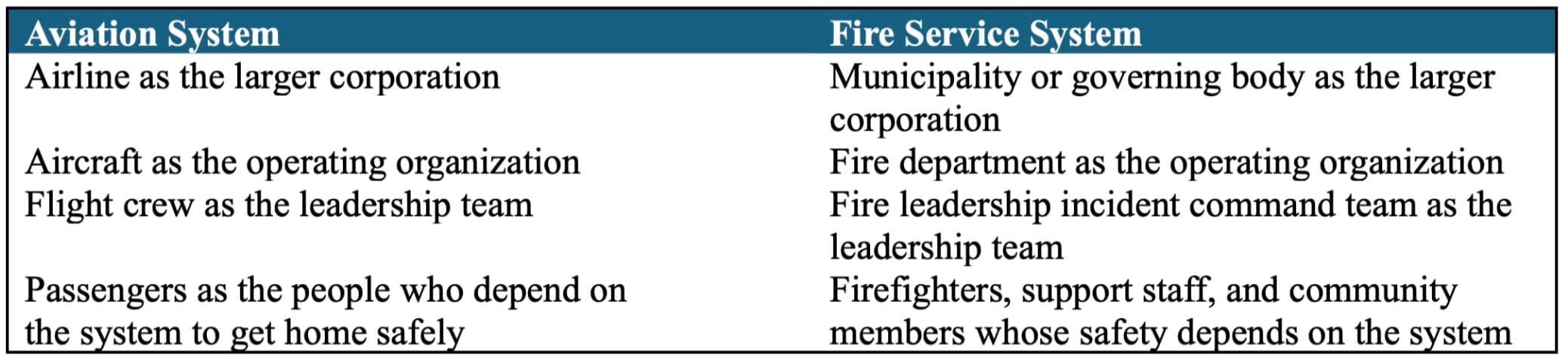
Together, these cases reveal both sides of human factors: how breakdowns accumulate and how effective leadership can interrupt them. In this last section, we discuss how leadership lessons in aviation can be put into practice for the fire service. Aviation and the fire service have comparable operational safety issues, both functioning as high-risk, low-frequency incident industries [10]. Further, both rely on hierarchical structures, strict safety protocols, time sensitive decision making while under pressure, and similar use of CRM principles. We discuss this comparison using the airline, aircraft, flight crew, and passengers as a metaphor for a corporation, fire department, fire leadership team, firefighters and support staff (see Table 1).
Table 1. System-Level Comparison of Aviation and Fire Service Roles
Clear command
Using our metaphor, the pilot and copilot can be viewed as the fire officer or incident commander. The pilot and copilot share responsibility for the aircraft, just as both fire leaders share responsibility for the department and the safety of firefighters and support staff. One pilot may be responsible for flight control while the other manages communications and instrument readings. The point is not to divide authority, but to reduce confusion and ensure critical information is not missed. The same principle applies to fire service leadership teams.
Although we saw from QF32 that clear command matters, it does not mean that one person carries the entire cognitive load or controls every decision. For example, QF32 showed that CRM can help the flight crew collectively solve problems. De Crespigny was accountable but also used the knowledge and experience around him. The hierarchy was clear enough to maintain command, but open enough to allow meaningful contribution. In the fire service, this could be the difference between command authority and command isolation.
There are also training and staffing takeaways. Under 14 C.F.R. § 121.438, aviation has recognized the risk of “green on green,” meaning a new pilot is not paired with a new first officer. This same practice can apply in the fire service. That is, there are inherent risks to placing a fire officer, incident commander, or newly promoted company officer in complex leadership situations without enough experience, mentoring, and stabilizing support around them.
This notion of role clarity on teams connects to procedural justice and supervisor communication. In previous research, we found that safety compliance is stronger when employees believe the same rules apply to everyone, when they can question rules or procedures, when leaders make sure concerns are heard before new rules are made, and when employees are involved in improving rules and procedures [12]. A practical takeaway is that fire service leaders can make shared input operationally normal during routine work, so it is available during non-routine (i.e., emergency) events.
Communication, psychological safety, and just culture
Both aviation examples illustrate possible outcomes of withheld information in a psychologically (un)safe environment. Our examples were tied to speech mitigation, where delays in message translation might occur because of rank, uncertainty, or fear of being wrong. This aligns with previous research showing that under pressure, the go-to person is the higher status person, not necessarily the subject matter expert. Confidence and assertiveness training may help reduce speech mitigation so that critical information is stated clearly and early enough to be acted on. This also transfers to the fire service. A firefighter or safety officer may see something that the person in command does not see. If the culture reinforces people to not speak up, wait too long, or avoid challenging authority, the department loses options.
This is where the concept of a “just culture” comes into play as a mitigator of psychological safety because that culture fosters positive or negative conditions long before an incident occurs. This is particularly relevant during routine operations because emergency behaviors are practiced before a crisis. Crews will not suddenly challenge a decision during a mayday if they have learned during daily work that questioning is unwelcome. Likewise, leaders will not suddenly become comfortable receiving dissent during a crisis if they have treated dissent as disrespect during training or other reviews.
Maintaining our aviation metaphor, a flight crew monitors weather, instruments, radio traffic, system alerts, fuel, aircraft performance, and crew workload. Fire service leaders face the same complexities in a different operating environment. They manage changes in fire behavior, staffing, weather, dispatch information, building construction, mutual aid coordination, community pressure, and resource availability. Both face incident conditions that can shift quickly, impacting decision making and how the team can work together. For example, pilots and fire officers can misread conditions, fixate on one cue, become overloaded, or rely too heavily on familiar patterns. Human performance, meaning the ability to stay in an ideal performance state, is integral for pilot and fire leadership effectiveness.
Disciplined leadership and continuous review
In QF32, the leadership of the captain helped preserve enough order for the crew to keep working the problem rather than becoming consumed by the 100+ failure messages. Experienced pilots and fire chiefs can become confident and complacent over time, becoming subject to fatigue, complacency, and fixation. Although experience is essential, it can also make familiar conditions feel safer than they are. A routine fire, dispatch call, or roadway incident can create the same kind of trap as a familiar flight path. Here, the danger becomes overconfidence when leaders stop actively thinking because they have “seen this before.” Consequently, fire service leaders may benefit from communication practices that help the team stay oriented, not just informed. For routine incidents, this may mean asking whether expectations were clear during size up, task assignment, and accountability checks. For non-routine incidents, leaders may not have complete information, but they can still communicate what they do and do not know.
In aviation, pilots are trained according to the size and complexity of the aircraft, whether small, medium, or large, and whether they are flying a propeller aircraft, jet propeller aircraft, or a jet engine aircraft with two or four engines. Fire leaders also operate across different sizes and complexities of organizations, including small, medium, large, and metro departments, as well as volunteer, career, combination, and wildland environments. Leadership preparation has to match that complexity. A leadership model that works in one department type may not fully prepare someone for another.
Along a similar vein, in aviation, two schools are used to prepare pilots – ground school and flight school. Fire leaders may benefit from a more robust “ground school” to be effective in their “flight school” capabilities. In other words, moving beyond incident command practice and grounding in human factors, communication, and how routine leadership habits shape emergency performance. For example, fire service leaders can train to communicate in adaptive cycles: assess, communicate, act, reassess, and update. This supports naturalistic decision making because crews are constantly updating their mental model as conditions change.
Takeaways
The key point in this article is that effective leadership, whether on the flight deck or the fireground, is not solely for an emergency – it is built during routine operations, when crews learn what is expected, welcomed, and questioned. Routine operations are where teams build trust, practice shared language, and strengthen decision habits that they rely on during non-routine events. Developmental psychology research has shown that if someone wants something to move from short term to long-term memory – practice is a necessity, especially when our evolutionary fight or flight response gets activated. Since, the non-routine events are what truly test a leader’s capability, and uncover the depth of trust that exists between team members/crew, if leaders yearn for firefighters to speak up, reassess conditions, challenge unsafe assumptions, and adapt under pressure - those behaviors have to be practiced beforehand when the stakes are lower so they are automatic when the stakes are high.
**Disclaimer:**The findings and conclusions in this paper are those of the author(s) and do not necessarily represent the official position of the National Institute for Occupational Safety and Health, Centers for Disease Control and Prevention.
Emily J. Haas is the Associate Director for Science in the NIOSH Division of Safety Research, Pittsburgh, PA, United States.
James R. Rychard is a firefighter and instructor for the City of Burlington and Chair, Humber College Program Advisory Committee for Fire Services in Ontario, Canada.
Zoe Cameron-Casey is an A350 Captain for Virgin Atlantic and Founder of C2Human Factors Ltd. in England, United Kingdom.