
Three levers of power — force, incentives, and voluntary action — reveal the distinction between managing people and truly leading them
Being in charge of others puts you in a position of power. In the fire service, if you are in a position of power, you probably went through some courses. Perhaps those courses were from a local fire service education program. Perhaps you went to a college or university. If you were asked right now “what are the different levers of power?”, would you be able to answer it clearly and explain it to your team?
Conflating a “Leader” with “Leadership”
Before getting into the three levers of power, it is important to understand that just because you may have been put into a position of power, and therefore are the “leader” of a team or an organization, that does not mean you are doing leadership. To prove the claim, consider the 2x2 matrix below that I first presented in a previous Crackyl article titled “How to Be a Leader Without Actually Doing Leadership”. The matrix simply takes the word “Leadership” and breaks down how it can be used as a noun or a verb. The vast majority of the time, “leadership” is used in a way that lands in one of the red boxes.
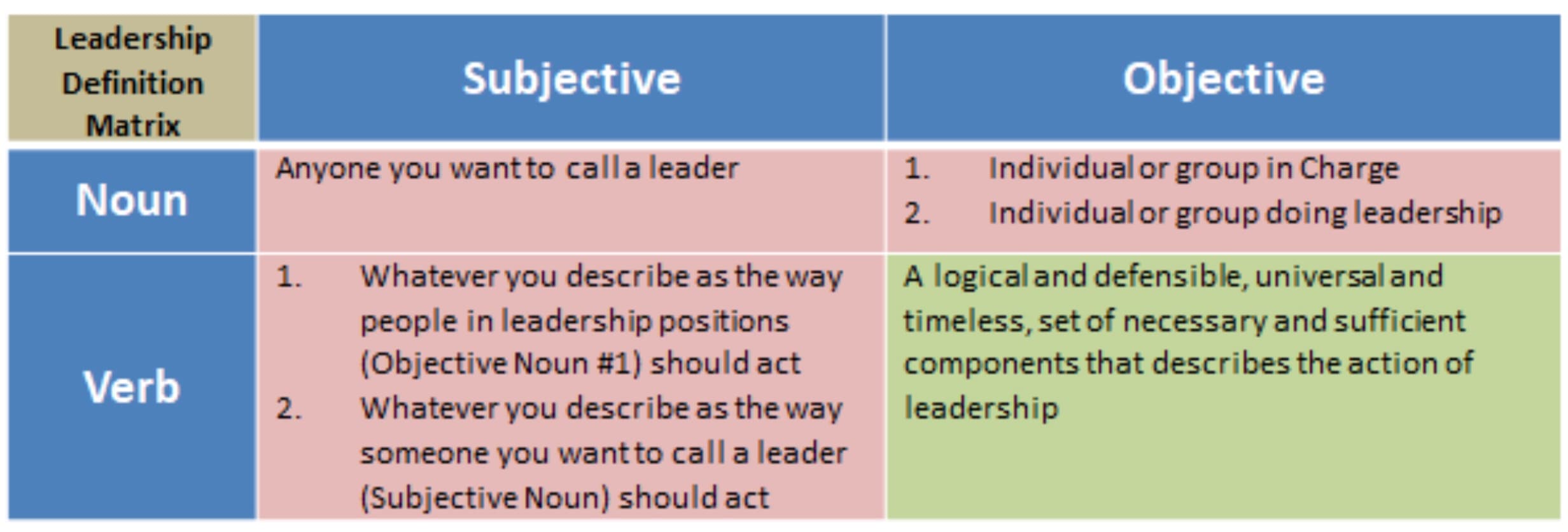
The green box of the 2x2 matrix designates the space for a logical objective verb usage of the word leadership. That part of the matrix indicates that leadership can be talked about in a way that is not based on an individual opinion, or even of an organization or an entire culture. It indicates that it is possible to define leadership as a verb in a way that is the same all the time, and can be applied to any one, which means that you can compare two or more individuals who claim to be doing leadership.
Defining Leadership as a Logical Objective Verb
In my book, Operational Intelligence for Health, Wellness, and Leadership, I offer a definition of leadership that works as an objective verb. By clearly defining leadership as an objective verb you can then distinguish leadership from management which is important because the two words often get used as synonyms with leadership being a more appealing version. But the two words are not synonyms.
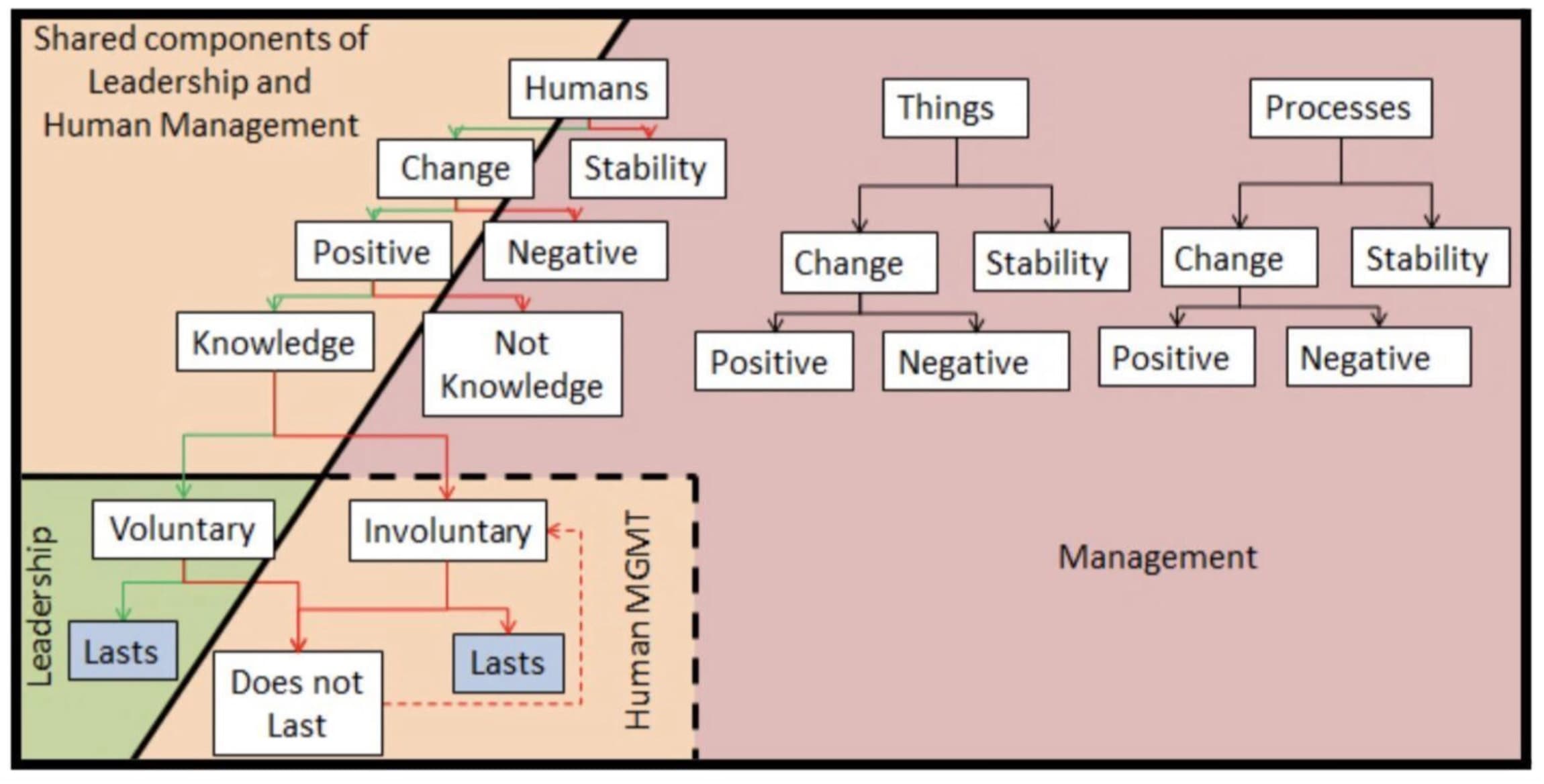
The definition I offer in the book includes six necessary and sufficient components as can be seen in the algorithm above. Leadership has to involve humans, as opposed to things and processes, because only humans can choose to follow another human. Things and processes are manifested as an output from human input without any decision to follow or not. Leadership has to involve change because change indicates that something occurred that was different than nothing occurring. Leadership has to be a net positive on a human’s body, mind, and soul triad (or bio, psycho, social, or hand, head, heart if you prefer), because no sane human will follow another person if it leads to a net negative. Leadership has to involve passing on knowledge (which is separate from opinion) because learning something new is the only way someone can be expected to change. Critically, leadership has to involve voluntary action because Aristotle argues that only through voluntary action can someone be held fully responsible. Finally, leadership has to result in a lasting change in the follower(s), especially in the absence of the leader, because otherwise it cannot be clear if the follower is only acting from fear or influence.
If the action by the potential leader involves deviating from any of those six components (the path of the green arrows in the algorithm), then it becomes management. Management is not a bad thing, and is absolutely necessary to maintain accountability and to accomplish missions. However, the major difference between leadership and management is that management treats people (humans) as a means to an end, whereas leadership treats people as an end in themselves. In other words, a manager would be happy to accomplish the mission with robots and AI if that is available and possible because it reduces the opportunity for humans to fail or to push back. In the case where someone in charge is trying to develop someone else to be better, if the method is involuntary (think the fire academy or parenting minors), then that has to be management because the followers are not fully free to choose. If that was leadership then we would have to conclude that forcing others to do things because we believe it is good for them would constitute leadership and that logic leads to totalitarianism or slavery, and we can just call that dictating.
The Three Levers of Power
As someone in charge, especially in the fire service, you will be responsible for holding firefighters accountable to organizations (and government) standards. This means that one way or the other, you will have to ensure that certain behaviors are manifested while other behaviors are not. Understanding the three different levers of power will reveal whether you are doing leadership or management.
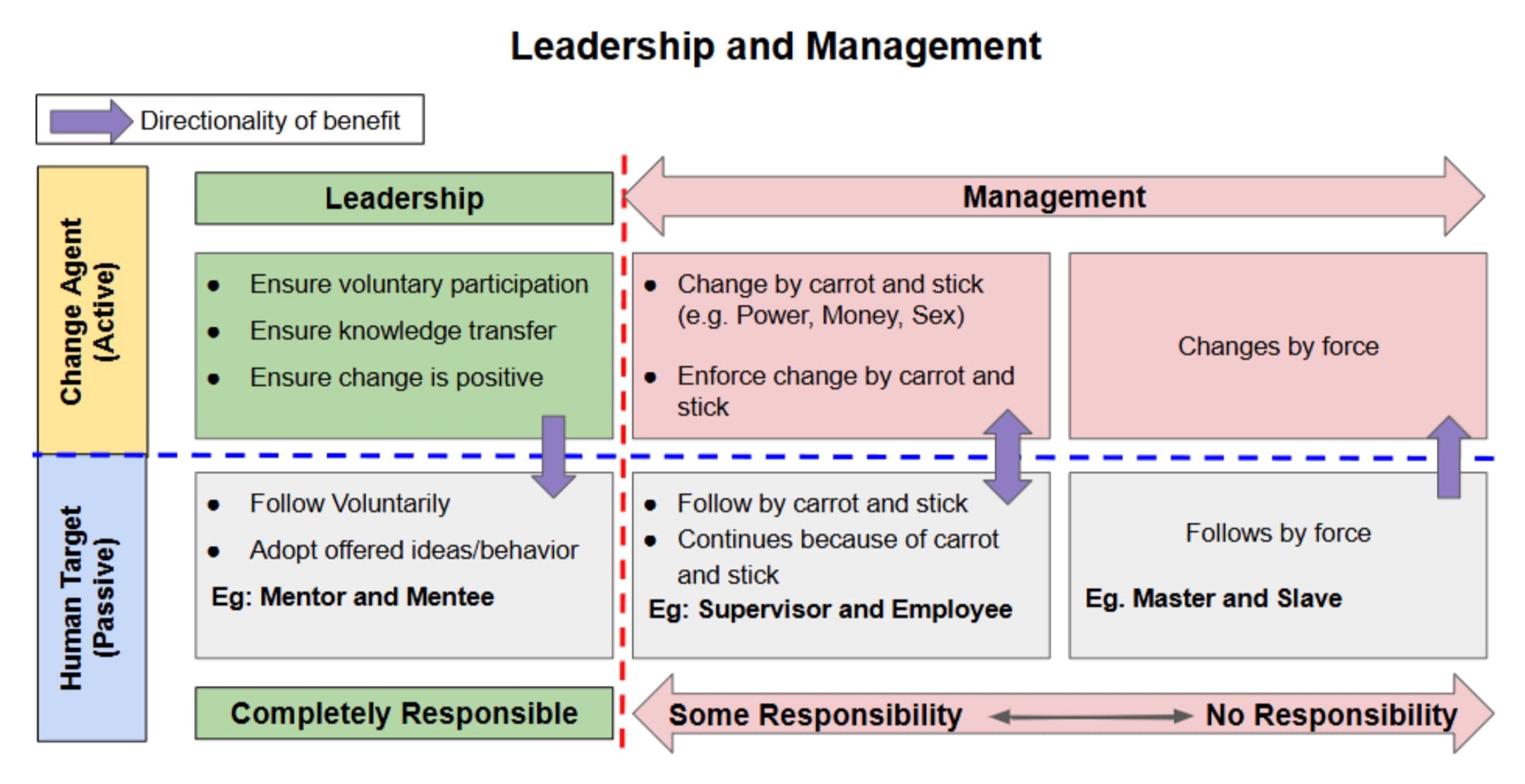
Starting from the most basic lever of power, the first is making change by force. Force sounds bad but it is not a bad thing on its own. For example, as a parent you do not give your infant or toddler any choice whatsoever when it comes to diaper changes, that is a forced behavior. When your crew responds to a patient that is in such critical condition that they are being emergency petitioned (EPed), that is an example of the use of force to ensure someone (often adults) receive necessary medical care. An administrative example of force might be mandatory weigh-ins or mandatory training. It could be argued that there is always the option to quit, which is true, but that is akin to the death of a career, and the force that is being applied assumes that the person wants to keep their career “alive”. By definition, if a man is forced to do something, he has no responsibility for that action because it was imposed on him.
The second lever of power, which increases in complexity from force, is change by carrot and stick (incentives and disincentives). This lever can also be manifested by exchange (you give me X and I give you Y). In both cases, the idea is that as a change agent, you are attempting to motivate a man (or woman) by offering him something he wants in order for him to do something that you want him to do. You can also threaten something he does not want, in order for him to do something you want him to do. When you deploy this lever of power, you may be tempted to think that you are engaging in voluntary action with a potential follower, but that is not the case. By engaging in carrot or stick change, you are introducing pressure on your target, not matter how miniscule the pressure is. The moment you introduce pressure, no matter how small, is the very moment you have given up on your ideas alone. That threshold, from ideas alone to introducing carrot and stick, is designated by the red dashed line in the image. A follower would bear some amount of responsibility for their actions under this lever of power, but the amount of responsibility is directly correlated to the intensity of the carrot or stick that is being deployed.
The last, and most complex, lever of power is change by purely voluntary action. This type of change requires the exchange of knowledge (not opinion since opinions do not close knowledge gaps) between the change agent and the human target. This requires the change agent to have knowledge that the human target does not already possess, which creates a potential to close a knowledge gap in the human target, which then creates the further potential for a change in behavior if the human target adopts and acts upon that knowledge. A change agent using this lever of power (after all, “knowledge is power”) is not relying on anything other than knowledge alone which leaves the human target to decide if they want to follow in a way that is completely voluntary. By ensuring a completely voluntary interaction, the change agent fully respects the sovereignty of the individual to make choices that do not involve pressure of any kind, and this is what allows the potential follower to be completely responsible for their actions. Purely voluntary action is what gives people the highest form of human dignity.
Final Thoughts
The claim being made is not that leadership is good and management is bad - far from it. Any parent knows that kids who demonstrate good behavior did not get there by purely voluntary means. The same goes for organizations. It is likely impossible to run an organization like a fire department using purely voluntary action, and the stakeholders (including the public that pays our salaries) rightly demand that accountability structures exist and that certain behaviors are manifested while other behaviors are prohibited. Any Chief or CEO knows that good management is critical to success, and they also know that managing is not easy. The issue I am raising is that leadership and management are distinguishable therefore it is worthy to refine the leadership and management literature in a way that allows for a clearer understanding and education for the next generation of decision makers. Having people change in a completely voluntary way is hard and rare, but that is what makes leadership special.