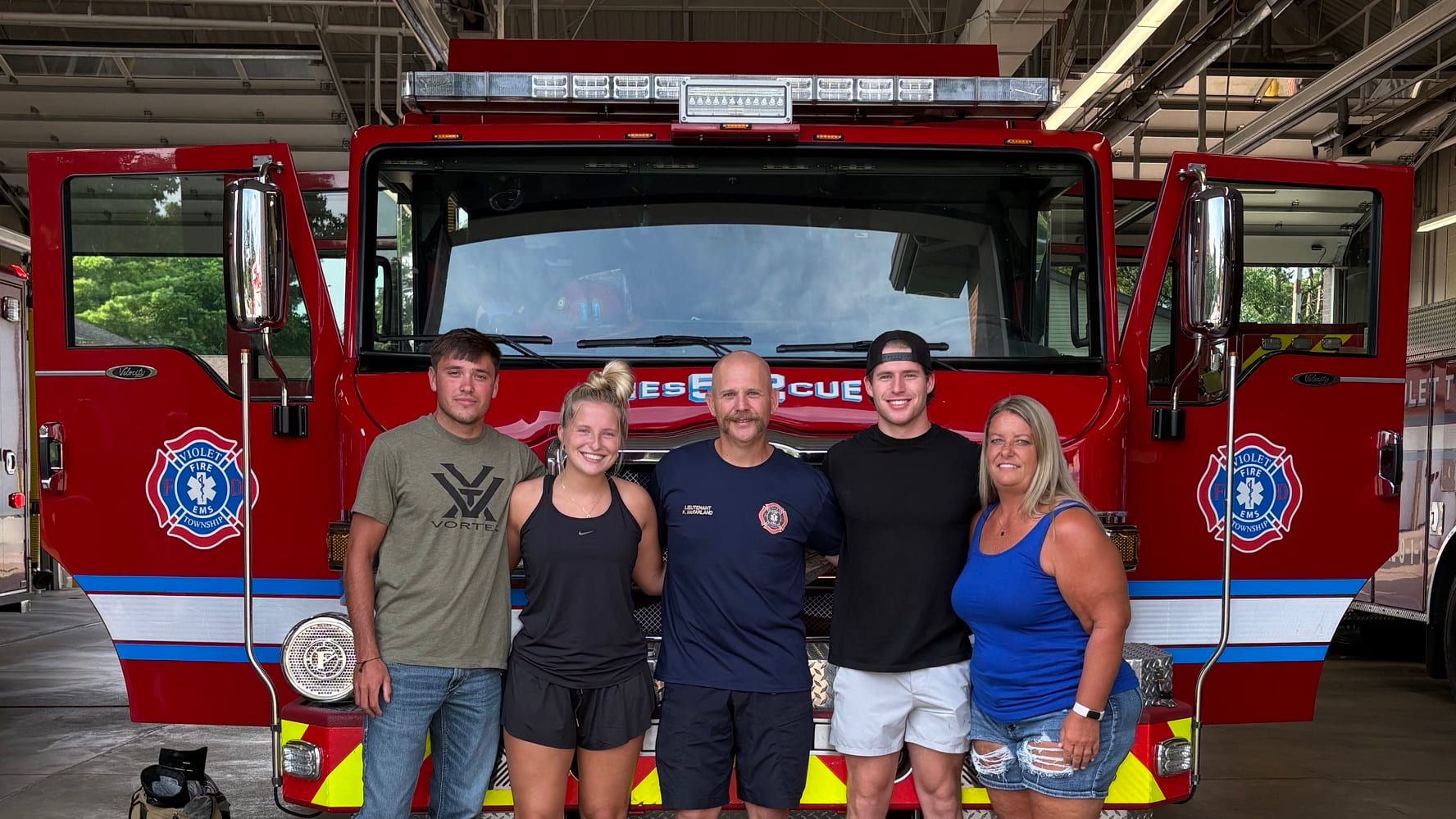
How Chris and Brittain Johnson turned one firefighter’s recovery into Two In Two Out, and a growing mission to help first responders and their families come home healthier, stronger and together
For years, Chris Johnson had a simple way of measuring whether he was doing enough: take on more. More overtime. More projects. More training. More opportunities to be useful. If someone asked, he said yes.
At the time, it felt like ambition. Underneath it was something more complicated. Johnson was trying to figure out who he was while also trying to become the person everyone could count on. “I was someone that was trying to find myself,” he says. “I was taking on so much to show everyone else I could handle anything they asked that I didn’t take care of myself.” He wanted to fit in with anyone and everyone, and somewhere in that effort he began equating capacity with worth. The more he could absorb, the better he believed he was as a person.
The fire service gave that instinct somewhere to go. Johnson didn’t simply have a career as a firefighter; the job became the organizing principle around which much of his life revolved. “I identified as a firefighter. It was who I was. On and off the clock,” he says. There was always another way to improve: another overtime shift, another project at the department, another training session on a day that was supposed to be his own. He rarely considered what the accumulation was doing to him because stopping long enough to consider it was never part of the routine.
His body had its own system for keeping up. Three or four Red Bulls a day provided enough energy and stimulation to get him through, followed by beer at night until he went to bed. It was less a single destructive decision than a cycle built around getting through the next thing, and then the next. Since recovery, Johnson has stopped drinking both energy drinks and alcohol. He says the decision has helped him in ways that extend well beyond removing two habits from his life.
What made the situation harder to recognize was that Johnson remained functional. More than functional, in fact. He could arrive at work positive, engaged and willing to give everything he had. “I was great at masking how I was feeling, not just for myself but to everyone,” he says. Work became both a responsibility and a distraction. If he could keep moving, he could avoid some of what he was feeling. If he could keep performing, maybe nobody would notice what was happening underneath.
He remembers hoping no one would see through the mask and recognize that he was breaking inside. Asking for help carried its own threat because, in Johnson’s mind, needing support meant admitting that he was no longer capable of handling his life. “I felt like if I was to admit I was not capable of carrying the weight of life, I would be looked at as weak or incapable.”
March 20
That belief survived until March 20, 2024. His deputy chief called and invited him to do something he called “street school.” When he arrived at the station to pick Johnson up, he put a hand on his shoulder and said, “We are worried about you.” Johnson began to cry. He describes it as the moment he was finally able to release some of what he had been holding and recognize that he could not continue managing everything alone.
Brittain, his wife, had already reached the same conclusion from the other side of their life together. Without knowing how Johnson might react, she called his friend Dylon Baker. Between them, they helped connect him with support, and by the end of March 20, Johnson had entered Deer Hollow, a 40-day recovery program for first responders and veterans.
The experience disrupted much of what he believed about mental health and recovery. Until then, endurance had largely meant continuing to function. Deer Hollow introduced him to another version of it. “They showed me how to show up for myself, show up for my family, and be able to show up for the job,” Johnson says. He began doing things he hadn’t enjoyed in years and rediscovering parts of himself that had been buried beneath work, obligation and the constant need to keep going. “I was able to find different parts of me that gave me hope for the future.”
Recovery also widened his understanding of who lives with the effects of a career in the fire service. “My family is the most important part of my life. They cannot be replaced,” he says. When Johnson is on shift, Brittain is home with their two young boys, assuming the full load of parenting until he returns. She has been open with him about the stress she experiences while he is working, and Johnson describes her as the anchor of their home.
His own change has involved becoming equally open with her. He now talks about what he is dealing with from the job, but also what he is dealing with in their life at home. Firefighters can become accustomed to viewing the station as one world and home as another, even though the demands of each inevitably follow them through the same front door.
“She wants to support me any way she can,” Johnson says. “By sharing what I am carrying, it gives me a chance to release it, while she is given an opportunity to support.”
For someone who spent years believing his value came partly from how much he could handle, allowing another person into that experience required a different definition of strength. If Johnson could now sit across from the version of himself who was struggling, he knows what he would tell him.
“Times have changed. People are built to support one another. There are people out there that want to see you healthy, happy, and successful,” he says. “Make the call. Send the text. Reach out to anyone and say, ‘I need you. I am struggling. I need help.’”
Those words would eventually become larger than his own recovery.

Two People Go In
The name Two In Two Out came to Johnson soon after returning home from Deer Hollow. What the name meant as an organization — or what they were supposed to do with it — was far less obvious.
Brittain was already raising a question that would eventually define much of the mission: What about the spouses?
It took Johnson time to understand what that could become. His recovery had understandably focused on the first responder who was struggling, but Brittain had lived through the experience from beside him. She knew the effect didn’t stop with the person wearing the uniform.
An idea shared with Brittain by another first responder spouse eventually gave Two In Two Out its meaning. When a first responder signs on the dotted line, the spouse signs alongside them. Both enter the first responder world together. The goal, then, should be for both of them to eventually come out of it better, stronger, and together.
That changed the scale of what Johnson and Brittain were considering. Supporting first responder wellness could no longer mean looking exclusively at the first responder. The family was already part of the experience.
The concept became tangible when they built a wellness room at Rock Creek Fire District. Johnson had been using wellness resources at IT83 Fitness since the day he returned from Deer Hollow, but the idea of bringing those tools directly into a fire station emerged almost casually. A firefighter approached him and said how great it would be to have a sauna in the firehouse.
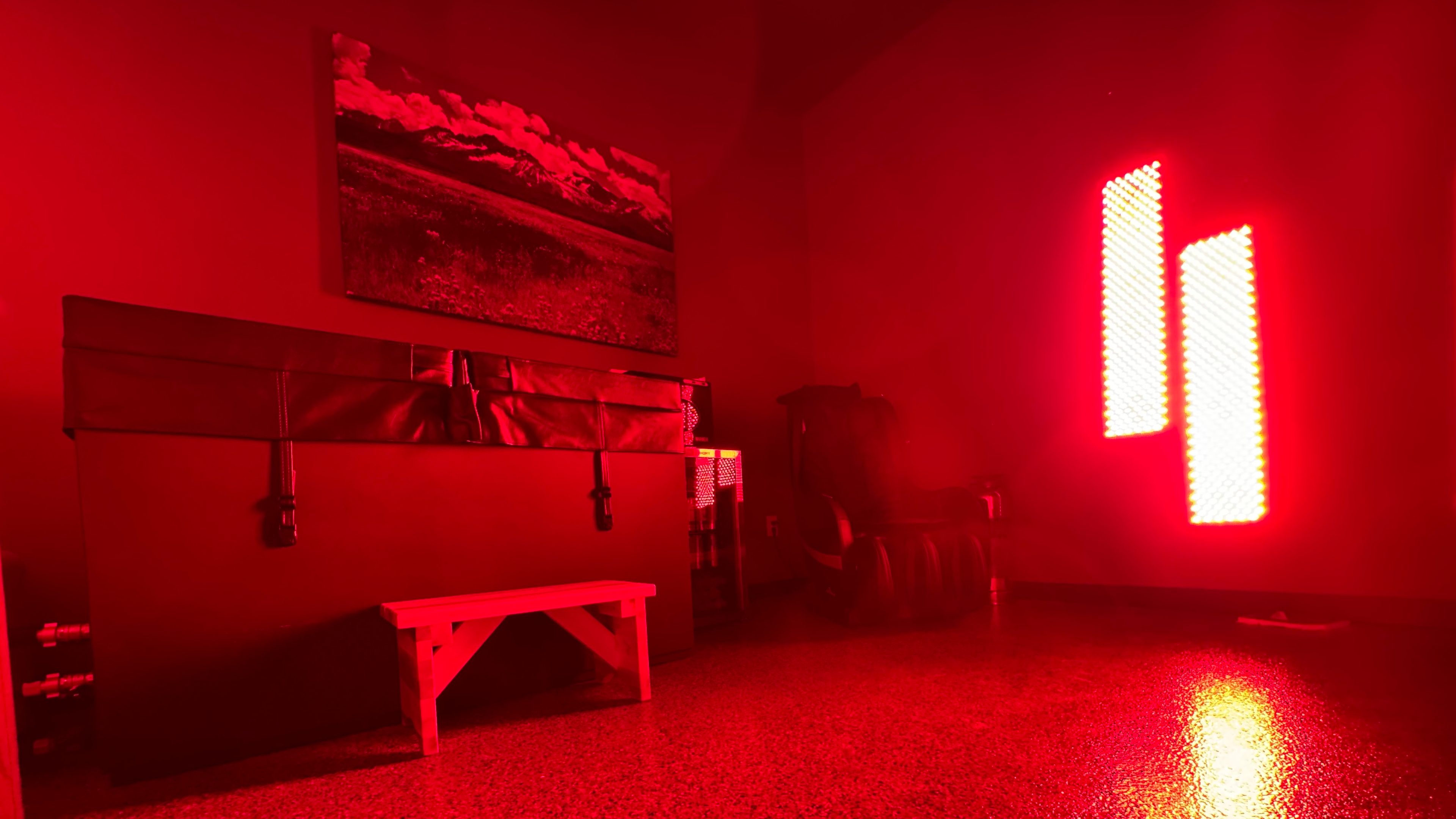
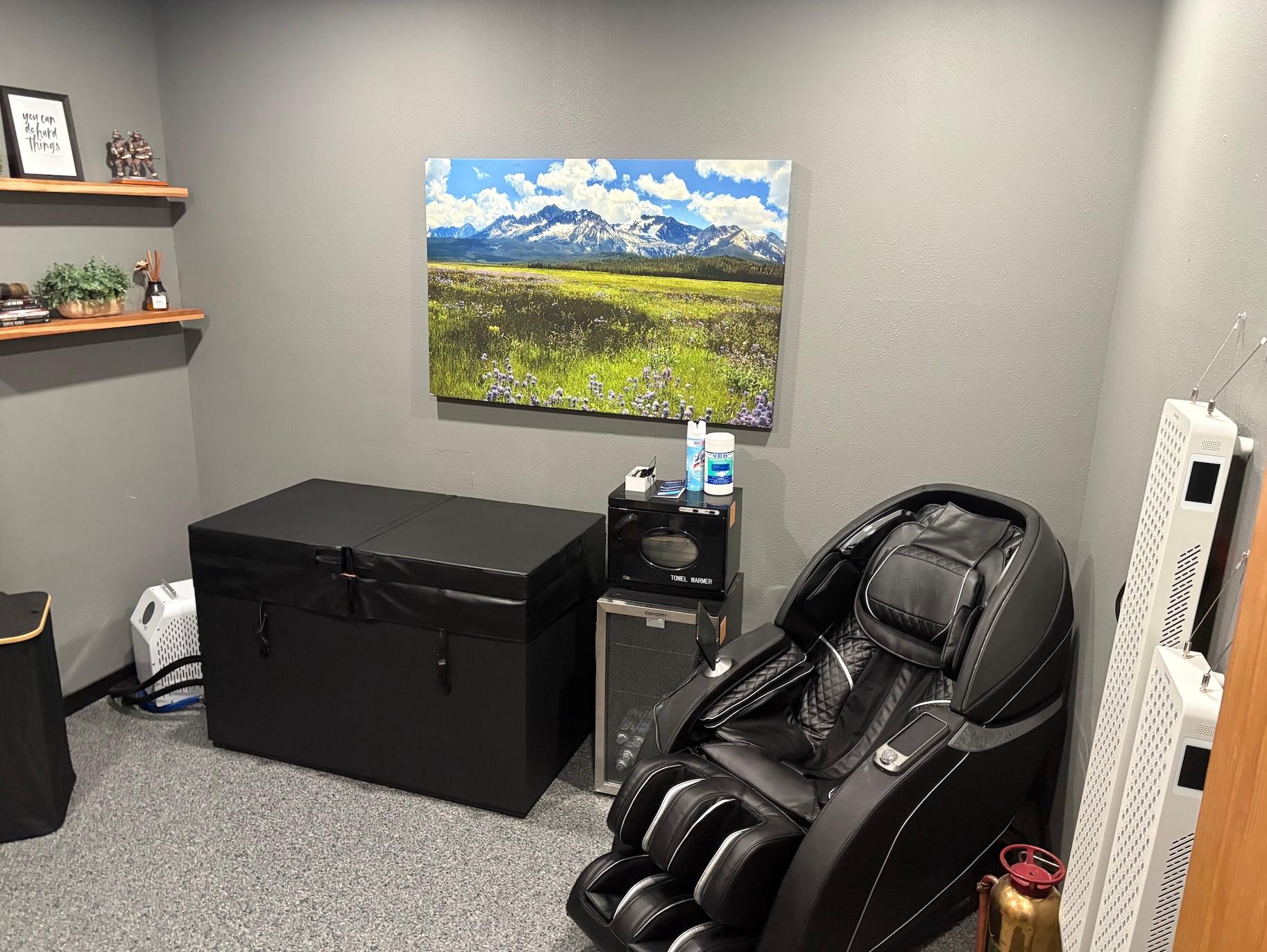
Johnson hadn’t imagined anything close to what followed. The room would eventually include a sauna, cold plunge, massage chair and red-light panels, creating a place where firefighters could work on their physical and mental well-being while they were still on duty.
The location was intentional. Accessing the room didn’t require a firefighter to make an appointment, leave the station or formally tell someone they were struggling. A firefighter could simply walk through the door and use it.
“They are working on themselves in a safe environment while not leaving the station,” Johnson says. “Our firehouses are our second home. Having the access in the stations gives all of us a chance to come home healthier, happier and safer.”
There is an important idea inside that model. Wellness doesn’t have to begin after someone has reached the point where they are willing — or forced — to announce that something is wrong. Resources can already be there. Using them can become part of the environment rather than evidence of a crisis.
For Johnson and Brittain, building that first room was also the moment when Two In Two Out stopped being a name and began to look like something they needed to pursue.
Building It Before Knowing Where It Would Go
Brittain was the first person to believe in the idea. Chris Nelsen, a close friend of Johnson’s, came on board early enough that Two In Two Out barely existed yet.
Johnson remembers standing with Nelsen during the demolition process for the wellness room and suddenly questioning what they had started.
“Are we sure this is a good idea?” Johnson asked.
Nelsen looked at the construction around them and answered, “Little late for that now.”
He is still with Two In Two Out a year later.
The physical work may have been underway, but Johnson says the biggest thing he had to overcome was fear. He wondered what people would think, what they would say, and whether the fire service was ready for what he and Brittain were trying to introduce. Building the organization meant accepting that he wouldn’t know all of those answers in advance.
“Ultimately I had to put fear aside and take each day as it came,” he says.
The response soon became larger than he anticipated. Johnson began connecting with people across the United States, Canada and Europe. Support came from his local community, first responders, spouses and fire departments. What had emerged from one firefighter’s recovery and one family’s experience was finding relevance with people Johnson had never met.
Some of the most meaningful moments came when Two In Two Out was able to move beyond conversations and put actual resources into another station. The first department the organization supported happened to be the same department that had given Johnson his first opportunity as a full-time career firefighter.
Once they found a donor and the chief quickly came on board, Johnson could see what the model might become. Each time Two In Two Out is able to order resources for another department, he says it gives him another push forward.
He also acknowledges that building the organization has difficult days. There are times when he wants to step away from it, even temporarily. Then a phone call comes in or an email arrives from a first responder who wants to know more about what they are building.
“That gives me hope and energy to keep going,” he says.
Within its first year, Two In Two Out helped a department in Illinois bring wellness resources into its station. The organization also built and shipped 30 connection boxes nationwide to first responders and their spouses, taking the family-centered premise behind the name and turning it into something that could reach people far beyond Idaho.
Those accomplishments also taught Johnson something about trying to plan an organization whose possibilities were still emerging. He began the year with an idea of how things would unfold and ended up changing that plan multiple times.
His relationship with that uncertainty has changed. He no longer feels that every stage of Two In Two Out needs to be predetermined before they get there.
“TITO will grow the way it is supposed to grow,” he says. “I am fortunate enough to get to be a part of the TITO journey.”
Build Before the Breaking Point
The larger ambition now extends well beyond building recovery rooms. Johnson sees the equipment as one entry point into a broader question: What could the first responder experience look like if taking care of people was built into the career instead of introduced only when someone began falling apart?
For fire chiefs and departments, he believes the investment can start long before a firefighter reaches the point he did.
“These resources are an investment in the longevity of your people,” Johnson says. “It gives your people access to proven resources that help even if a member of your team is not at a place to ask for help.”
That last piece continues to connect directly to his own experience. Johnson knows what it is like to be struggling while still showing up, still working and still making sure the people around him see someone who appears capable. A resource that is already inside the station removes at least one barrier between a firefighter and doing something beneficial for themselves.
Two In Two Out is also continuing to develop resources outside the station. Nutrition information is available through the organization’s website, with plans to expand that programming to better support firefighters and their families. Connection boxes remain another way of reaching both first responders and spouses rather than treating one person in the household as the entirety of the problem — or the solution.
The organization is also preparing for a larger launch of its connection boxes at the beginning of 2027, with a goal of distributing 200 boxes during the year. For an organization that shipped 30 during its first year, the target represents a considerable increase in reach.
Johnson’s thinking is already moving beyond that.
No Finish Line
Ask Johnson what Two In Two Out could look like five or 10 years from now and he doesn’t put a geographic boundary around it.
“The dream for TITO has no limit,” he says. “We will support any department, any first responder, any spouse that reaches out to us. Nationwide is great. We have first responders worldwide, so why not get resources to them?”
Ideas tend to arrive faster than they can be built. Johnson writes them down, comes back to them and considers whether they could eventually make a meaningful contribution to the first responder community. Some will change. Some may never happen. Others could become projects he cannot yet fully imagine, much like the wellness room that began with a firefighter wondering aloud what it would be like to have a sauna at the station.
If funding and resources suddenly stopped being limitations, Johnson still wouldn’t describe Two In Two Out as complete. “The ultimate version of TITO is nowhere close to being built,” he says. “We have dreams of where we want to go. We are excited for what we have built and hoping to build in the future.”
There is a symmetry to where the organization now stands. Two In Two Out began with Johnson learning that he could not do everything himself. Its future will depend on other people deciding to become part of it: spouses, firefighters, departments, donors, community members and leaders willing to invest before somebody reaches a breaking point.
The premise has remained remarkably consistent through all of it. A firefighter signs up for a career, but the experience rarely belongs only to the firefighter. Someone is covering life at home during the shift. Someone is waiting when the tones go off. Someone sees what happens after the difficult calls, the overtime, the missed events and the years of exposure that accumulate across a career.
Two In Two Out is Johnson and Brittain’s attempt to recognize both sides of that experience and put something useful in place before either one has to face it alone.
When asked what would eventually have to happen for him and Brittain to look at everything they had created and say they had accomplished what they set out to do, Johnson doesn’t describe a certain number of wellness rooms, connection boxes, departments or even countries.
“For me, I don’t feel like that day will ever come,” he says. “The passion I have in supporting first responders and their families has no end.”
For the man who once believed he had to prove how much he could handle himself, it is an appropriate place for the story to arrive. Two In Two Out began when other people stepped into Johnson’s life and helped him when he could no longer do it alone. Everything they are building now is an attempt to make sure the next firefighter — and the family beside them — doesn’t have to wait as long for someone to do the same.