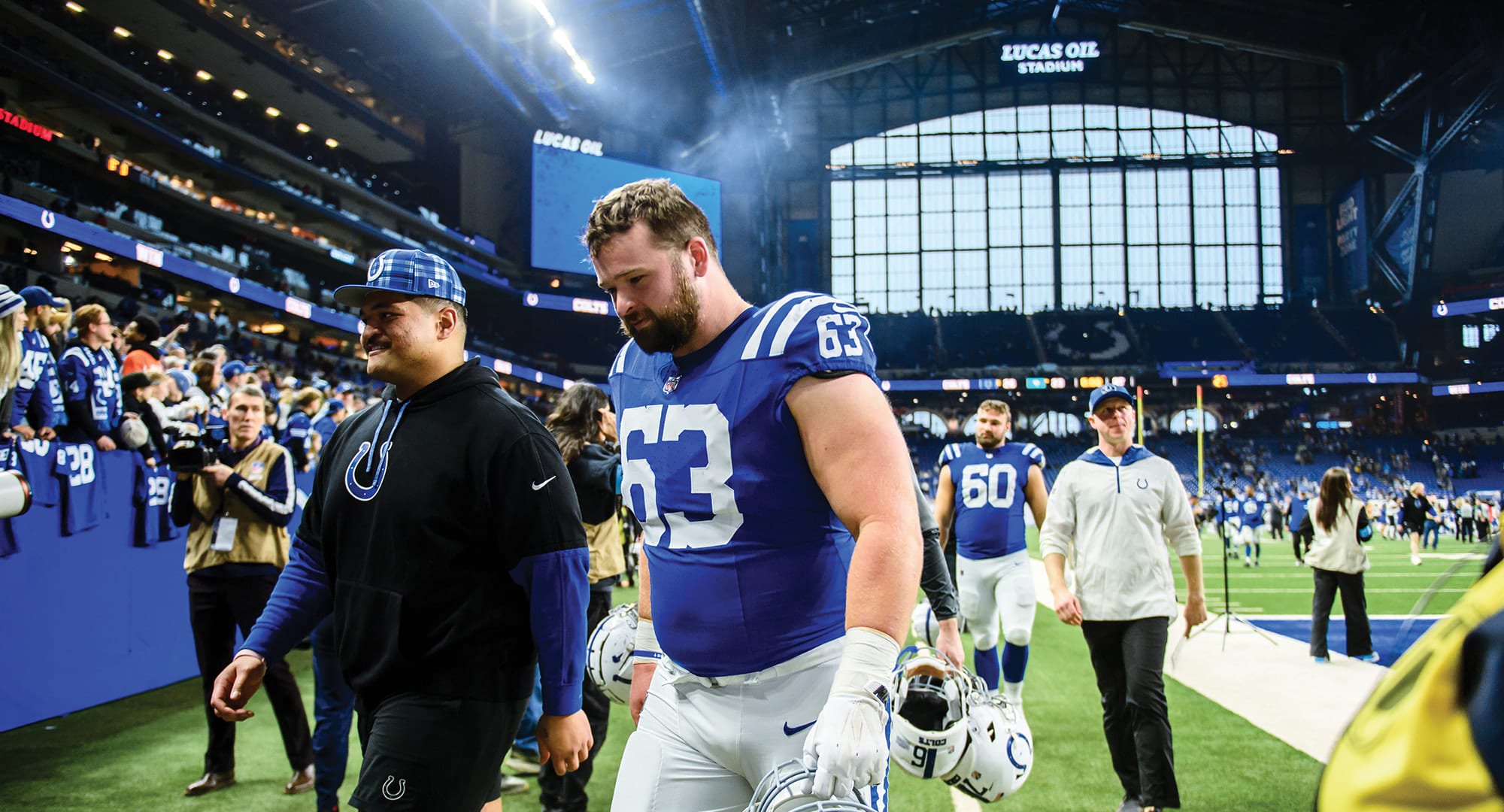
When NFL football player Danny Pinter walks onto the field as a center for the Indianapolis Colts, he doesn’t just bring cleats, a helmet and a game plan. He brings with him years of physical and mental training so he can perform at one of the highest levels of professional sport.
For Pinter, who has been with the Colts since 2020, success in the NFL demands strength and speed, as well as resilience, focus, and the ability to reset under pressure.
Sound familiar? The firefighter experience resonates deeply with Pinter, as a brother, brother-in-law, and grandson of firefighters. With family members serving on the front lines, Pinter has seen firsthand the similarities between the locker room and the firehouse: camaraderie, teamwork, and supporting one another in stressful situations.
Pinter’s older brother, Matt, is a career firefighter with Noblesville Fire Department and a volunteer firefighter with Yorktown Fire Department. Matt’s wife, Kara, is a full-time firefighter with Fishers Fire Department. All three departments are near Indianapolis, where Pinter plays. The brothers’ grandfather served as a firefighter in Rochester, N.Y.
“My brother and I can definitely relate,” Pinter says. “I think (firefighting and football) have very similar environments. From our locker room, we’re always talking about pranks and that sort of thing, giving each other a hard time, but then also there’s the camaraderie piece. Everyone cares about each other as you’re working towards a similar goal.”
He pauses, then adds, “Obviously, there’s a lot more at stake for [firefighters] than we have going on. We’re just going to play a game, but I think the camaraderie piece is super simple. We’ve definitely compared that quite a bit.”
That shared sense of connection isn’t just emotional, it’s also physical. Like firefighters, NFL players train year-round to keep themselves in peak condition. For Pinter, mental training is just as important as crushing every workout.
“We’re doing physical training pretty much all year, and I usually give myself a little break after the season just to let the body rest a little bit,” he says. “Then we’re getting right back into physical training, but the mental piece is just as important: There’s the complexity of knowing what you need to do out on the field, but there’s also the public scrutiny that comes with it. You have to know how to just block that stuff out so you can just focus on what you need to do, understand the opinions that do matter, and the opinions that really don’t matter. That’s something I’ve definitely come a long way with in learning over the past. I’m going on my sixth year here, so I feel like I’ve got a pretty good routine in blocking that stuff out.”
On field, there are few positions as pressure-packed as center. He has the ball, something everyone on the other side wants. He lines up, bent over the ball, vulnerable, knowing as soon as he flinches, it’s on – smash or be smashed. He has to keep his eyes alert to the moving and shifting defensive line, while blocking out their shouts and taunts and focusing on his quarterback’s voice.
If he’s a split second too fast or too slow on the snap, flags fly and yards are walked off against his team. He has to be ready to quick snap if a defender jumps off side. He has to know multiple assignments in case the play is changed at the line, and it often is. And did we mention the meat locker of snarling defenders poised to get a running charge at him? Yeah, he has pressure.
And he has do all this with millions of people watching and ready to hyper analyze his every move. Every year there's a new crop of young bucks out to take his job away from him.
Sound familiar again? Firefighters face a similar type of pressure, albeit from a different angle. Our work is not only highly visible, it can also be emotionally charged. Every response to a fire, rescue or medical emergency is subject to scrutiny by the public, the media and even the very people you’re trying to help. One misstep can be magnified and the weight of those expectations can be intense. And just like football players on the field, you strive to filter out the noise, focus on the goal, and trust your training and your team.
"I can’t remember who said it, but it was along the lines of, ‘Why would I care what your opinion is if you’re not someone I would go to for advice?’ which I think is a pretty good way to live,” says Pinter.
That kind of mental discipline takes work, and Pinter has put in the hours. He’s practiced meditation and breathing techniques to help keep himself focused and composed under pressure, and advocates any method that enables you to bring your focus back to where it should be in the moment.
“For us, we’re playing a play at a time. Nobody’s ever played a perfect game,” he says. “You might go out there and might have a play that did not go the way you wanted it to in any way. How can you get your mind to reset because you’re about to go do another one, and not let those types of things pile on top of each other? That’s when things go bad, when you can’t reset your focus to the current moment, you’re letting the past dictate how you are now.”
The challenge is staying locked in, even when things are going great. “Sometimes things go well and we get too excited or we get too content,” Pinter says. “It’s just keeping that center focus.”
That mindset also applies when it comes to staying fit, which is another area where Pinter has noticed overlaps with his brother’s career.
“I think there are different requirements to [how we each train]. I know firefighters obviously have to stay in great physical shape and [Matt] does a lot of training,” Pinter says. “It’s cool we’re both in careers where you have to physically be ready to go.”
The brothers have tried to train together, but their schedules have yet to align. “One day, maybe, we’ll get it down,” Pinter says.
They share something else in common, too: suffering and recovering from ankle injuries. Matt “rolled his ankle pretty good earlier in the spring, and I broke my ankle two years ago,” Pinter says. The broken ankle, which sidelined Pinter for the entire season, took more of a toll on his mind than his body.
“You’re prepping for the season, you’re prepping for all this, and in a second you can’t play anymore,” he says. “You’re out for an entire year. It’s tough to watch. You want to be out there playing with your guys, but you can’t. And there’s obviously the mental grind of each day: you’ve got to show up, and you’ve got to get the ankle right, and you’ve got to just focus on that when really you want to be going out and playing football.
“I learned a lot from that year, and looking back, maybe I wouldn’t trade the situation because I learned a lot about taking things a day at a time, and it’s a different type of challenge. I think the mental aspect of being hurt sometimes, in terms of a long-term recovery, can be harder than the physical.”
It’s a struggle many firefighters know well. When sidelined by injury, they often face the same challenge, but in their case, it’s watching life at the firehouse go on without them. The physical recovery is only part of the process – the deeper work is staying mentally engaged and believing in the day you’ll be back on the job.
“The physical part of it sucks, but I think it was more that I knew eventually my ankle was going to heal and I was going to be OK,” says Pinter, who aided his brother’s recovery by bringing him the tools he used to help heal his own ankle.
Physical injuries are just one risk of playing football and fighting fires. Another is mental injuries. Firefighters face intense situations that can be hard to talk about when they get home. Pinter, as someone who’s close to firefighting through his family and who also deals with high-pressure moments in the NFL, encourages firefighters to open up when they’re struggling.
“Asking for help is the hardest thing to do,” he says.
“In the firefighting profession and our profession, all you hear about is, ‘be tough, be tough’ and all that type of thing, so it’s really hard for people to take that step when they do need help. But, the most important thing is realizing if you’re going through something that people close to you have no issue at all with you reaching out and asking for help.
"I would want, in a heartbeat, for any of my friends going through something to ask me for help – so why wouldn’t that be the same for me?
Then once you get through that first step, you start to realize how much help is available out there," he says. "It's just doing it, which is so much easier said than done, but it’s realizing how many people do care about you and want you to do that.”
It’s not just talk from Pinter, either. He has participated in the “My Cause My Cleats” initiative, where players choose a cause that’s important to them and represent that organization on custom-designed cleats. They wear the cleats during weeks 13 and 14 of the season.
In 2022 and 2024, Pinter chose the National Fallen Firefighters Foundation, to honor fallen firefighters.
His care isn’t limited to public gestures, either. It shows up in his everyday life, too. Pinter makes an effort to maintain close ties with the people who matter most to him.
“I’m very fortunate,” he says. “I’ve been in Indiana my whole life. My family is all from here so I’m fortunate that I have my brother close by, my sister and parents live two hours north of here, so I get to see them every weekend.”
"But it’s also being mindful of picking up the phone and making a call when you get a second. It’s the little things that add up. Just stay in touch.” Staying in touch with Matt and Kara has revealed one thing about firefighting to Pinter that perhaps most people wouldn’t know: the bond between firefighters.
“They’re so effective at what they do because of the connection they all have to each other in the station, how much work they put in with each other,” Pinter says. “Matt’s got people that I’m sure consider him family. You’re going to work every single day and then all of a sudden, you’ve got a situation where you’re putting your life on the line and you’re depending on the person next to you. I always knew that existed, but to the extent that it does exist has been the coolest thing to learn.”
Pinter has visited Matt and Kara at the firehouse, where he has witnessed the camaraderie firsthand.
And if they had to pick a position for Pinter in the firehouse, what would it be?
“I can tell you that my brother would not let me pick anything that involves cleaning. He gives me a hard time about that,” Pinter says. “I think they’d just start me right at firefighter. Let me earn my stripes.”
For now, Pinter’s life is full-on football, and eyeing his next big catch: A 50-inch muskie to surpass the 46-inch muskie he had previously caught. “Outside of football, about all I do is fish,” he says.
After the kick-off, the challenges Pinter faces on the field aren’t so different from those his family members face on the fireground.
Whether it’s football or firefighting, a win includes being part of a team you can rely on that’s based on trust, training and the knowledge you don’t have to face the struggles alone.