Some are naturals. Some are accidental; you know, those firefighters who aren’t trying to be funny, but are still hilarious. Some try so hard and fail so badly they are funny — looking at you, endless dad-joke guy.
Some are so good they turn pro. Certainly firefighters Jason Patton, Brent “Firefighter” Fenton and Travis Howze have all dipped more than a little toe in that career pond.
And you don’t need a PhD in psychology or psychiatry to figure out why. We see a lot of dark shit, and humor is a great coping mechanism. Being matched up with the same crew — be it on shifts or the same volunteers who always show up — builds trust, which makes the humor soil all the more fertile. And like career comedians, we have to think fast on our feet.
But what happens if you hold that idea up to a mirror? If firefighters are like comedians, does that mean comedians are also like firefighters? Maybe not in the strictest sense, but you may be surprised by just how much they do share in common with us. It’s kind of funny.
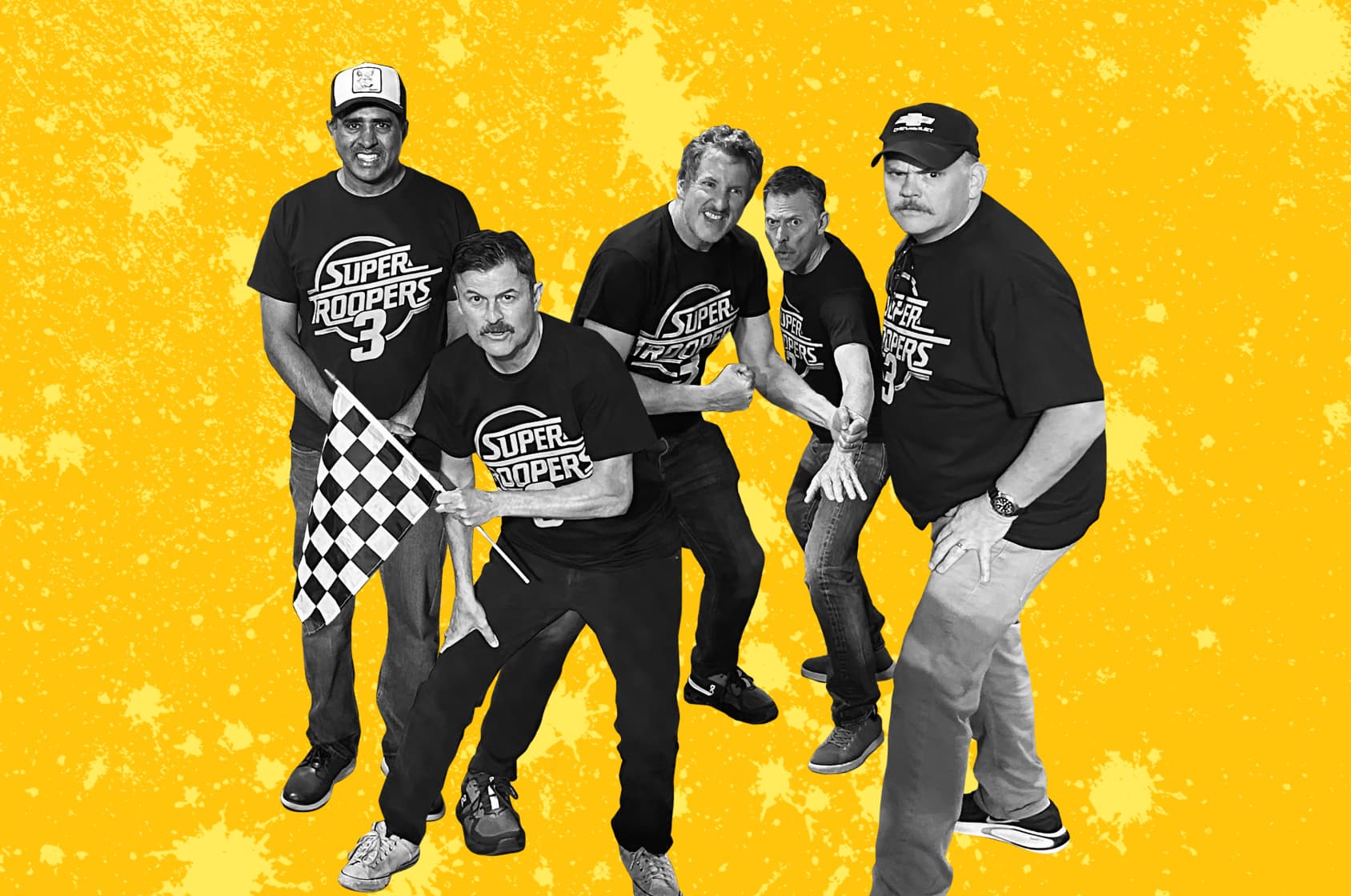
Actors, writers and comedians Steve Lemme and Kevin Heffernan from Broken Lizard recently spent time with CRACKYL to talk about their latest movie Super Troopers 3, which hit theaters in August and will be available for streaming early this fall. Like Rescue Me’s Denis Leary, Heffernan and Lemme both play firefighters in their show Tacoma FD, which ran four seasons, ending in 2023.
But understanding firefighters to be a more authentic writer and actor isn’t the same thing as sharing things in common.
For example, Super Troopers 3 took 28 days to shoot on location. In the TV and movie world, time spent is money lost. Super Troopers 2 took about 35 days to shoot, nice job staying on task. Despite that being fast in the movie world, it is still more than a month away from home. Heffernan and Lemme describe home life re-entry issues that most career and wildland firefighters will recognize.
“We have this thing called the post-movie blues,” Lemme says. “It’s an extreme example, but after we made our first movie, I went back to waiting tables. I was the lead character in that movie. You sneeze and 100 people go, ‘God bless you.’ It’s a real thing. From an acting standpoint, you do become the center of attention. If you want water, within two seconds, there’s water with ice and water without ice. That’s something you don’t foresee happening, but then it’s gone. It’s like, ‘Where’s my friggin ice water?'”
“And we have wives and families,” Heffernan says. “The wives, they don’t give a shit. In their minds, we were on vacation for a month, hanging with our friends, cracking jokes, da-da-da-da-dah. While they’re at home, with the kids, taking them to school, blah blah blah. And when you get home, it’s like, ‘Forget about your vacation and cracking your jokes, now you’re on duty.’ It’s a rude awakening. Our wives thrust us back into the world.”
“By the way,” Lemme says, “they are not wrong. Our job is to have fun with each other and make people laugh. At the end of the day (on location) we go out for dinner, have drinks; we’re hanging out with our best friends having laughs.” And when the kids are young, he says, “that’s when you start to get mature and realize this is a problem — the re-entry. I have to keep in mind that I’m going to go back tomorrow and be just a regular dude. I step off the plane and now I’m walking into reality.”
Of course incident commanders get this. On scene, ask for something and get it. At home, you speak and it’s like no one hears you. Shop at just about any store in your duty shirt and you get discounts, cuts to the front of the line and “thank you for your service.” At home… yeah.
And there’s the same need for a chain of command on a movie set as there is in a fire department. Broken Lizard founding member Jay Chandrasekhar served as director on all three Super Troopers movies.
“At a movie set and TV set, there are a hundred people walking around,” Heffernan says. “Like a fire department, the hierarchical thing is very important to keep the train moving on the track. There needs to be a clear leader to get the thing done. It’s a chain of command. Decision-making becomes more efficient that way.”
OK, maybe the Broken Lizard crew spent a little too much time around the fire service. And yes, we resisted introducing them to the joys of “span of control.”
Like the fire service, leadership and coaching happens outside the hard lines of chain of command. When a crew has been together for a long time, they learn one another’s strengths and weaknesses. You can often anticipate what that person will do on a given call, usually before they know it.
“We’ve been together for 35 years and have a kind of personal shorthand,” Heffernan says about how they coach one another during shoots and writing. Regardless of who is director, or incident commander, Lemme and Heffernan can pick up on what the other is doing in a scene and with something as simple as, “Hey, do that one thing you do,” can pull better acting out of each other.
And if you’re looking for someone to blame for all the havoc Broken Lizard has wreaked, all fingers pretty much point to Chandrasekhar. In 1989, while attending Colgate University, he was asked to put together a comedy group. He pulled in then-fraternity brothers Heffernan, Lemme, Paul Soter and Erik Stolhanske and became known as Charred Goosebeak.
After college they kept the group together, performing in comedy clubs under Broken Lizard. The new name was what first came to mind for Chandrasekhar, but it did beat out “chocolate speedo.”
Through the 1990s they did live performances and some small films. In 2000, they shot Super Troopers and were invited to show it at the Sundance Film Festival, where viewers basically went bananas over it. In early 2002, it had wide theater distribution, paving the way for it to become the cult classic it is, and for Broken Lizard to keep making movies.
Lemme says Broken Lizard has a few scripts it wants to do. And the week after Super Troopers 3 opened, the Broken Lizard team was riding that momentum to sell new ideas.
“It’s putting together as many projects as we can to pitch,” Lemme says. “Your selling window is much more open if you do something good. You try to strategize with the timing. If you have something coming out, you better have your next project ready. If you don’t you’re stupid, and we’ve been stupid before.”
Broken Lizard has a couple animated shows, some live-action TV shows and a couple movies incubating. One is turning Tacoma FD into a movie.
In the fire service, we know that beneath all the pranks, chop busting, banter and camaraderie, there’s a darkness.
An alarmingly high number of firefighters struggle with mental health issues like depression, anxiety and PTSD. And far too many of us end our own lives due to those struggles.
Comedians are typically not dealing with the same external demons we are; they’re not watching people die or on scene when they’ve lost loved ones or worldly possessions. They do have a lot of the same internal demons we have and it shows up as suicide and mental health struggles.
Actor and comedian Robin Williams’ suicide threw a sharp light on mental wellness in general and on comedians specifically. Then, there was an understanding among insiders that comedians were prone to mania and depression, especially stand-up comedians. But there was scant scientific evidence to back that up.
In his 2014 article for The Conversation, Steve Ellen, a Monash University professor of psychiatry, wrote, “Many comedians report difficulties during childhood. And depressed people often use comedy to try to lift their spirits. Sometimes, it’s also an attempt to hide sadness from others.” He went on to say there just wasn’t enough good research to understand the why behind depression and ultimately suicides.
That tracks pretty well with the fire service. We bring a crap-ton of baggage into the service, we see and do things that feed depression, we turn to humor as a release, and, sadly, we take our own lives way too often. And when you look back at the fire service 10 or more years ago, we were talking a little bit about suicide and mental wellness, and doing even less.
Now, we’re having more conversations, taking more action in the form of mental wellness programs for prevention and recovery, and we have more data to point to. That tracks for the comedy world, as well.
New research is showing that areas of the brain connect comedy and depression. Those findings also show that comedians have greater rates of depression and anxiety than the general population. They also show enhanced cognitive flexibility and creativity. Like the fire service, the research into comedians’ mental health status is catching up with what many of them already knew.
If you jump back to our first interview with Lemme, when we put him on the cover of our second issue, he got it. Here’s what he told us while in the heat of making Tacoma FD.
“Now that we have delved into the world of firefighting, we know they see some really terrible stuff. And we know that there are things they take with them from that job that they cannot undo or unsee. Something we discovered pretty early on — which is something we didn’t intend or anticipate — is that laughter is the part of life that’s important. It’s something that keeps people going in hard times. And first responders need that to deal with the hardships of the job.”
And it’s funny how comedy can at times relieve our pain, at times mask our pain and sometimes do both at the same time. That, of course, holds true for comedians and firefighters alike.