
Some people have forgotten more about fitness than I’ll ever know. I’m good with that. What I do find interesting is sitting back and watching how much the conversation around fitness, functional fitness and physical capacity continues to evolve. We keep drilling down into different areas, finding better ways to explain what works, what matters and how the pieces fit together. At CRACKYL, our fitness advisor Ryan Provencher has continually opened conversations around intentional fitness in a way that is practical, approachable and actually makes sense for firefighters. So as these conversations develop, every once in a while I come across something that makes me look at the whole picture a little differently. This is one of those things.
I recently listened to Ben Bergeron explain fitness in a way I had never quite heard before, and I found it enlightening because of how everything connected. Bergeron coached Mat Fraser and Katrin Davidsdottir to CrossFit Games titles, and these days, through CompTrain and his Chasing Excellence podcast, much of his focus is on training for longevity. What interested me is how someone who spent years coaching at the highest level has translated those lessons into a much wider conversation about what fitness should actually allow us to do over a lifetime.
Part of the reason this caught my attention has to do with how I learn. I like logic, and I like it even more when something complicated gets distilled down and explained in a way I can understand and remember. I also think understanding fitness is half the battle. There’s a reason P90X was so successful: it mixed strength training, cardio, yoga and stretching with a nutrition plan, and average, everyday people could just put the video in, press play and exercise without knowing all the reasons why it worked. Bergeron’s framework fills in the why, and it does it simply enough that I can remember it.
Fitness as a Spectrum
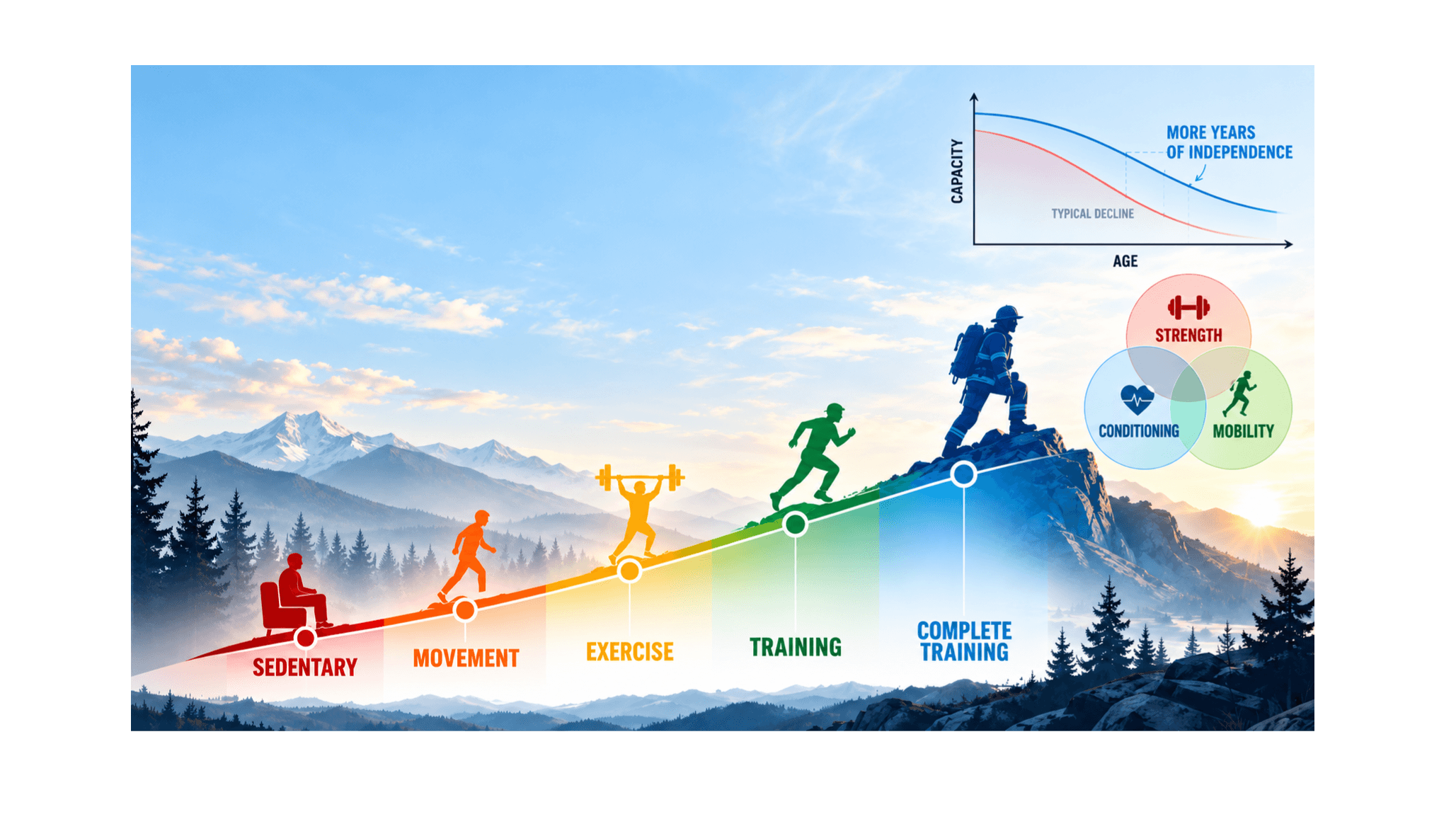
Think about fitness as a spectrum. At the bottom is sedentary. You’re doing nothing. From there comes movement: walking more, taking the stairs, using a standing desk, getting 10,000 steps, finding reasons not to sit all day. Above movement is exercise. Now you’re going to the gym, taking a class, getting on a bike, lifting weights or doing something intentionally physical. Then comes training. Training is different because there is a predetermined outcome attached to it. You’re trying to run a marathon, improve your mile, do a pull-up, increase your strength or accomplish something measurable. Bergeron takes it one step further and calls the highest level complete training.
Complete training is where this started to become much more interesting to me, especially when I put it through a firefighter lens. It brings together three areas: strength, conditioning and mobility. Where those three overlap is your physical capacity. That, in a much broader sense, is your fitness, and it takes in far more than your bench press, your 5K time or whether you can still hammer through a workout with the younger firefighters.
Even those three categories break down further. Strength includes absolute strength, explosive power and muscular endurance. In simple terms: how strong are you, how quickly can you produce that strength, and how long can your muscles continue working? Conditioning includes cardiovascular endurance, aerobic power — VO2 max and lactate threshold — and anaerobic capacity, which is your ability to work extremely hard for a short period of time. Mobility includes flexibility, motor control and stability. Can you move through a full range of motion? Can you control yourself through it? Can you remain stable when you add load?
From Fitness to Physical Capacity
Then apply all of that to nine basic movement patterns: squat, hinge, lunge, push, pull, carry, run, jump and cut. Now think about what we actually ask our bodies to do as firefighters. Climb stairs in gear. Drag hose. Lift equipment. Crawl. Pull ceilings. Force doors. Carry people. Get off the floor. Move awkward loads in bad positions when your heart rate is already through the roof. Suddenly being “fit” becomes a much bigger conversation than whether you work out a few times a week.
But the part that really tied all of this together for me was what happens when we stop looking only at the job and start looking at the rest of our lives. Physical capacity declines with age. None of us avoids that. Somewhere along that decline is a point where we begin losing independence. Traveling gets harder. Stairs become harder. Getting dressed, carrying groceries, cooking, getting down on the floor and getting yourself back up can eventually become difficult. Someone who becomes frail reaches that point earlier. Someone who remains functional can push it farther into the future.
Bergeron uses another word I really like here: formidable. What if our goal is bigger than avoiding frailty? What if we build enough capacity throughout our lives that we remain formidable for as long as we can? For firefighters, I think there is something important in that. We spend decades thinking about whether our bodies are capable of doing the job. Maybe we should be equally interested in whether the way we’re living today is protecting our ability to enjoy everything that comes after it.
For Duty. For Life
The fire service itself has been pointing in this direction since 1997, when the IAFF and IAFC launched the Wellness-Fitness Initiative. It calls for a holistic approach that includes medical, fitness, rehabilitation and behavioral health, and it even notes the program could be made available to retirees. More recently, the IAFF built on that foundation with Fit to Thrive, a program centered on firefighters’ physical, psychological and social well-being, with a tagline that fits this conversation perfectly: For Duty. For Life.
Training is only one piece of that. How we eat matters, with an emphasis on real food. Sleep matters, and eight hours is the target Bergeron talks about. How we think matters. His language is to think like a warrior rather than approach life as a victim, a pessimist, an optimist or even simply a realist. Connection matters, too: connection to yourself, other people and nature. Do you know your values and what you actually want your life to look like? Do you have meaningful relationships? Do you get outside, into the sun, the woods, the mountains, the water or whatever reminds you there is a world beyond work?
I’m not suggesting this is the only way to define fitness, and I’m certainly not pretending to be the expert in the room. I just found the framework useful because it connected a lot of conversations that are often treated separately: strength, conditioning, mobility, movement, sleep, food, mindset, connection and longevity. They are not isolated pieces.
Building Capacity for the Long Run
The truth is, I hope this has provided some further explanation as to what fitness means to the experts. If this gave you something to think about or deepened your understanding of the fitness spectrum, then keep the conversation going. Ryan Provencher’s work here at CRACKYL and the IAFF’s Fit to Thrive program are both good places to take the next step.