


In August 2026, my wife, dog and I were exposed to rabies.
I woke up early in the morning to find a bat circling in our bedroom. It had come in through a gap in the window screen that was over our bed. I thought nothing of it, other than I need to get it outside. I opened the window in our living room and shooed it out of the bedroom, closing the door behind me. The bat was now in our living room, and with a window wide open, I figured it would leave on its own … or so I thought.
Our daughter happened to stay with us the next night. When she found out about the bat, she insisted we get screened for rabies. I’ll be honest, with an early morning flight just 12 hours away and a mountain of work waiting for me in Washington, D.C., I blew off her recommendations. But it’s a long flight from Seattle to D.C. Lots of time to think.
Upon arrival, I recanted this incident with a colleague. He’s one of those guys with a well-developed scientific mind, and a healthy amount of realism. In short order, this conversation was reduced to that most fundamental triaging of risk tolerance: “What’s the worst thing that could happen in this situation?” Death.

This is a photo of the bat found in our home one week after our exposure. And NO, I did not kill it. It was already dead.
I got home five days later and began the PEP treatment protocol. My wife started hers four days earlier, as did our dog.
I found out from the ER doc that this is a common rabies exposure, and one that often goes untreated. The bat bite is so small that a heavy sleeper is unlikely to awaken. Furthermore, bat teeth are razor sharp and often leave the smallest of visible marks, if at all. This is why anyone found to have slept in a room with a bat, for any length of time, is to be considered exposed to rabies and must receive preventative treatment right away.
This most lethal companion is here to stay.
Claiming more than 60,000 lives each year, this story is far from over. But here in the U.S., we rarely see more than 10 lives lost annually. More than 100 years of animal vaccinations and an ever-evolving medical support system means our lot has improved substantially. And yet, this virus lingers. It has lost none of its potency over the millennia. Still, few of us will ever have to even consider the sheer terror, physical suffering, and psychological torment knowing that there is but one outcome: death. And it is through the thinnest of veils that our well-being is afforded.
I say this because absent modern immunization treatments, sustained and prescriptive animal inoculations, and the continued efficacy of the rabies vaccine … the horror of it all could return within a few months. Because rabies never actually left. It is, and will likely always be present in wild animal populations. So, without domestic animal and human vaccines, a widespread surge in outbreaks is the reality we never speak of. But look closely and you will quickly realize rabies is here to stay.
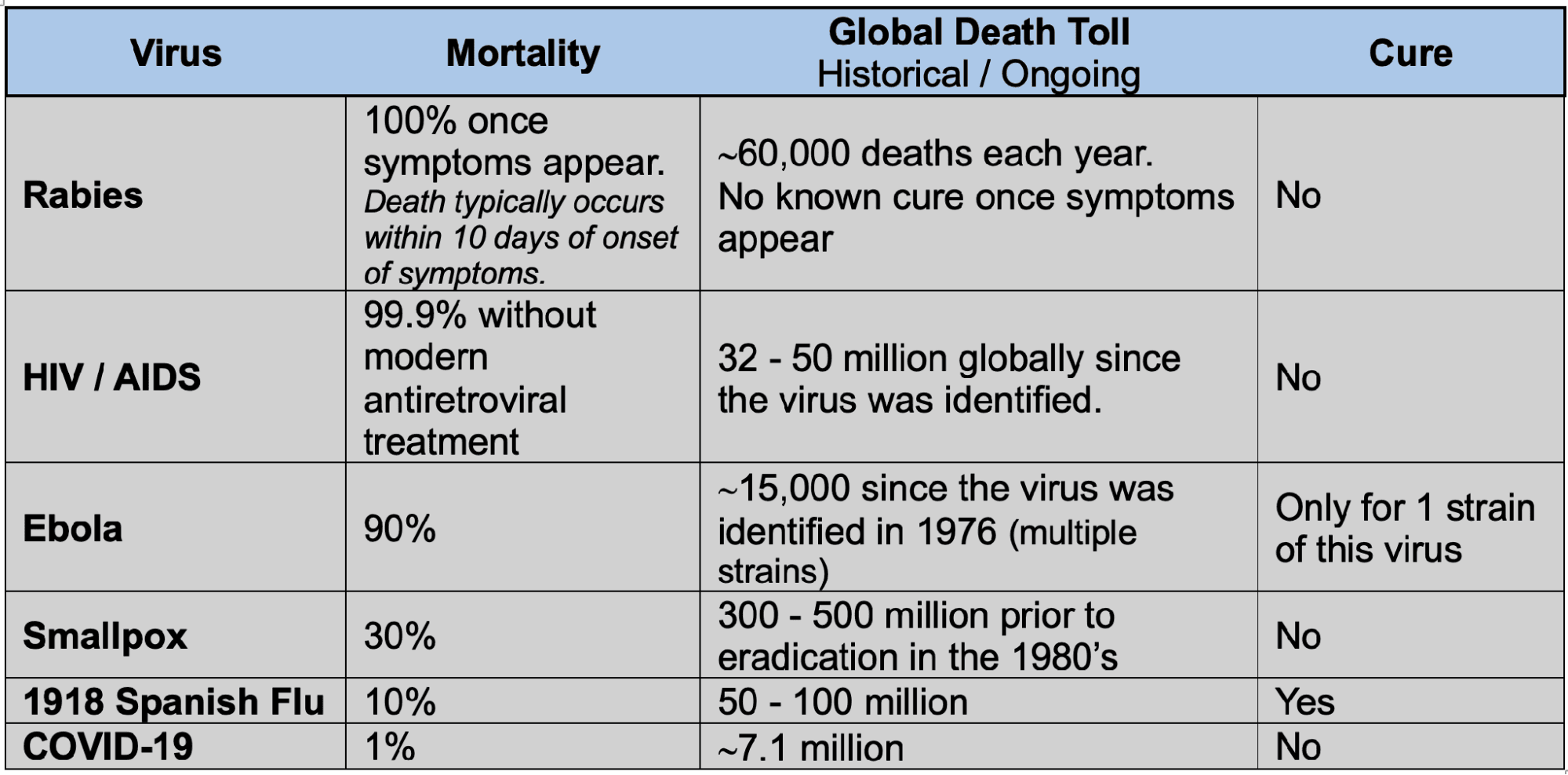
The lethality of rabies places it at the top of this list. Note that this chart does not represent all viruses with high mortality rates.
There is No Cure
And there is no treatment once this virus makes its way into your central nervous system. There is but the narrowest of windows for survival, and it is time sensitive. Patients who report an exposure may be in real trouble without even knowing it. The death clock is ticking. Emergency responders need to understand this. Immediate medical evaluation by a physician is critical to survival. And if you do not take this seriously, the patient may not, either.
How We Are Exposed
Rabies is a virus that spreads through salivary transmission. And animal bites are the most common way it spreads to people. In rare cases, transmission has occurred when infected saliva came into contact with open cuts, wounds and even mucous membranes (eyes, nose, or mouth). Rabies is not known to be transmitted through blood, urine or feces.
Globally, the most common exposure is through dog bites, and prior to 1960 this is how we contracted it in the U.S. However, today, bats are the principal carrier and primary source of rabies exposure.
Symptoms of Infection: Prodromal Phase
The early prodromal phase is when a patient begins to experience the vague, non-specific symptoms of this virus taking hold. Initial symptoms may appear within five days of infection. And they will likely mimic a common flu. Fever, headache, nausea, weakness and overall fatigue. These early symptoms of infection can last for several days. Patients may also report site-specific symptoms like pain, itching, numbness and even a burning sensation near the wound site.
Symptoms of Infection: Advanced
Acute neurological symptoms signal the virus taking hold within the central nervous system. These advanced symptoms can confuse emergency responders if there is no known history of rabies exposure:
- Furious Rabies: Characterized by hyperactivity, extreme agitation, anxiety, confusion, slurred speech, delirium and hallucinations
- Hydrophobia: Difficulty swallowing, leading to an irrational fear of water
- Hypersalivation: Excessive drooling or foaming at the mouth caused by the patient’s inability to swallow saliva
- Paralytic Rabies: Gradual muscle paralysis and coma prior to death. This less frequent outcome occurs in about 20% of the cases.
I’ll be honest, those first three look a lot like many of the drug-induced illnesses I’ve seen in my career. And, without a known rabies exposure, I don’t know how I would be able to connect these dots. Furthermore, the incubation period for this virus can take months. And that time lag, from exposure to symptomatic, can amplify diagnostic confusion.
In Part 2 tomorrow, we will look at how emergency responders can protect themselves from rabies exposure.