
This article originally appeared in the Fall 2025 issue. Download the full issue here.
“Don’t kick that pile of leaves.”
Important advice – and when you’re hiking in the dense Costa Rican rainforest, you pay attention to important advice. That pile of leaves, it turned out, was a fer-de-lance – one of the deadliest snakes in the world. If one bites you, you have about an hour, but my guide didn’t seem worried.
“We could helicopter you out to the hospital, where they’d have the antivenom.”
Given that I didn’t see any hovering helicopters, I made a mental note to pay very close attention to where I put my feet, my hands and, in fact, all parts of me. Costa Rica doesn’t play around.
And yet, it is one of the most beautiful places I’ve ever seen – lush, green, and filled with an enormous variety of fish, reptiles, mammals, and birds – more than you’ll find in almost any other country in the world. In fact, Costa Rica is home to more than 500,000 different species – 5% of the world’s total in a relatively small geographic area, making it one of the most biodiverse countries in the world.
On a recent trip to this favorite Central American country, we decided on a total immersion in the wild. Instead of heading to Guanacaste province – a tourist hub, jumping with surf towns and resorts – we went instead to the quieter central part of the country and to its Caribbean coast, areas filled with national parks and wildlife sanctuaries.
We followed long paths through dense green forests, listening for the croaking of frogs, the chattering of monkeys, and the whistling of birds. Our guide Fernando, an avid birder, brought along a powerful scope that allowed us to see the smallest creatures of the forest, even at great distances. Other park guides joined us from time to time, pointing out incredible things we’d have missed completely, had we been on our own.
“Look at this frog,” said one guide.
Instantly forgetting my vow to keep my hands to myself, I squatted down to reach for the tiny, red frog with the dark blue legs, whose glistening skin stood in such stark contrast to his leafy surroundings.
“Don’t touch! Those strawberry poison dart frogs eat a kind of poisoned ant, then sweat out the venom. While the venom doesn’t hurt the frogs and they don’t bite, they can still kill you with a single touch.” A sweet little creature, just an inch long, able to fell a human with its sweat. Incredible.
Tip No. 2 on my survival list. Don’t touch frogs – no matter how cute.
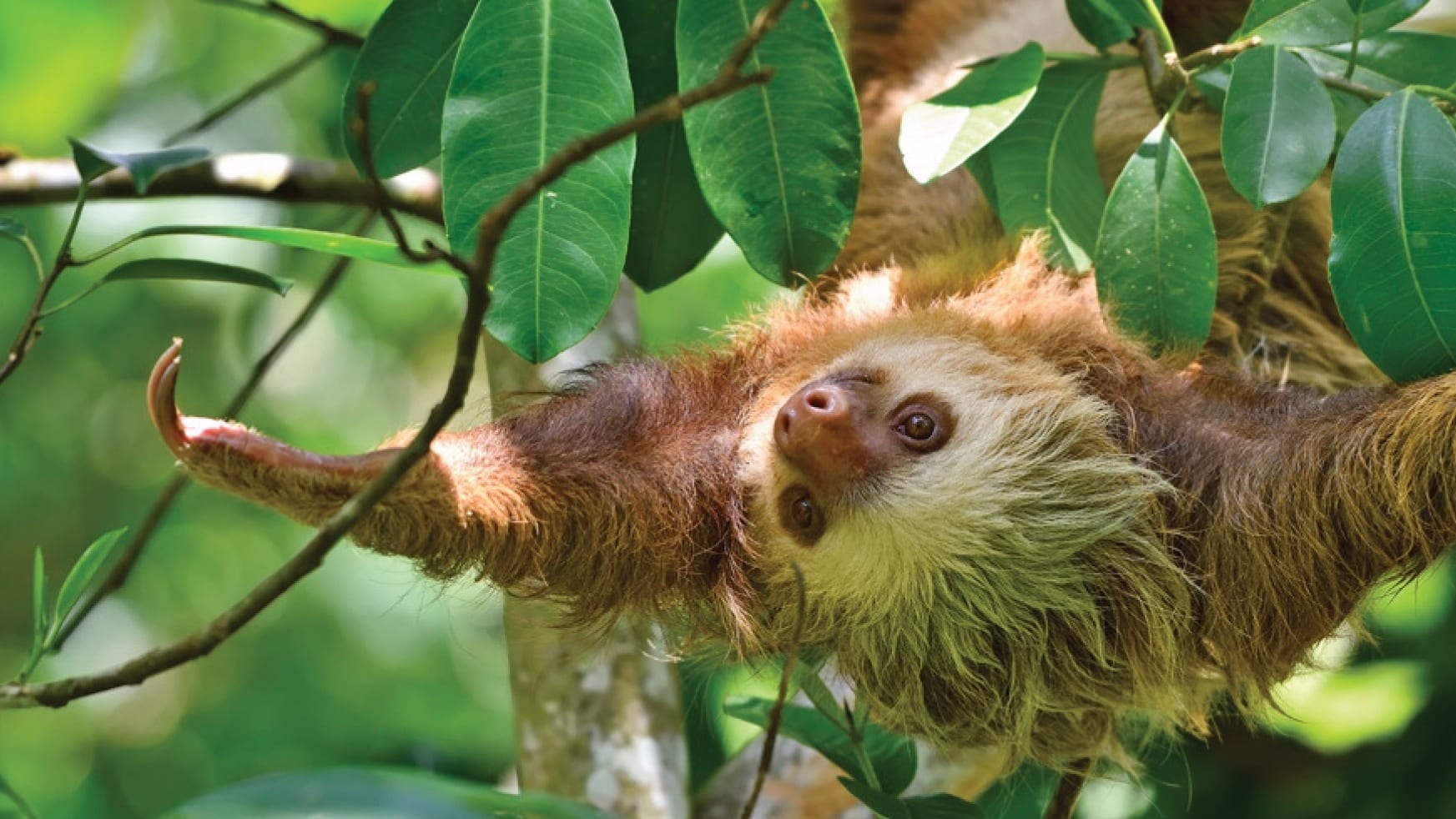
Don’t imagine that every Costa Rican creature is a terror. Some, like the two varieties of sloth you’ll find in many areas of the country, are downright adorable. Distinguished by their long toes (two or three), substantial nails and their faces (perpetually smiling or sweetly piggy) sloths hang quietly in trees, well-camouflaged by greyish fur that blends perfectly with bark. Spot one and you can easily sit and photograph it all day while it munches on leaves and dozes in the warmth of the tree canopy. In fact, these animals are so … uh … slothful that their digestive systems require them to poop once a week. On that momentous day, a sloth will climb slowly down from its perch and then, mission accomplished, make its way back up – equally slowly. Thinking a once-a-week sloth would make an outstanding pet? Bad news. Sloths are protected and can’t be taken home – I asked … for a friend!
Sloths aren’t the only things that hang around in Costa Rican trees. Keep your eyes on the branches above and you’ll see monkeys – the tiny capuchin variety, looking like little old men crouching over a game of dice, or the big, black howler monkeys jealously watching their babies swing like tiny Tarzans through the trees. Brilliantly colored parrots and toucans wing their way across the sky while iridescent hummingbirds dart in and out of giant hibiscus blooms. There’s a Jumanjii-like quality to the jungle – a sense that nature is in overdrive, exploding with growth and life and color.
If you find yourself falling in love with Costa Rica’s creatures, just wait until you meet the people. While it’s dangerous to generalize about the population of an entire nation, there’s something charming about a country that long ago dispensed with having an army and chose instead to use that funding to improve the quality of public education. The effects are obvious, and the people you meet are, on the whole, as well-informed as they are welcoming.
Just one word of warning – don’t be surprised if you find it difficult to leave Costa Rica when your holiday is over. Instead of briskly packing your bag and heading for the airport, you may find yourself suddenly slothlike … slowly climbing back to a lovely, leafy oasis to stay for at least another week.
This article originally appeared within the Fall 2025 issue. Download the full issue here, or browse all back issues in theCRACKYL Library.