
Firefighter tactical fitness does not require complex equipment or elaborate facilities. It requires intentional training grounded in sound movement patterns, appropriate workload, and energy system demands that reflect the realities of the job.
The Simple Tools Series is a collaboration between Firefighter Peak Performance and CRACKYL Magazine featuring practical, versatile training tools that firefighters can use at the station, in the recruit academy, or in a home gym.
This workout features one of my favorite training tools for firefighters, the sandbag.
The Tool: Sandbag
One of the greatest benefits of training with a sandbag is the ability to work with an awkward, shifting load. Depending on how you hold the bag, the same weight can challenge your body in very different ways.
Think about the difference between carrying a sandbag on your shoulder, holding it against your chest, or gripping it by the handles. Each position places different demands on your strength, stability, grip, and coordination.
This is particularly valuable for firefighters. Carrying a hose bundle up a flight of stairs, moving a patient in a confined space, and maneuvering extrication equipment all require strength and control while managing awkward loads.
With an adjustable sandbag, you can train these physical qualities through a wide variety of exercises without requiring much equipment or space.
The Training Protocol: AMRAP
AMRAP stands for as many rounds as possible. You complete a prescribed number of repetitions for a series of exercises and repeat that sequence as many times as possible within a set work period.
This 20-minute workout challenges muscular endurance, aerobic capacity, and the ability to sustain physical effort under load.
Unlike interval protocols with prescribed recovery periods, AMRAP allows you to determine when and how long to recover. Managing your pace from the beginning of the workout will help you maintain consistent effort as fatigue builds.
This is a valuable skill on the fireground, where firefighters often move from one physically demanding task to another with limited opportunities for recovery.
Use the number of rounds completed as a measure of performance while maintaining movement quality and the prescribed training intensity.
Managing Your Intensity
This workout is designed to be performed at moderate or high intensity. Adjust your volume, load, and tempo based on your current fitness level and the training intensity prescribed for the day.
Volume: Manage your pace and recovery to complete an appropriate number of rounds in 20 minutes. Use your first session to establish a baseline and your workout scores to guide progression over time.
Load: Select a sandbag weight that allows you to maintain solid technique throughout the workout. Increase or decrease the weight to adjust your training intensity. Load may vary between exercises.
Tempo: Adjust the speed of each repetition to manage your effort. Use your movement rating as a guide, maintaining a rating of 8/10 or higher throughout the workout. If your technique begins to break down, slow down, reduce the weight, or take time to recover.
Use your rating of perceived exertion (RPE) and heart rate as complementary guides to training intensity.
Moderate-Intensity Training: RPE of 5 to 7 and a heart rate of 70% to 80% of your estimated maximum.
High-Intensity Training: RPE of 8 to 9 and a heart rate of 80% to 95% of your estimated maximum.
Training Exercises
This workout incorporates four exercises that train essential movement patterns using different sandbag loading positions.
Reverse Lunge
The Reverse Lunge develops single-leg strength, balance, and trunk stability through the Lunge movement pattern. Loading the sandbag on one shoulder challenges your ability to maintain alignment while moving with an uneven load.
Think about carrying a ladder on your shoulder across uneven ground or shouldering a high-rise pack up a stairwell. Both require lower-body strength, balance, and stability while managing an uneven load.
Base Stance Row
The Base Stance Row combines a sustained Hinge position with the Horizontal Pull movement pattern. It develops upper-back strength, grip endurance, and the ability to maintain a stable trunk while pulling.
These qualities carry over to tasks such as pulling hose, hoisting tools, and moving equipment from awkward working positions.
Front Loaded Squat
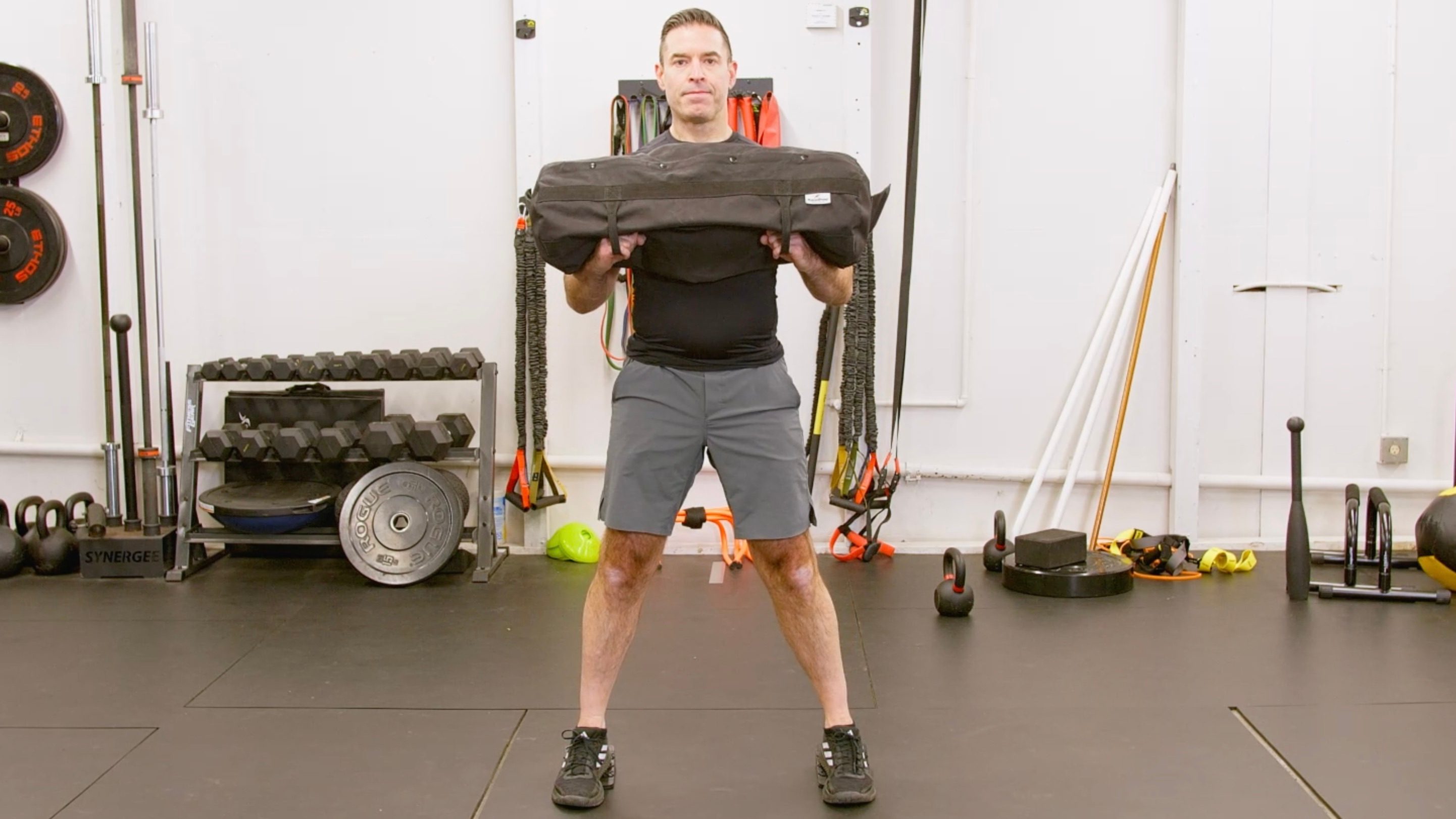
The Front Loaded Squat develops lower-body strength and trunk stability through the Squat movement pattern. Holding the sandbag against your chest challenges your ability to maintain posture and control as you lower and raise your body under load.
This prepares you for tasks that require lifting equipment, moving patients, and repeatedly transitioning between standing and lowered working positions.
Standing Halo Rotation
The Standing Halo Rotation trains the Rotation movement pattern while developing shoulder mobility, stability, and coordination. Moving the sandbag around your head challenges your grip strength and ability to control rotation through the trunk as the load shifts.
These qualities are particularly valuable when maneuvering tools and equipment in confined or awkward working spaces.
Workout Instructions
Recommended Equipment
One or more sandbags with options to adjust weight. Use filler bags or other loading options compatible with your sandbag.
20-Minute AMRAP (As Many Rounds As Possible)
Training Exercises
- Reverse Lunge: Alternating x 20 repetitions (10 with the bag on the right shoulder, then 10 with the bag on the left shoulder)
- Base Stance Row x 15 repetitions
- Front Loaded Squatx 10 repetitions
- Standing Halo Rotation: Alternating x 10 repetitions
Reverse Lunge: Alternate legs. Right step + left step = 1 repetition. 20 repetitions = 20 steps on each leg.
Standing Halo Rotation: One full circle = 1 repetition. Alternate directions with each repetition.
Recommended Loading
- Level 1: Up to 25 pounds
- Level 2: Over 25 and up to 50 pounds
- Level 3: Over 50 pounds
Select an appropriate weight for each exercise based on your current fitness level, movement quality, and prescribed training intensity. You may find that a lighter sandbag is more appropriate for the Standing Halo Rotation than for the Reverse Lunge or Front Loaded Squat.
Complete the Workout
- Complete the Dynamic Warm-Up to prepare for your training.
- Perform the prescribed repetitions for each exercise to complete one round.
- Complete as many rounds as possible in 20 minutes while maintaining movement quality and the prescribed training intensity.
- Complete the Comprehensive Cool-Down to support recovery.
Scoring the Workout
Scoring your workout is part of your training. It gives you a reference point for future workouts and helps you understand how your body responds to the workload.
Record your results on the Sandbag AMRAP Score Sheet.
For Each Exercise
- Low Weight: The lightest sandbag weight used for the exercise.
- Repetitions Completed: The total number of repetitions completed for the exercise.
- Load Level: The training level corresponding to the lowest weight used for the exercise.
For the Workout
- Total Rounds: The number of complete rounds performed in 20 minutes.
- Total Repetitions: The sum of all repetitions completed, including any partial round.
- Sum of Low Weight: The sum of the lowest weight used for each of the four training exercises.
- Final Heart Rate: Count your pulse from 15 to 30 seconds after your final repetition and multiply by four, or record your heart rate from your monitor 30 seconds after your final repetition.
Ratings (1 to 10)
- Movement Rating: The quality of your movement and exercise technique throughout the workout.
- Intensity Rating (RPE): Your perceived level of exertion throughout the workout.
- Discomfort Rating: The level of physical discomfort experienced during the workout, separate from normal muscular fatigue and exertion.
- Focus Rating: Your ability to maintain mental focus and attention throughout the workout.
- Dexterity Rating: Your ability to maintain coordination and control while handling the sandbag.
AMRAP Workout Score Sheet
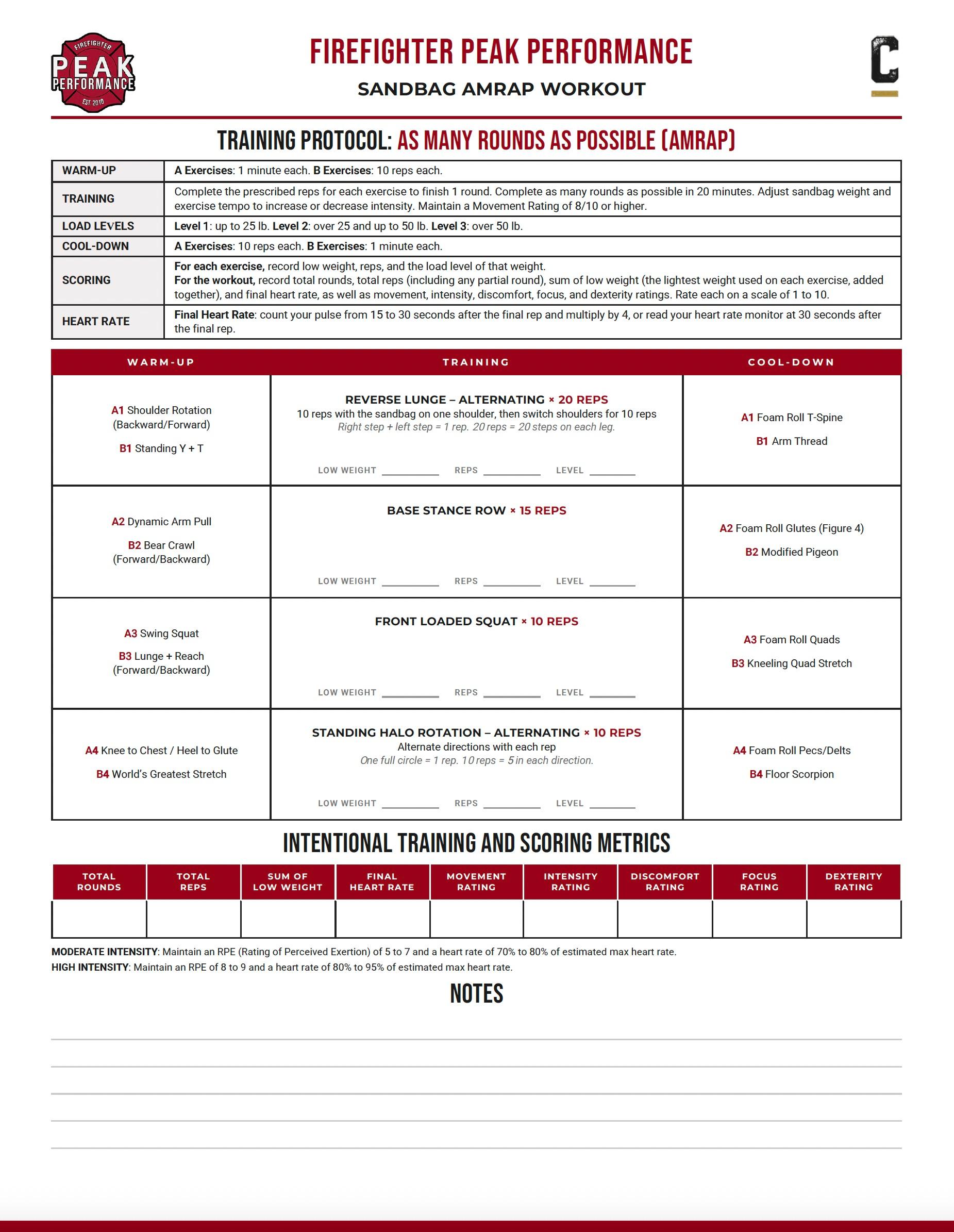
Progress doesn't always mean completing more rounds. Completing the same number of rounds with more weight, better movement quality, or a lower heart rate or intensity rating can also indicate improved fitness when training conditions are comparable.
Train With Purpose
The Sandbag AMRAP Workout is a practical way to develop the strength, stability, and work capacity firefighters rely on during emergency operations.
You can use it as a Workout of the Day, incorporate it into your current training plan, or combine it with other sessions from the Firefighter Workouts Playlist.
There is real value in a well-designed firefighter-specific workout. The greatest benefits come from following a structured plan that progressively develops your fitness over time.
Consider your shift schedule, vary your training intensity, and pay attention to how you recover between sessions. Use your workout scores to track progress and guide your training decisions.
This approach can help you improve fireground performance while supporting your long-term health and career longevity.
Train With Purpose. Perform With Confidence. Be Response Ready.
Visit Firefighter Peak Performance for more firefighter fitness and wellness resources.