
Firefighter tactical fitness does not require complex equipment or elaborate facilities. It requires intentional training grounded in sound movement, appropriate workload, and energy system demands that reflect the realities of the job.
The Simple Tools Series is a collaboration between Firefighter Peak Performance and CRACKYL Magazine, highlighting practical, field-tested training tools that support firefighter readiness through specific, comprehensive physical training.
These tools are versatile, affordable, and accessible, making them ideal for use in the station, the recruit academy, or a home gym.
The purpose of this series is to help firefighters train with purpose and apply their training to the demands of the job.
This workout centers on one of the most versatile bodyweight training tools available.
Tool: TRX
A TRX provides a simple way to train fundamental movement patterns using your own bodyweight as resistance.
Unlike fixed machines, TRX exercises require you to control your body position while producing force through the straps. This challenges strength, stability, and coordination throughout each movement.
One of its biggest advantages is scalability.
Changing your position relative to the anchor point changes the resistance, allowing the same exercise to accommodate different fitness levels and training objectives.
For firefighters, that makes the TRX a practical option for full-body training with minimal equipment and space.
Training Protocol: For Time
Complete 50 repetitions of each exercise and record the total time required to finish the workout.
The objective is to complete the prescribed work as quickly as possible while maintaining excellent technique. This requires you to manage your pace as fatigue builds rather than racing through the first few sets.
The target time is approximately 20 minutes. Finish under 20 minutes while maintaining a Movement Rating of 8 or higher, and you can increase the challenge. Finish over 20 minutes and you can decrease it.
This combination of sustained effort, muscular endurance, and pacing reflects the demands of the fireground, where physical tasks are often performed consecutively with limited opportunities for recovery.
Complete the work. Manage your pace. Maintain movement quality.
Managing Intensity
TRX training allows you to adjust intensity without changing the workout.
Body Position
Change your angle relative to the anchor point to increase or decrease the amount of bodyweight you are moving.
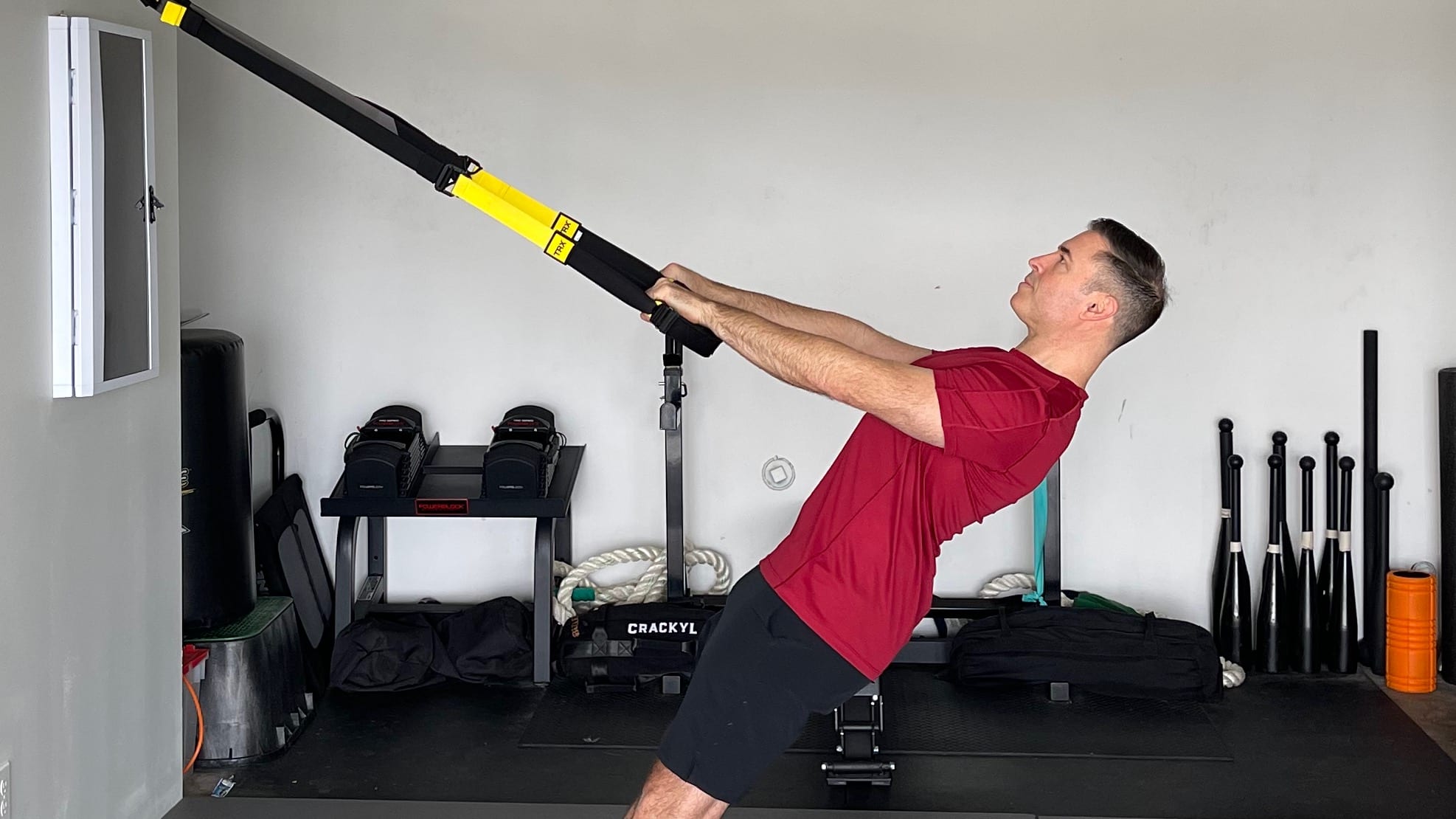
For the Chest Press and Low Row, standing more upright decreases resistance. Leaning farther forward on the press, or farther back on the row, increases it. For the Squat and Reverse Lunge, relying more on the straps makes the movement easier. Using them primarily for balance makes it harder.
Tempo
Increase your pace to increase the training demand, or slow your pace to emphasize greater control.
Resistance
Add a weighted vest when additional resistance is appropriate.
Use your Movement Rating as the guide. Maintain a rating of 8 out of 10 or higher throughout the workout. If your rating drops below 8, adjust your pace, body position, resistance, or rest.
Moderate-Intensity Training: Maintain an RPE of 5–7 and a heart rate of 70–80% of estimated maximum heart rate.
High-Intensity Training: Maintain an RPE of 8–9 and a heart rate of 80–90% of estimated maximum heart rate.
Complete this workout at moderate or high intensity, depending on where it falls in your training plan.
Workout Timer
Target Time: approximately 20 minutes. Time Cap: 25 minutes.
Training Exercises
Each exercise trains a fundamental movement pattern and develops physical qualities that support firefighter performance.
TRX Reverse Lunge
50 repetitions, alternating legs (right + left = 1 rep)
Adjust the straps to mid-length and stand facing the anchor point with the feet slightly wider than hip-width apart.
The TRX Reverse Lunge uses the Lunge movement pattern to develop unilateral lower-body strength and stability, supporting tasks such as stair climbing, hose deployment, and carrying equipment across uneven terrain.
TRX Chest Press
50 repetitions
Adjust the straps to fully lengthened and stand facing away from the anchor point with the feet shoulder-width apart.
The TRX Chest Press uses the Horizontal Push movement pattern to develop upper-body strength and trunk stability for tasks that require pushing, controlling equipment, and applying force from different positions.
TRX Squat
50 repetitions
Adjust the straps to mid-length and stand facing the anchor point with the feet shoulder-width apart.
The TRX Squat uses the Squat movement pattern to develop lower-body strength and endurance. These qualities support lifting equipment, moving patients, and repeatedly transitioning between standing and lower working positions.
TRX Low Row
50 repetitions
Adjust the straps to fully shortened and stand facing the anchor point with the feet slightly wider than hip-width apart and the ankles flexed.
The TRX Low Row uses the Horizontal Pull movement pattern to develop upper-back strength and pulling endurance for tasks such as pulling hose, hoisting tools, and lifting equipment.
Workout Instructions
Warm-Up
Complete the Dynamic Warm-Up before beginning the workout. Perform each exercise for one minute, focusing on range of motion and control.
Training
Perform 50 repetitions of each exercise:
- TRX Reverse Lunge
- TRX Chest Press
- TRX Squat
- TRX Low Row
For the TRX Reverse Lunge, one right and one left lunge equals one repetition.
Complete all prescribed repetitions for one exercise before moving to the next.
Adjust tempo, body angle, or resistance to increase or decrease the challenge while maintaining excellent technique. If you scale the repetitions, record your Total Reps.
Cool-Down
Complete the Comprehensive Cool-Down following the workout. Perform each exercise for one minute, emphasizing breathing, mobility, flexibility, and recovery.
Review the instructional videos as needed to ensure each exercise is performed properly.
Find full exercise demonstrations and coaching instructions in the Firefighter Workouts Playlist.
Scoring the Workout
Fitness without feedback is guesswork.
Scoring the workout is part of the workout.
Record:
- Total Time
- Total Reps
- Final Heart Rate: Starting 15 seconds after your final repetition, count your pulse for 15 seconds and multiply by four. Or record your heart monitor reading at 30 seconds.
Rate each of the following from 1 to 10, with 10 being the highest:
Movement Rating: Quality of technique throughout the workout.
Intensity Rating: Overall effort (RPE).
Discomfort Rating: Physical discomfort during the workout.
Focus Rating: Ability to stay mentally engaged.
Dexterity Rating: Fine motor control after the workout, such as working a radio, buckling SCBA straps, or handling tools.
These metrics allow you to measure performance, evaluate your response to the workload, and compare results over time.
Workout Score Sheet
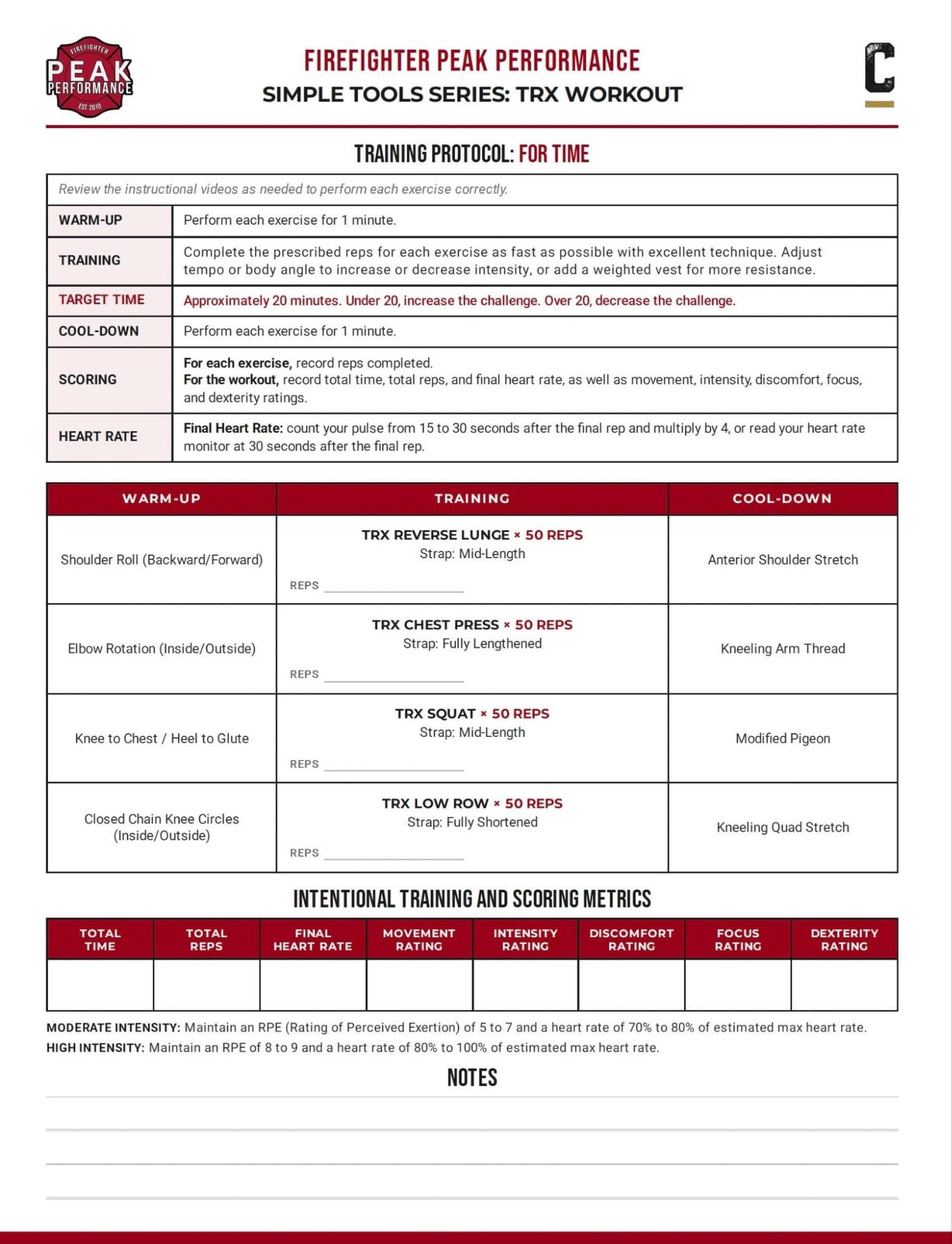
Go to your Firefighter Workouts Playlist to download, save, and print the PDF.
The TRX For Time Workout provides a simple, measurable way to train four fundamental movement patterns while challenging your ability to sustain effort.
Use it as a Workout of the Day, plug it into your current plan, or combine it with other sessions from the Firefighter Workouts Playlist as part of a progressive tactical fitness program.
There is real value in a well-designed single workout. Firefighters, however, benefit most from structured training that progresses over time.
One workout challenges you today. A progressive program builds capacity over months and years.
That is the difference between leaving the gym exhausted and showing up on scene prepared.