The shift from the front lines to the front office holds a hidden danger: metabolic complacency. What is your incident action plan to fight back?
For more than 34 years, I have lived and breathed the fire service. My career has taken me from the front lines as a military and federal firefighter to the intensity of the fire officer ranks, into the strategic realm of the chief’s office, and today, into classrooms as an instructor and across the state as a fire prevention and fire department safety and health coordinator.
Over more than three decades, I have been trained to mitigate almost every conceivable external hazard. I have stared down structural fires, managed complex hazardous materials incidents, and engineered detailed emergency response plans to keep both the public and my crews safe.
But recently, I was blindsided by an emergency I never saw coming. It didn’t arrive with a screaming siren or a dispatch tone. It arrived quietly in a doctor’s office with a diagnosis of Type 2 diabetes.
Finding out I had diabetes was a harsh wake-up call. It revealed an internal, metabolic threat I had long overlooked while focusing entirely on external dangers. In our line of work, we are exceptional at protecting everyone else. We enforce code compliance, build community risk reduction plans, and train our crews until tactics are second nature. Yet, when it comes to our own internal health, we often allow a culture of complacency to take over.
This is especially true for the veteran members of our service, those who have transitioned from the high-tempo physical demands of active suppression to the equally critical, but far more sedentary, worlds of administration, code enforcement, and instruction.
In these roles, tactical complacency can become just as deadly as any modern flashover. It is time we applied the exact same strategic discipline we use on the fireground to our own metabolic health.
The Shift: From Active Response to the Administrative Burn
When you are an active firefighter, the job forces a baseline level of physical exertion. You are throwing ladders, hauling hose lines, and carrying heavy equipment. But as we move up the ladder into leadership, training, or prevention roles, our daily operations change dramatically. Instead of pulling ceilings, we review lesson plans, analyze fire codes, write strategic plans, and sit in meeting rooms.
This transition comes with a hidden hazard. Your physical activity drops, but your eating habits, sleep deprivation patterns, and stress levels from decades on the job remain the same. This creates a perfect storm for metabolic syndrome and Type 2 diabetes.
“*Ignoring a rising A1C level or expanding waistline is the medical equivalent of ignoring a bowing roof line during an interior attack. The signs of collapse are there; we are just choosing not to look at them.” *
In the fire service, we love to talk about situational awareness. We scan structures for structural compromise, changing smoke conditions, and utility hazards. But we must ask ourselves: are we maintaining that same situational awareness when it comes to our bodies?
A Strategic Roadmap for Metabolic Health
Managing, preventing, and even reversing Type 2 diabetes while maintaining a high-tempo career in the fire service requires a formal incident action plan (IAP). We cannot rely on guesswork. We need an evidence-based roadmap built on the same structural discipline we bring to emergency management.
Metabolic Incident Action Plan
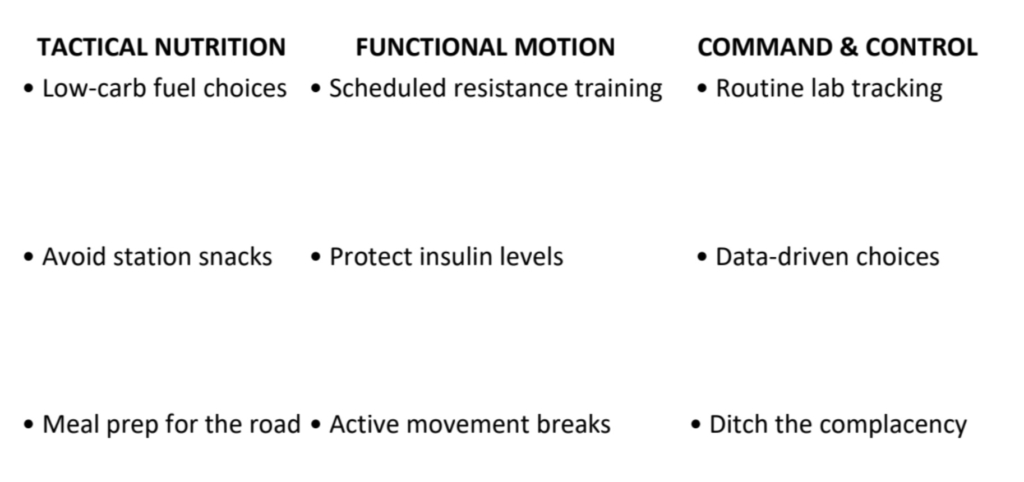
1. Tactical Nutrition: Changing the Fuel Mix
On the fireground, putting the wrong fuel into an apparatus will destroy the engine. The human body is no different. The traditional firehouse diet — heavy on processed carbohydrates, sugary energy drinks, and late-night post-incident fast food — is a direct route to insulin resistance.
Treat your nutrition like a tactical assignment. Shift your focus toward whole foods, lean proteins, healthy fats, and non-starchy vegetables.
Cut out the empty carbohydrates and refined sugars that cause massive blood glucose spikes. When you are traveling for inspections or teaching long weekend academies, prep your meals ahead of time. Do not leave your health at the mercy of whatever drive-thru happens to be at the next highway exit.
2. Functional Motion: Combatting the Office Chair
Transitioning to an administrative or instructional role means you must intentionally schedule the physical exertion that used to be a natural part of your workday.
If you are teaching or managing programs, you are likely on your feet, but that is not a replacement for targeted cardiovascular and resistance training. Weight training is highly effective for managing diabetes because muscle tissue absorbs glucose from your bloodstream, helping to naturally lower your blood sugar and protect your insulin sensitivity.
Commit to a minimum of 30 minutes of intentional, daily physical exercise. Treat this time as a non-negotiable meeting on your calendar. If your day is consumed by code research or meetings, use a standing desk or take walking breaks every hour.
3. Command and Control: Know Your Numbers
As fire service leaders, we make decisions based on objective, verified data. We look at response times, fire administrative rules, and community risk data. We need to bring that exact same data-driven mindset to our personal health care.
Establish a routine medical monitoring program for yourself. Do not wait for an annual department physical to find out something is wrong.
Work closely with your physician to track your fasting blood glucose, your hemoglobin A1c (which shows your average blood sugar over three months), your fasting insulin, and your lipid panels. Treat these lab results like your department’s annual budget or emergency performance metrics. If a metric begins to drift outside of the safe operating limit, take immediate corrective action.
Leadership by Example: Protecting Our Own
Throughout my 34 years in this profession, I have always believed that true leadership means doing the right thing every single day and leading by example. John Quincy Adams wrote, “*If your actions inspire others to dream more, learn more, do more and become more, you are a leader.” *
As senior members, instructors, and chiefs, our personnel watch everything we do. If they see us taking care of our physical health, prioritizing nutrition, and actively managing our well-being, it sets a standard for the entire department.
Community risk reduction (CRR) is a concept we regularly use to keep our municipalities safe from fire. We look at data, pinpoint risks, and install smoke alarms or enforce building codes to stop fires before they ever start. We must start applying those exact same CRR principles internally.
Preventing Type 2 diabetes across the fire service requires a cultural shift where physical health, nutrition, and metabolic wellness are discussed just as openly as cancer prevention, clean turnout gear, and mental health awareness.
A diabetes diagnosis does not mean your fire service career is over. Whether you are actively riding backwards on the engine, leading your fire department as a fire chief, or teaching the next generation of firefighters and fire officers at your local college, you can successfully manage, control, and even reverse this condition.
Let’s stop ignoring the slow internal burn. We have spent our entire lives protecting our communities; it is time we bring that same strategic discipline, passion, and focus home to protect ourselves.
Gary Peck is the Fire Prevention and Fire Department Safety and Health Coordinator for the Wisconsin Department of Safety and Professional Services, where he advises fire departments on fire prevention, safety, code compliance, investigations, and community risk reduction. A 34-year fire service veteran, Gary has served as a military, federal, and municipal firefighter, fire officer, and fire chief. He helped develop Wisconsin’s statewide community risk reduction strategic plan and Fire Risk Reduction Tool, and continues to provide leadership through state and national fire service organizations, including the National Fallen Firefighters Foundation’sUntil Everyone Goes Homeprogram.