Many years ago, as a new training officer still suffering from shift withdrawals, I tagged along to a regional leadership conference. After the first day, I met up with firefighters and officers from a neighboring department for dinner and drinks. One was a soft-spoken deputy chief nearing the end of his career, a “silent soldier,” the kind of administrator I didn’t understand the value of at the time. During a lull I tossed him what I thought was a nothing question:
“Well, chief, I’m a new training officer on days. Any advice?”
I expected something tired and forgettable. Instead, he set his drink down and said, “Yeah, if you aren’t working on projects that will still benefit the department in five years, you’re working on the wrong things.”
It felt like he saw my soul and every shallow, short-term aspiration in it. He spent the next five minutes unpacking what he meant, and it was like cresting a hill on a country road and seeing the valley open in front of you. In about the time it takes to finish a drink, that deputy chief pushed my planning horizon further out than anyone had in the previous 10 years of my career.
Success Within a Small Frame
Here’s what makes that moment uncomfortable to write about: by every visible measure, I was crushing it. I was instructing regionally, had recently stood up our first in-house academy, and was a discipline lead on the county tech rescue team. Wife, two kids at the time, the whole deal. I was proud of myself. Just ask me, I’d have told you. And in that one exchange, I started to understand there was an entire tier of the organization I had barely been exposed to.
Not above me in rank necessarily. Above me in altitude.
I spent the next nine years in administration trying to learn what he had been pointing at. What that deputy chief gave me, in about 300 words and a flat stare, was a recalibration of my orientation. I just didn’t have the vocabulary for it yet.
Boyd
I picked up the vocabulary from John Boyd in Robert Coram’s biography, Boyd: The Fighter Pilot Who Changed the Art of War. The entry point was the usual OODA loop: Observe, Orient, Decide, Act. We talk about OODA on the fireground, and we should. But the part of Boyd’s model we often underappreciate is Orient.
Orientation is the lens. It’s the sum of your experience, cultural inheritance, training, analysis, previous decisions, and internalized patterns. Two leaders can observe the same incident, budget cycle, or personnel problem and orient on it completely differently. The one whose orientation is built from a broader base of experience can see the problem more accurately, faster, and with more options.
That’s what was happening in the bar. That deputy chief wasn’t smarter than me. He was oriented differently. His lens had been shaped over decades of watching short-horizon projects die on the vine and long-horizon investments compound. He had sat in city council meetings and regional planning workgroups. He had seen the results of the long game. I was operating from a lens built mostly from one shift, station, and battalion. The recent wins were real wins. But they were inside a small frame.
Expanding the Lens
Operational calibration comes from a broad perspective. On the fireground, we celebrate the officer with the calibrated gut, the one who reads not only smoke, buildings, and technical problems but crews, pressure, incentives, and second-order consequences. That calibration doesn’t always come from doing the same job for 20 years. It comes from exposure to enough different problems, at enough different altitudes, that your orientation has real range.
This is the part of administration nobody warns you about. You think you’re stepping back from the work. If you do it right, you’re widening your aperture.
You sit in a training planning meeting and see the horsepower it takes to make real behavioral change across an agency, not just your crew. You sit in labor management and learn that contract language you thought was sacred was negotiated as a concession to keep something more important alive. You help collect department-issued items from a member separating after a preventable on-the-job injury.
None of that makes the tactical decision on the next fire less important. It makes it better. When you walk into a fireground, personnel, political, or fiscal problem, you’re orienting from a larger map. Boyd would say you’ve expanded the inputs to your loop. I’d say it more plainly: you can see further, so you can decide better, sooner.
If you’re a company officer reading this, I’m not telling you to chase administration. Many great leaders never leave the line, and the fire service needs them desperately. Building newer members and supporting, guiding, and correcting tenured members are compounding investments of their own.
What I am telling you is this: the quality of your decisions is downstream of the quality of your perspective.
Better Decisions Through Broader Experience
The value you bring to your team is also commensurate with the depth and breadth of your perspective.
And perspective is the one thing you can’t build by working harder at the altitude you’re already at.
Short promotional tenures and rapid growth limit the reps many leaders get.
Go to the meeting you’ve been avoiding. Sign up for the committee outside your comfort zone. Read the after-action from a department that isn’t yours. Take the class aimed at the rank above where you sit. Find the silent soldier in your organization who isn’t flashy but just shows up consistently and ask an earnest question. Then actually listen.
Somewhere out there is your quiet deputy chief with a five-minute answer that will reshape the next decade of your career. Your job is to be in the room, and be the kind of follower who can hear it when it shows up.
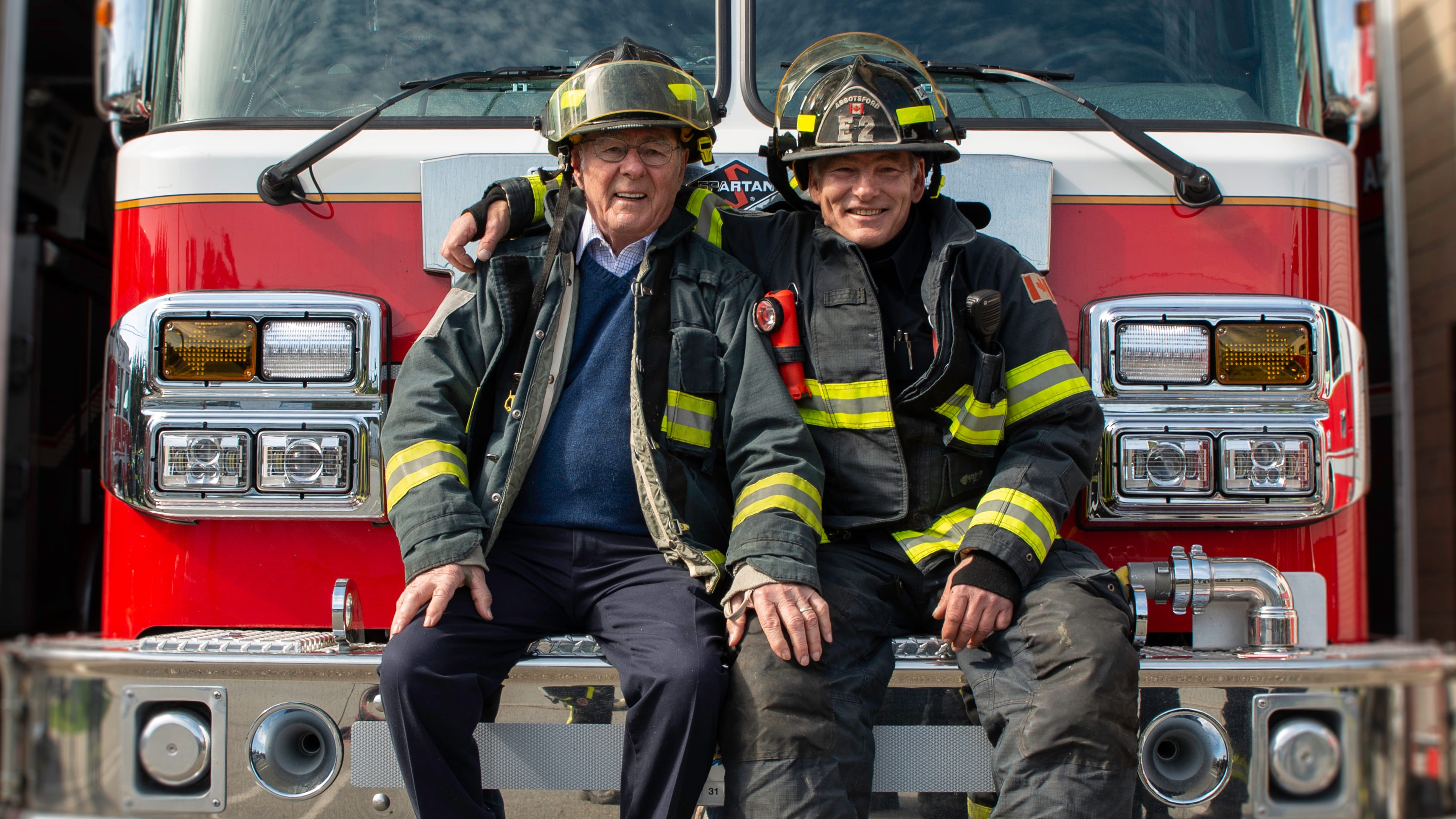
Thank you Deputy Chief Greg Wright – Olympia Fire Department (ret.)
Photo by Steve Baer | FireDog Photos