Clean, well-maintained gear reduces exposure to the fireground contaminants that put firefighters’ health and safety at risk
Firefighters log more than a hundred hours of training each year. Live-fire evolutions, SCBA drills, mayday scenarios, the works. But one of the most important safety skills isn’t taught in a burning building; it happens after the call.
An analysis by the National Institutes of Health (NIH) found almost one in five firefighters had no on-scene decontamination procedures after being exposed to smoke and products of combustion present at fires and non-fire events. Research has shown that common products of combustion include substances such as benzene, soot, Polycyclic Aromatic Hydrocarbons (PAH), particulates, flame retardants, and other hazardous substances. The hazardous substances produced by emergency incidents contaminate firefighter PPE, which can lead to the potential for secondary exposure.
PPE Contamination Has Dangerous Consequences
Properly wearing all firefighter personal protective equipment (PPE) is the first line of defense against exposure and contamination risks.
However, not thoroughly and effectively cleaning gear at emergency incidents creates risks to health and safety. Contaminated gear can carry harmful substances back into the apparatus, the station and living areas, and can then cause exposures from handling and storage. Cancer is now the leading cause of death among firefighters, surpassing heart disease, according to a report by the National Institute for Occupational Safety and Health (NIOSH). Firefighters are twice as likely as non-firefighters to be diagnosed with mesothelioma and testicular cancer. According to Occupational and Environmental Medicine (OEM), fire fighters have a 14% higher risk of dying from cancer than the general public.
On-Scene Gross Decon, and Post-incident recommendations like “shower within the hour” can help improve long-term health. But firefighters deserve more.
Many departments recognize that exposure to contaminated gear is an avoidable risk if the proper procedures and resources are in place. Even when departments want to do more to protect their members, they’re often forced into tradeoffs: better cleaning vs. lower cost, faster turnaround vs. deeper decontamination, sustainability vs. performance. When budgets are tight and time is limited, leaders are left choosing between imperfect options. This is exactly why the fire service needs solutions that don’t force compromises when safety is on the line.
Standards Rise with NFPA 1850 Updates
The National Fire Protection Association (NFPA) recently merged and updated its standards, creating a new guideline for fire departments to follow: NFPA 1850. Instead of juggling multiple documents, departments now have one comprehensive framework for selecting, caring for and maintaining turnout gear.
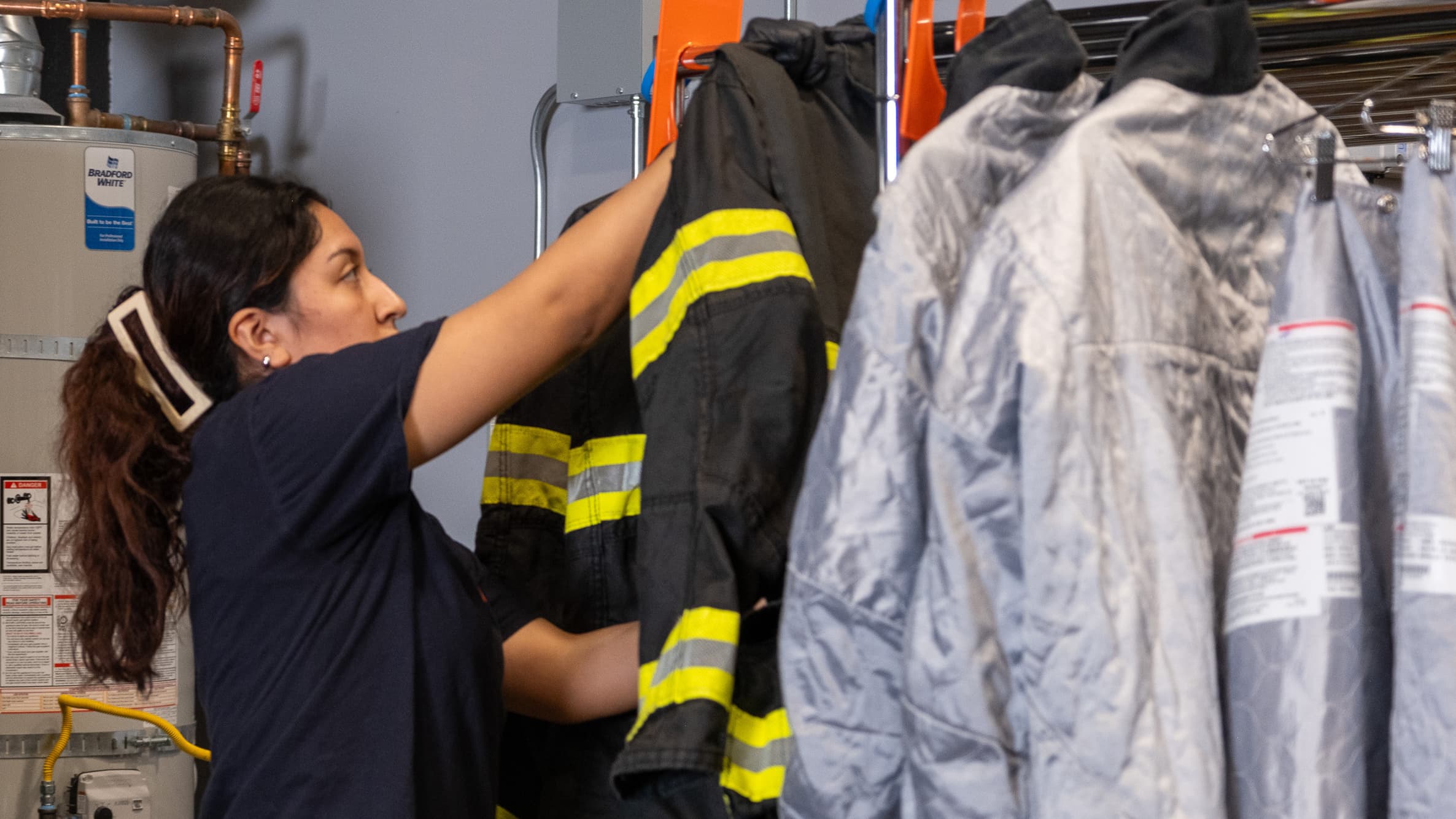
Firefighter health and safety start with proper PPE management. Under NFPA 1850, PPE needs advanced cleaning at least once every six months, and any time it has been exposed to products of combustion.
The new NFPA 1850 standards help improve safety through:
● Contamination reduction: Reduced exposure protects firefighters from a variety of contaminants encountered on the fireground
● Better decision-making: Improved documentation and accountability around inspection, repair and retirement strengthen PPE policies
● Department compliance: Clarified roles and responsibilities create one program and establish more efficient procedures for departments
In summary, NFPA 1850 treats cleaning as a critical part of the PPE life cycle, not just a maintenance task. It mandates regular, high‑temperature, water‑quality‑controlled cleaning, pre‑issue washing, contaminant removal verification, and clear documentation to protect firefighter health and ensure gear performance.
CO₂ Cleaning Exceeds Safety Standards
For years, firefighters have used soap and water to clean their gear. These traditional washes are inexpensive and easy to do, but they don’t completely remove carcinogens trapped in soiled gear.
That’s where supercritical CO2 cleaning comes in.
Invented by NASA and perfected by Decontex, supercritical CO₂ technology fully decontaminates protective gear. Supercritical CO₂ is another state of matter — it’s not a distinct solid, liquid or gas — but rather, a fluid with properties between a gas and a liquid. In this hybrid state, the CO₂ can fully penetrate fabrics (like a gas) and dissolve contaminants (like a liquid).
This award-winning technology is the most advanced gear cleaning on the market. It exceeds all NFPA 1850 standards and leaves turnout gear cleaner than it’s ever been.
Independent testing has verified that supercritical CO2 cleaning removes:
● 100% of polycyclic aromatic hydrocarbons (PAHs) and volatile organic compounds (VOCs) from all PPE layers
● 100% of stains and odors from protective gear
● > 99% of heavy metals from outer shell materials
The process is also fast and eco-friendly:
● It takes just 45 minutes from start to finish, so gear can be returned sooner.
● It uses no water or harmful chemicals and all contaminants are properly disposed of.
● It runs at low temperatures with minimal agitation, which helps preserve protective gear.
To date, Decontex’s supercritical CO₂ technology has been used to clean more than one million pieces of PPE worldwide.
Long-term Health is Defined After the Call
LION TotalCare is partnering with Decontex to deliver its next-generation supercritical CO₂ care to more departments. Over the coming months, LION will deploy supercritical CO2 machines across its facilities, expanding access to departments nationwide.
“We are constantly seeking ways to improve how we serve our customers,” said Tom Rose, Senior Vice President of LION Safety Solutions. “That means developing and delivering the best technologies available and deploying them in ways that make our solutions safer, more sustainable and more effective. This partnership allows us to do exactly that — combining advanced innovation with the trusted expertise and support our fire service customers rely on.”
LION Total Care is a full-service PPE maintenance partner helping fire departments keep turnout gear cleaner, safer and performing at its best. It offers the industry's most advanced cleaning technologies — plus expert inspections and repairs — to departments of all sizes.