Until Everyone Goes Home: Turning Honor into Action
A memorial weekend.
The NFFF expands its mission by empowering firefighters to learn, lead, and reduce preventable tragedies
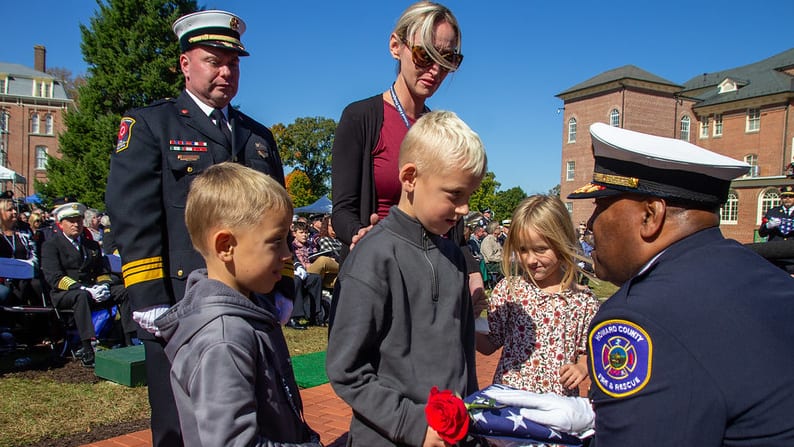
When you hear National Fallen Firefighters Foundation, your mind probably goes straight to the memorial in Emmitsburg, Md., visualizing rows of honor guards, the sound of bagpipes, and families holding onto each other as names are read aloud. That work matters. Honoring the nation\u2019s fallen firefighters and providing support for their families are the NFFF\u2019s greatest responsibilities and honor. But the mission doesn\u2019t end there, and in many respects, that\u2019s where it begins.
Behind the ceremonies and remembrance is an additional, equally important commitment, and one that doesn\u2019t always make headlines: ensuring fewer names are added in the future. At the NFFF, that commitment is captured in a simple but powerful phrase: \u201cUntil Everyone Goes Home.\u201d It\u2019s not just something we say. It\u2019s something we are still striving to achieve.
Some line-of-duty deaths are unavoidable. But not all of them. Firefighting is dangerous and sometimes things go horribly wrong. We\u2019ve all read the reports, stood in formation, and told ourselves, \u201cThat wouldn\u2019t happen here.\u201d And yet, the same patterns show up again and again: risk without purpose, communication breakdowns, cultural blind spots, and leadership gaps that go unaddressed until it\u2019s too late. \u201cUntil Everyone Goes Home\u201d only means something if we\u2019re willing to confront that truth.
Reframing Prevention Through Culture
Prevention doesn\u2019t fail because we lack information. It fails because we struggle to change behavior. This is where the main effort lies, and where the NFFF Fire Service Programs has concentrated its work.
The NFFF\u2019s in-person training doesn\u2019t look or feel like traditional fire service education. There\u2019s no checklist to memorize or new piece of equipment to master. Instead, it dives deeper. Why do we take the risks we take? Why do we stay silent when something feels off? Why do we accept behavior we know violates best practice? And, how can we approach this subject differently?
Programs like NFFF Staff Rides take firefighters back to the scenes of line-of-duty deaths, not to relive them, but to learn from them. Participants walk step-by-step through decision points, human factors, and the moments where different choices may have changed the outcome. Staff rides are not critiques of the event. We have the benefit of hindsight. It\u2019s not about second-guessing. We simply hear the story from those closest to it.
Advocate fellows attend their graduation.
Learning That Sticks: Emotion, Ownership, and Shared Responsibility
It\u2019s about learning in a way that captures the emotion of the event, which is so essential for impactful learning. Because \u201cUntil Everyone Goes Home\u201d isn\u2019t achieved through words; it\u2019s achieved through learning and application.
The Stronger Together \u2013 Wildland Firefighter Safety and Preparedness Workshop builds on that same idea, bringing the community, departments, and varying disciplines together to confront the realities of wildfire events. It emphasizes shared responsibility for mitigation and response planning. Through awareness and ownership, implementation has a higher probability of success.
Not everyone can attend an in-person program, and the NFFF recognizes that. That\u2019s why the Fire Hero Learning Network (FHLN) exists. It\u2019s not just another online platform to click through and forget. It\u2019s a growing library of real conversations about leadership, behavioral health, decision-making, and the human factors that often determine outcomes long before the first line is stretched. Because \u201cUntil Everyone Goes Home\u201d isn\u2019t just about tactics, it\u2019s about people. Add facilitated workshops and video-based learning, and the strategy becomes clear: meet firefighters where they are, in formats they\u2019ll actually engage with. Because if the message doesn\u2019t land, it doesn\u2019t matter how good it is.
What distinguishes the mission and gives it its strength is the way it is carried out. Nearly all outreach is led by firefighters and fire service stakeholders themselves \u2013 NFFF advocates and fellows who volunteer their time for the cause. These individuals deliver training sessions, facilitate discussions, and attend conferences to promote the NFFF mission. Their work extends to visiting neighboring departments and entering spaces where they may encounter resistance to change or challenge long-standing beliefs.
A notable feature of their service is it frequently occurs without acknowledgment, publicity, or compensation. What inspires them is an authentic dedication to a cause beyond themselves. Their guiding principle, \u201cUntil Everyone Goes Home,\u201d carries significant weight, especially since individuals share it with direct experience in the fire service.
Building Leaders Who Carry the Mission Beyond the Fireground
To sustain and expand this effort, the NFFF invests in its fellowship program, developing emerging leaders who can carry this message beyond the firehouse. Fellows are equipped to communicate not only with their peers but also with policymakers, community leaders, and decision-makers who influence funding, legislation, and priorities. They learn how to translate the realities of the job into language that resonates outside the fire service, ensuring that firefighter survivability and quality of life remain part of broader conversations. Because if we\u2019re not part of those conversations, someone else will be, who may not necessarily understand what\u2019s at stake.
Today, more than 300 NFFF advocates are active across all 50 states. That sounds impressive until you compare it to the size of the fire service. There are approximately 1.2 million firefighters nationwide. Three hundred advocates is a solid foundation, but it barely scratches the surface of what\u2019s needed to drive meaningful cultural change. Behaviors don\u2019t change because a program exists. They change because enough people decide it matters. Enough people speak up. Enough people model something different. If \u201cUntil Everyone Goes Home\u201d is going to be more than a phrase, it will take more than 300 firefighters to carry it forward.
If you believe that preventable firefighter LODD can be reduced, then consider getting involved. You don\u2019t have to overhaul your department or become a national speaker, but decide whether to engage. That might mean attending a Staff Ride, hosting a Stronger Together workshop, using the FHLN with intention, or stepping up as an advocate and carrying the message. \u201cUntil Everyone Goes Home\u201d isn\u2019t someone else\u2019s responsibility; it rests with us all.
\u2018The Most Sincere Way to Honor the Fallen Isn\u2019t Just to Remember Them, It\u2019s to Change What We Do Because of Them\u2019
We will always honor our fallen heroes and provide for their families. We will stand in formation, ring the bell, and say their names. But if that\u2019s where it ends, we\u2019re missing the point. The most sincere way to honor the fallen isn\u2019t just to remember them, it\u2019s to change what we do because of them. To lead differently, to speak up sooner, to refuse unnecessary risk, and to take ownership of the culture we pass on to the next generation. That\u2019s what \u201cUntil Everyone Goes Home\u201d demands. And that\u2019s the part of the NFFF mission that doesn\u2019t always make headlines but might matter most.
To learn more about how you can get involved with the NFFF to reduce preventable LODD and injuries, contact Danny Kistner at dkistner@firehero.org or John Kane at jkane@firehero.org.
Chief/Dr. Daniel T. Kistner, DLS, is the director of fire service programs for the National Fallen Firefighters Foundation (NFFF). He has 40 years of experience with the Texas fire service, including 14 years as fire chief between the McKinney and Lufkin Fire Departments. He holds a Doctor of Liberal Studies from Southern Methodist University, an MS in Fire and Emergency Management Administration from Oklahoma State University, and a BS in Fire Service Administration from Western Oregon University.