‘We Have Time’ — The Lie We Tell Ourselves
… and becoming Five-Minute Firefighters
You’re sitting down at the station. Maybe you’re in the middle of enjoying your first meal of the day. Perched at the kitchen table with a fresh hot cup of coffee, catching bits of the weather report in between your buddy’s sarcastic one-liners. Maybe your mind is consumed with what’s going on at home with something that you can’t shake — a fight you had with your wife, a project you’re in the middle of completing, financial stress, car trouble, or your kid’s science project coming up – you had made a promise to help with which you absolutely can’t break.
Only now possible conflicts with the schedule are lingering over your head like the dark shadow of a storm cloud on the brink of a downpour with disappointment. Maybe you’re focused on tribulations at work – an assignment or report needing to be finished. Dwelling on the side effects of a personnel issue that has caused low morale. Maybe you had a conflict with your officer, or you’re thinking about next month’s training and your to-do list that you’ve been procrastinating between calls and daily duties. Maybe you’re not dwelling on much at all and are simply taking advantage of a peaceful moment … for once.
Then, in the common fashion of convenience at which they bring, the tones drop. But not just those tones. This time it’s THOSE tones.
You now have 80 seconds to be downstairs and in your gear. A minute and a half to roll out the door. Notes are coming in as you’re donning your turnouts and your SCBA — your lifelines to survival. Your mind is trying to process a million objectives at once. The adrenaline has kicked in to raise your heart rate, and scrambling through the station didn’t help. You’re absorbing the words coming in from dispatch and trying to slow the physiological jolts within yourself to a manageable state. All the while, ensuring your gear is free of any wrongdoings from the pesky fire gremlins intent on throwing a kink in your procedure. Your procedure is aimed at preparing to step off the truck and straight into an environment where consequences can kill you, your crew, or the people who are dependent on you.
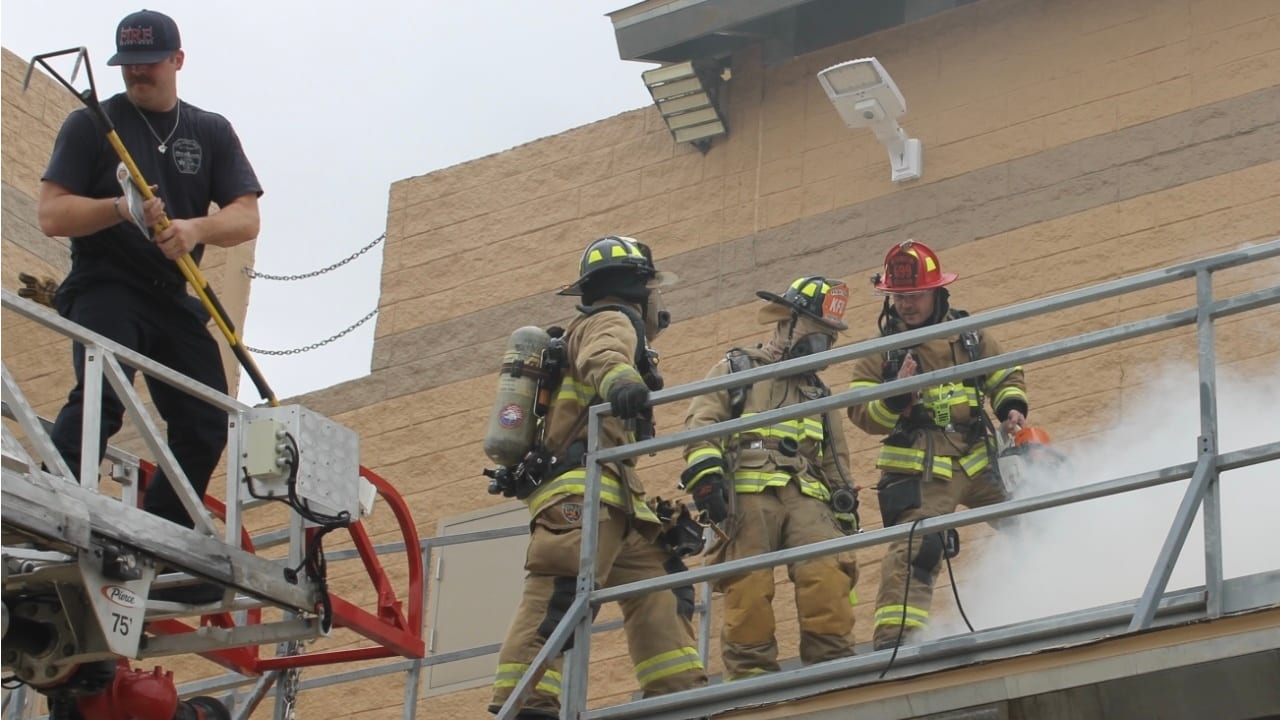
Lt. Nic Campbell of Katy Fire Department in Katy, Texas.
When you’re face to face with an unknown situation that is unpredictably changing with each passing second, this is not the time to be inadequate. New information is likely thrown at you either by a frantic parent, spouse, or an interjecting onlooker. The time-consuming shock of hindrance in your decision making is not welcome here. In fact, there’s no time at all. You now have exactly zero time to make up for your shortcomings at this point.
Congratulations and welcome to the stinging regret brought to you by reality. The bleeding wound — your lack of preparation — has been lingering in the back of your mind on a daily basis, repeatedly covered with a cheap Band-Aid that says: I’ll be fine. That won’t ever happen to me. We don’t make many fires anyway. Rarely is there actually someone inside needing to be saved. I won’t ever be involved in a mayday. I won’t ever be deployed on RIT. I don’t need to train today. It’s too hot. It’s too cold. It’s raining. I don’t feel like working out today. I don’t feel like getting in my gear.
That Band-Aid, ripped off when you’re standing face-to-face with a puking fire and occupants unaccounted for. Face to face with an entrapment among a mangled heap of cars that resemble more of an abstract sculpture than (once) vehicles. Face-to-face with any other dire and extremely critical situation we may find ourselves confronting. In that moment, directly preceding the initial gaze from taking it all in, absorbing the elements among the scene, you’re expected to perform like a pro quarterback in a bowl game with a doctorate degree and the correct answers to all of life’s questions.
But wait, there’s more! To top off the pressure from those public expectations, let it sink in that no one else is coming to fill your spot or do your job for you. Even with consideration of the roster on your initial box card and the presumption that the rest of the boys are on the way to help, when a life hangs on your hands as the initial arriving company, the seconds within an IDLH environment convert to years of damage. As quick as one breath away from death. there’s no time to wait. you’re obligated to be a part of a team and expected to contribute effective actions towards completing your assigned task. Even more consequential, maybe you hold the heavy weight of being responsible for leading that team, assigned or assumed of an initial task.
As professionals, what we need to do is create a foundation and a culture of training that allows us to confidently and genuinely say to ourselves: We in fact HAVE time.
We have time because I know where this building is located that I’ve been dispatched to.
I have time because I set my gear up effectively and checked my equipment this morning — even though it’s Day 2 on tour.
I have time because last tour, I trained on forcible entry on this type of door, on this type of structure. I practiced it until it became muscle memory.
I have time because I know I will move faster than anyone else on this fireground. Because I ran 3 miles in the gym and ate with intention today.
I have time because to me, one training evolution of VEIS just doesn’t cut it.
I have time because I recognize the stage of fire based on arriving conditions and how to read the smoke.
I have time because I know how long this home will burn based on its age or era of construction.
I have time because I am a student of my craft.
I have time because I trained to expect the unexpected.
I have time because I trained to adapt — every time I came into work.
Every second we shave off through efficiency adds up and the sum of those seconds can become our determining factors at success. We can create our own time — but that time is created within our moments of preparation with accurate and thorough training. Before the tones drop. Before we get bunked up. Before we step off the apparatus. Before we give in to the alluring temptation of comfort and the ease at which complacency can be disguised. The normalization of deviance, seeping into the firehouse like water slowly oozing under the bay doors during a heavy rain.
They say the first five minutes often dictate whether an incident will be controlled or chaotic. In that case, owning those first five minutes are what we should be honing in our thinking towards, every time we train. In regards to this notion mixed with a concept of time; we must become the masters of this window as what I like to call “Five-minute Firefighters.”
To become master Five-Minute Firefighters, we must be confident in our decision-making upon arrival. This is the most vital first step within those first five minutes. Development of that level of confidence can only come from expecting and preparing for the worst possible scenario. I’ve often repeated the saying that we should never expect to rise to the occasion, but plan on falling back on our last level of training instead. When we arrive, we must contain the capability to quickly adapt and customize our stored knowledge and apply it effectively toward mitigating the situation. When you boil it down, we are amplified problem solvers. We are fixers of critical faults with detrimental side effects. We show up to a problem and we are expected to solve it — using only the tools and knowledge we have to assemble the pieces of the puzzle and create a tangible resolution. If you think about it, if we are successful in the immediate application of this concept, and the work and effort is seasoned to perfection, when carried out within the first five minutes, the rest of the incident is basically glorified manual labor.
So how do we do this?
We must think outside the box with our training and be persistent, creative, and thorough. If the goal is to perfect the first five minutes of a fire, then our training must revolve around what takes place within those first five minutes. Not just from the perspective of the much admired and desirous back seat nozzle jockey, but develop evolutions that aim at a rotation of involvement among every position.
Practice delivering clear, accurate, and concise arrival reports, establishing command. Run size-up scenarios. Utilize technology through simulators and the application of cutting-edge tools or equipment. Get out of the firehouse and drive your district, practicing initial reports. Listen to yourself on a talk-around channel, a recording, or have an experienced officer or senior firefighter tune in and provide feedback. Perform real 360s and look for real life hazards.
Develop muscle memory of using your TIC during 360s to help locate the seat from the exterior. For example, on my shift, when we were developing an EO to ride-up in an officer capacity, we called a couple of firefighters from our department who lived within our district. We asked permission to visit their houses and use their properties as if we were arriving to a working fire. We would show up in staggered order and have that EO give an initial report based on context clues provided. Then he would perform a real 360, taking note of any real-life considerations. As companies arrived, he would relay his IAP and assign tasks. The firefighters of the different companies were then quizzed about their assignments and the steps they would take in completing this assignment. This conversation then led to all sorts of subjects and questions over fire behavior, building construction, tactics, etc. We turned it into a training that everyone could benefit from. We drove around and repeated this at multiple locations and we found the training was much more effective rather than looking at images on a screen from a desk.
Have the firefighters pull a line around houses under construction after the lot is vacant of workers for the day. Plan on real life obstacles like vehicles, trees, fences, gates, steps, porches, attachments, etc. Pull the lines in all sorts of imperfect conditions. Take the time to set up obstacles to work around on your training ground every time you pull hose.
Practice showing up to various lengths of set-backs and enticing on-the-spot critical thinking through long distance extension options or apartment lays. Have your E/Os, drivers, chauffeurs, and engineers practice apparatus placement in different environments with various limitations. Have them empty the pumper of the typical tools they would need to deploy during the first five minutes of a fire. Be creative with your scenarios and diversify your buildings.
We began to include background ambient noise from either generic fireground tracks online or even radio traffic from LODD incidents for our mayday scenarios. Although the LODD traffic may be emotionally jarring or difficult to hear, it adds a level of realism and intensity that are both impactful and drive home the seriousness as to why we are training in the capacity at which we are. Training is your time to experiment, so do it. Being innovative and opening the floor up to ideas also promotes buy-in from your people.
On a live incident, everyone should be conducting their own size-up mentally, even if it’s not your role to take command or transmit information over the radio. Firefighters must develop a foundation of knowledge that allows them to assess a situation and anticipate the likely next step as a member of a multi-company team. Experienced firefighters can predict their potential assignments based on their type of company and sequence of arrival combined with their perception of the momentum of the situation based on physical conditions. Naturally often making a mental list of their personal objectives within that potential assignment in order to achieve completion with notable efficiency as a contributing member. So, carry these aspects over to your training scenarios. Treat them with the level of seriousness, accuracy, and detail as you would on an active scene.
In relation to a company officer’s obligations specifically, exercise decision-making objectives until you know them by heart and the assigning procedures revolving around your IAP become as natural as breathing. Once you’re confident in your initial size-ups, 360 reports, and your radio traffic is calm, cool, and collected, circle back to refining your IAPs or possibly even expanding them as an incident is prompted to change. Think ahead. Imagine the bigger picture and consider who you could have showing up behind you for proactive assignments, but don’t become reliant on them as expected resources invulnerable to changes. Be proactive in your involvement — not just within your participation as a current or active officer, but involve anyone in training who could potentially be placed in that leadership role.
Lt. Nic Campbell at work.
As the initial incident commander, you need to think several moves ahead — setting the incident up for success before other companies even arrive. Assign companies with clear and efficient intent based on what the fire is doing or what it could do — not just theoretically, but geographically and task-specific.
Consider first arriving officers like coaches who also come off the sidelines to play in the big game. You have to see the bigger picture and be able to pick up on the signs that the situation is hinting at you. I like to think of this as playing chess. You use your pieces tactically, considering future possibilities both offensively and defensively. Make no mistake: the fire is fighting back, naturally and without remorse. However, before you can move those pieces effectively, you must be aware of their capabilities. You must also have the vision to comprehend the habitual traits and nature of your enemy.
Regarding your assets, gain familiarity not only with your department’s capabilities, but of those beyond your house with your mutual aid departments, as well. Who is on your initial box card and what are those companies capable of? What kind of reputation do they maintain? Are they career, combination or perhaps fully volunteer? Are they rescue, engine, truck, or tanker companies?
If it’s an aerial company, what type of ladder truck is it? How many do they typically staff on an apparatus? Does that department use the same SCBAs as we do? What type of hose lay do they practice? Make some sort of an effort to gain this type of information. Not only does it help you become familiar with the assets you could potentially be working with (your chess pieces), but it can develop positive relationships in the process. Relationships and familiarity that can become useful in aiding or boosting the cohesiveness between teams on the fireground. In return, influencing communication and efficiency and … making up for lost time.
In regards to the enemy in which you’re engaging, its volatile nature can’t be simulated to its full potential, so the desire for maximum realism within your preparation will never be fulfilled. We can supplement by being thorough in our research from a safe vantage point, which is before the tones even drop. Becoming a student of our enemy and an amateur scientist intent on gaining a degree in swift extinguishment is vital yet often disregarded. Additionally, the potential level of effectiveness is underwhelmingly underestimated.
Although, when compared to other analogies, the necessity for this proactively studious behavior becomes clear and obvious. For instance, when we go to war, we don’t just show up and pick a fight. We study how the enemy thinks and how they function. We identify weaknesses. We learn the terrain and how to use it to our advantage. We train in similar environments. We train with our equipment and firearms until they become an extension of us. We train to outthink the enemy — and to adapt when plans fail or weapons malfunction.
There’s little difference here. The only distinction is that a human enemy is capable of fear or remorse. Fire is not. It has no hesitation, no fear, and no mercy. Neither do any other critical scenarios we face. Murphy’s Law does not have a face nor does it care about you and your patient or victim. Because of that, preparation through training must also be targeted to reduce the natural human disadvantages we carry. Ego can’t override intelligence and a lingering fear of being wrong can’t paralyze decision-making. Often, a wrong decision that can be adjusted is better than no decision at all — because indecision is a guaranteed loss, especially when time serves as a major altering factor. Training is where mistakes belong. Place yourself and your crew in stressful decision-making environments until confidence and familiarity develop. In a controlled setting, you can identify what went right and correct what went wrong. As a result, this will build momentum, gain competency, and create time.
Simultaneously, ego-driven aggression without tactful thinking is just as dangerous and can create mistakes that take effort and time we don’t have to fix. If your goal is to look tough or chase your desire for destruction without purpose, you endanger yourself and others. The balance we seek is to become aggressive firefighters who act with discipline. Tactical thought with a broader perspective and overall goal in mind. Like trained wolves looking down from mountain tops at their hunting ground, ready to attack with planned precision and accuracy.
In short, preparation through thorough and divisive training is the key to controlling those first five minutes. Create your own time through becoming more efficient within your tasks by being a student of our craft. Turn the lie we tell ourselves into truth through perseverance.
Train to become an aggressive Five-Minute Firefighter and a thinking firefighter — because when it matters most, that mindset becomes an asset capable of contributing towards winning the battle. Do whatever is necessary to prevent placing yourself in a situation where you’re stepping off that apparatus and realizing, it’s too late. Too late to tell yourself “We have time.”
Lt. Nic Campbell is a Texas‑born fire service leader with a career spanning Sisterdale Fire Department and eight years with the Katy Fire Department. He has held every rank to lieutenant and currently serves as interim captain. Trained through TEEX, the National Fire Academy, and CFT, he developed a new Orientation and Probationary Training Program and established a Training Team. Campbell values the history and traditions of the fire service and is committed to mentoring the next generation. He is a husband to Rheanna and father to daughters Kennedy, Alyssa, and Arianna. Selected Awards: Firefighter of the Year (2017, 2019), Rookie of the Year (2019), Mayor’s Commendation (2021), Houston Firefighter of the Year (2022), Medal of Valor (2022), Engineer of the Year (2023), Fire Chief’s Award (2024).