By Ed Lippie
Human physical evolution was optimized to perform an array of survival tasks, including gripping and carrying things. If you had to identify a human physical superpower, it would probably be the ability to carry heavy things over long distances. That is likely why grip strength is still highly correlated with longevity and quality of life. Yet, for various reasons, as a species, we are losing our grip on functional strength and good health (pun intended).
Studies have found that since 1985, American men between the ages of 20 and 24 have had an average right-handed grip strength of 121 lbs and left-handed grip strength of 105. Today, those numbers have slipped to 101 and 99, respectively. American women have fared slightly better but still registered significant losses in the same studies.
Why does this matter? Grip strength is highly correlated with robust health and longevity because grip strength is more than just the strength of your fingers and forearms. Grip involves many of the upper body’s muscles, making it a perfect proxy for overall upper body strength. A weak grip also makes us more susceptible to conditions like tennis and/or golfers’ elbows and diminishes our ability to break falls as we age.
The strength of your grip is differentiated by several qualities. Here are those qualities, along with examples of exercises that address each specific dimension of grip strength.
Crushing strength is how strongly you can grip with your fingers and palm.
Exercise: Hex Head DB Hold – Select a weight with a hexagon head dumbbell you can hold for at least 20 seconds with notable fatigue in the last 5-10 seconds. Work your way up to 30 seconds with increasing amounts of weight. Typical starting weights are between 10-25lbs depending on your starting strength.
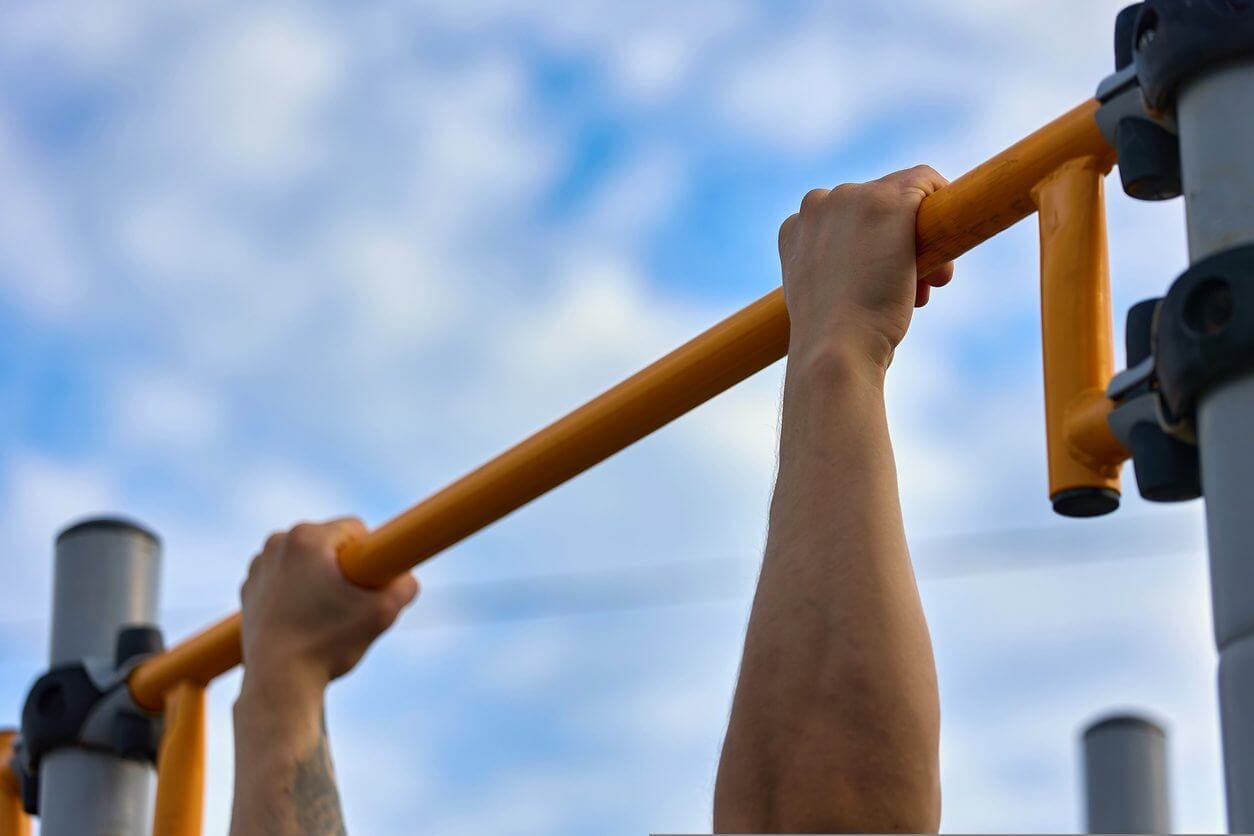
Supporting strength refers to your ability to hold onto or hang from something.
Exercise: Dead Hang – Simply hang from a chin-up bar or other sturdy structure with your hands slightly wider than shoulder width. Start with three sets of 10 seconds during upper body workouts and work your way up to as long as possible to reach two minutes (this is very hard to achieve). I would also test your max dead hang once per quarter. This is more challenging than most people think.
Pinching strength refers to how firmly you can pinch something between your fingers and thumb.
Exercise: Plate Pinch – Similar to the Hex Head DB Hold, select a plate weight you can hold for at least 20 seconds, working your way up to 30 seconds before selecting a heavier weight. Try holding two plates, a 25 and a 10, in one hand. This increases the degree of difficulty by the added weight, and the force required to keep the plates together adds to the pinching strength difficulty. I recommend using rubber bumper plates when available for the improved grip and the deadening effect of the rubber if you drop them.
Additional exercises include:
Farmer’s Carry: Walking with dumbbells or kettlebells works well for Farmer’s Carry. For a starting load, I would shoot for a quarter of your weight in each hand and carry for at least 30 seconds per set. The goal should be to carry 50% of your body weight in each hand for at least 30 seconds.
Kettlebell Waiter’s Walk – The objective is to invert the kettlebell into a bottom-up position and hold it at roughly shoulder height while keeping it upright, not letting it flop to one side or the other. When selecting weight error on the light side with this exercise.
Integrating a few grip exercises per week will go a long way in improving your grip strength and quality of life.