
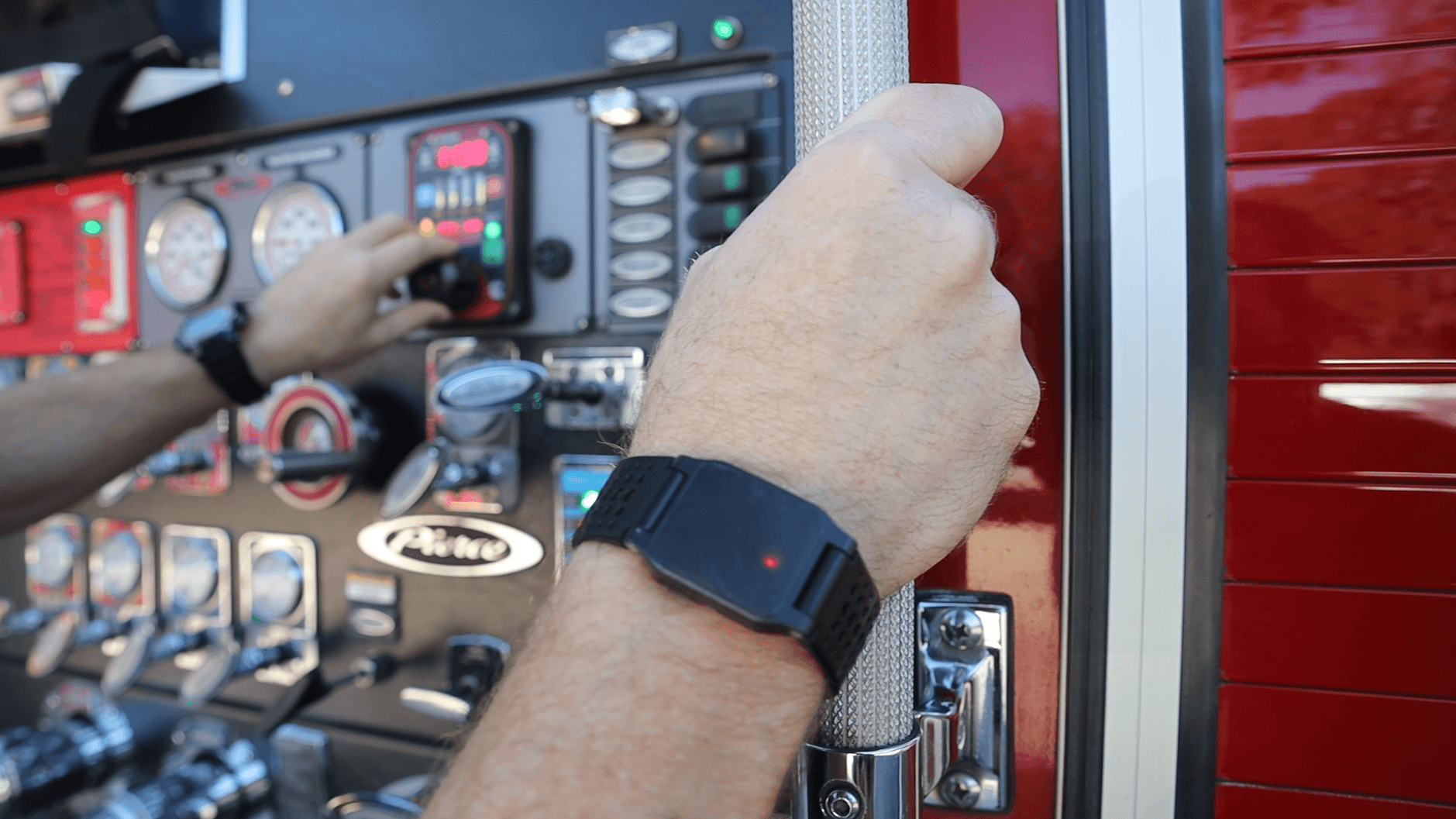
EaseAlert is a discreet, wrist-based alerting system that replaces traditional tones with vibration-based notifications, reducing stress and improving response times for firefighters.
A helmet. A coat. A radio. A hose line. For generations, these pieces of equipment have defined operational readiness on the fireground. But gear is evolving fast.
There’s a new category showing up on more wrists, charging in fire departments, and quietly enhancing firefighter safety: the wearable.
Not long ago, smartwatches and biometric bands were seen as fitness gimmicks. Today, they’re becoming commonplace PPE tools that protect, connect, and inform in ways that turnout gear never could.
From Novelty to Necessity
If you’ve been around long enough, you’ve seen the tech resistance cycle. It happened with thermal imaging cameras. It happened with drones. At first, people rolled their eyes. Then prices dropped. Interfaces improved. Capabilities exploded. And suddenly, not having one became a bigger risk.
Drones are now standard tools in hazmat, wildland, and search operations. Wearables are following the same trajectory.
They’re lighter. Smarter. Cheaper. Easier to use. And they’re already delivering measurable value on real firegrounds, in real stations, with real crews.
Real Tools With Real Results
Across the country, wearable tech is showing up on wrists, reducing risk, and giving crews and command teams the kind of insight that changes outcomes. Here are a few tangible examples from the field:
West Metro Fire (CO) – Smarter Recovery with WHOOP
At West Metro Fire, crews are using WHOOP bands to track recovery, sleep, and exertion. It’s not about surveillance, it’s about awareness. Battalion Chief Mike Binney has been leading the charge and sees wearables not as a trend, but as a turning point:
“The fire service needs to start thinking of wearables as essential PPE. These tools are already proving their value, not just to risk management and wellness nerds, but to the individual firefighters wearing them. Earning buy-in takes time and transparent conversations, but when crews see the data is working for them, the trust starts to build. I believe this is where the job is headed if we’re serious about taking care of our own,” says Binney.
WHOOP is a low-profile, wrist-worn wearable designed to support firefighter recovery by tracking sleep, strain, and heart rate; empowering departments with better insight into crew readiness.
Indianapolis (IN) and Youngsville (NC) Fire – Real-Time Health and Location Intel with WearTAK
Departments in Indianapolis and Youngsville are using WearTAK from Ascent Integrated Tech, a TAK-connected smartwatch platform that streams heart rate and live location data directly to command staff during active scenes.
It’s a wrist-worn tool firefighters don’t have to think about, but one that gives leaders a clearer, faster read on what’s really happening in the heat of a call.
“First responders often leave phones in the truck, and for good reason,” says Charles Laird, Captain Youngsville Fire Department. “WearTAK on a Samsung Galaxy Smartwatch solves that with a wearable they won’t forget because it’s on their wrist. And it helps command keep them safer and get them back in the fight faster.”
For Indianapolis Fire, WearTAK’s value comes from its reliability and field readiness.
“The simplicity of WearTAK is what makes it so valuable. Once the watch is on, it just works. It pushes real-time health and location data into TAK, giving us operational insights we need to keep our first responders safe,” says Dale Rolfson, Chief Technology Officer, Indianapolis Fire.
WearTAK is a commercially available smartwatch solution that streams real-time health and location data directly into a digital common operating picture; enhancing situational awareness for command teams.
Dyess AFB and Sherman Fire (TX) – Less Stress and Faster Response with EaseAlert
At Dyess Air Force Base, Fire Chief Greg Ranard deployed EaseAlert, a wearable alerting system that replaces traditional tones with silent vibrations. The change was simple, but the impact was big:
“EaseAlert has lowered the stress and anxiety of all members and helped decrease aggregate response times to all calls,” says Chief Greg Ranard, Dyess AFB.
In Sherman, Tex., Fire Chief Billy Hartsfield echoed the same sentiment, and pointed to the deeper challenge of change in a tradition-bound profession:
“Technology is slow sometimes because of how rooted we are in tradition … but when something like EaseAlert comes along that can really improve the lives of the firefighters to make sure they’re better prepared to take care of the citizens when that call comes in, you’ve gotta be all in for it,” says Chief Billy Hartsfield, Sherman Fire Department.
These examples aren’t concepts or experiments.
They’re real deployments, improving readiness, reducing stress, and giving both crews and command an edge when it matters most.
Carrot vs. Stick
The phrase “carrot and stick” comes from the image of trying to move a stubborn mule, either by dangling a carrot in front of it or threatening it with a stick from behind. One promises reward while the other threatens punishment. Both aim to spark action.
In the fire service, we’ve seen plenty of sticks: top-down mandates, policy pressure, or the fear of liability. They might nudge behavior in the short term, but they rarely build buy-in for the long term. Real and lasting change comes from the bottom up. From firefighters seeing something useful and saying, “I actually want to use this.”
That’s where the carrot matters. The wearable becomes the carrot. It’s not a hassle or another checkbox. The wearable is something that makes the job easier, smarter, and safer. It gives me useful info, keeps my crew connected, and might even help me go home healthier at the end of the shift.
Change that lasts in the fire service doesn’t come from fear. It comes from showing people something that helps them, and letting them eat the carrot for themselves.
Why This Can’t Be Ignored
There’s always a temptation to write off tech as “not for us” until it makes a rough call go smoother, prevents a mayday, or saves a life.
However, wearables are doing that already.
Wearables are helping the command understand how their crews are doing and where they are.
Wearables are identifying early signs of overexertion before someone drops dead.
Wearables are reducing anxiety during wake-ups and shift changes.
Wearables are helping firefighters bounce back faster between shifts.
And most importantly … wearables doing it without getting in the way.
The Road Ahead
This isn’t about chasing the next shiny object. It’s about rethinking what protection really means beyond bunker gear and helmets. It’s time we recognize that a firefighter’s well-being includes what you can’t see: rising heart rate, mounting exertion, dwindling situational awareness.
That’s why wearables matter. They’re not a luxury but instead they’re the next layer of PPE.
Making wearables commonplace won’t happen overnight or by accident. It takes coordinated effort from all relevant stakeholders:
Vendors must stay grounded in reality to build tools that are simple, rugged, and plug in cleanly to what departments already use.
Firefighters must stay curious. These tools aren’t there to watch you but instead here to help you.
Fire Chiefs must stop saying no and consider saying maybe. Maybe it’s worth trying a pilot. Maybe this technology helps my team stay safer, sharper, and more supported. Maybe we can help shape the SOPs. Maybe instead of saying “no,” we just start with “maybe.”
“Maybe” is where innovation starts and maybe this is your sign to try a pilot of wearables, reach out to early adopters, and take a first step to embracing this next evolution of PPE.