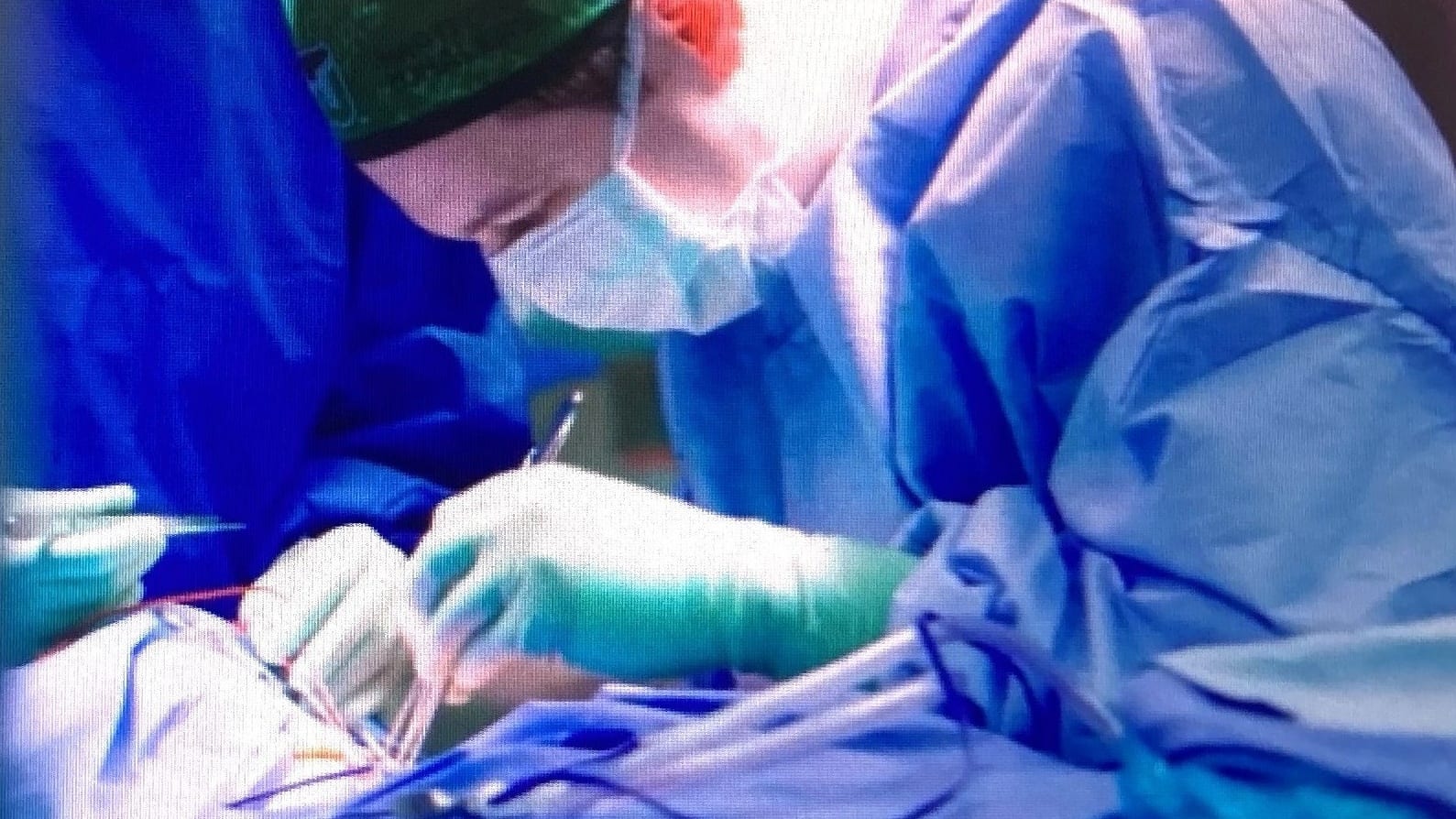
Dr. Christopher Conner performs surgery. Image by UConn Health
The Practice (Part 1 of a 5-part series)
It Feels Like A Miracle
Firefighter Anthony Pelliccio had a stroke in 2021. It left him paralyzed and unable to use his arm, drive, hold his grandson, and do daily life tasks. It was depressing. Then this year, Anthony found Dr. Christopher Conner, a trailblazing brain surgeon at the University of Connecticut’s Brain and Spine Institute and the Director of Functional and Epilepsy Neurosurgery. Dr. Conner was the first surgeon in Connecticut, and one of very few surgeons in America, to use a breakthrough implant technology for stroke patients called Vivistim® by MicroTransponder®, Inc.
Dr. Conner implanted the Vivistim device into Anthony’s upper chest (not unlike a pacemaker) during an out-patient procedure that now allows Anthony, and other stroke survivors, to super-charge rehab and regain enhanced function of their arms. Anthony’s recovery began with the FDA-approved surgical implant and six weeks of intense occupational and physical therapy. Anthony is now driving again and able to hold his grandson!
Stroke affects nearly 14 million people worldwide per year and can frequently produce loss of mobility. In the past, stroke survivors were offered limited treatment options allowing patients to regain some function with intensive rehabilitation therapy for the first few months after stroke. This recovery often plateaus, leaving patients with disabling challenges and feelings of extreme frustration, isolation and despair.
Implications for Firefighters: First Responders and Neuromodulation
“After fighting fires, black soot would come out of my nose for a week!”
– Firefighter, stroke survivor and neuromodulation recipient Anthony Pelliccio
Due to toxic exposures, firefighters are approximately three times more susceptible to strokes than the public. Firefighters and other first responders are exposed to the same toxins at fire and explosion scenes as veterans. They are developing some of the same illnesses as veterans, e.g. strokes, Parkinson’s disease, spinal cord injuries, epilepsy, intractable pain, phantom limb loss pain, severe tinnitus, post-traumatic stress and traumatic brain injuries, at significantly higher rates and at younger ages than the public.
Hope for The Future
“Neuromodulation is a revolutionary treatment option for patients who previously have had little to no hope for improvement. It is also a testament to the commitment of our world-class neurosurgery program in the Brain and Spine Institute that we will provide care second to none and continue to shape the future of treatment,” says Dr. Ketan Bulsara, Chief of the Division of Neurosurgery at UConn Health Brain and Spine Institute.
In this five-part monthly series, you will learn about functional neuromodulation treatments available to firefighters beyond just stroke treatments. Research is focusing on advancing neurological treatment for post-traumatic stress, traumatic brain injuries, rheumatoid arthritis and gastric diseases, such as Crohn’s disease, irritable bowel syndrome, multiple sclerosis and other conditions. In each case, the gift of “quality of life” allows our heroes to regain function, independence and dignity.
How It All Started: Outreach from Veterans to Firefighters
Veteran Jake was wounded in combat by a rocket-propelled grenade while deployed in Afghanistan. He suffered from multiple serious medical problems, including intractable pain. No medical interventions were working and he couldn’t tolerate his pain any longer. Jake told a volunteer trauma specialist that he was going to kill himself.
She immediately enlisted help from another trauma specialist, Veteran Sherri Vogt, and Dr. Subramani Seetharama. Together they saved Jake’s life and began a journey to help veterans, first responders and others. (Hear Jake’s “Soldier’s Story” at the 24-minute point in the video).
The Veterans with Disabilities Task Force Created
“Never doubt that a small group of thoughtful committed citizens can change the world.
Indeed, it is the only thing that ever has.”
– Margaret Mead
Humbled by the experience, and motivated to save more veterans’ lives, the three decided to reach out to gather a larger circle of community support. On Nov. 9, 2023, at the Connecticut State Capitol, the original three were joined by a Marine veteran physician, a hospital administrator and their legislative sponsor, State Representative Henry Genga. Together they launched the Veterans with Disabilities Task Force (VDTF).
The VDTF’s quarterly meetings are attended by military and veteran leadership and members, first responders, elected officials, private companies, non-profit organizations and citizens who want to help reduce the horrific rate of veteran suicide: 17.6 per day, according to a 2024 Veterans Administration report.
Enter Groundbreaking Neuromodulation Medicine
Neuromodulation technology now offers patients the chance to improve their stroke recovery and regain their lives even after significant time has passed.
As part of the VDTF’s efforts, Dr. Seetharama introduced his colleague, Dr. Christopher Conner, to the Task Force. Dr. Conner presented to VDTF twice, on Sept. 18, 2024, and Feb. 26, 2025, about the new trailblazing neuromodulation medical procedures designed to help reduce suffering and save lives. Immediately upon finishing his presentations on Feb. 26, 2025, a core group of Connecticut State representatives instantly said, “We want this for our veterans!” That day was a Wednesday, the legislation was written the following day and five days later members of VDTF and Dr. Conner were testifying at the Legislative Office Building on the importance of creating a National Neuromodulation Center of Excellence.
Simultaneously, the VDTF’s leaders educated its attendees on the correlation between toxic exposures from bomb blasts, burn pits, inhalants and contaminated water and many subsequent veterans’ illnesses that may now be treatable with these new neuromodulation procedures. (Hear Dr. Conner’s presentation on toxic exposures at about the 27-minute point of the video.)
$2 Million Secured
“This money will help disabled veterans get the care they’ve earned and deserve through their selfless service and sacrifice. The next step will be to help disabled firefighters.”
– State Representative Bill Heffernan, Retired Lieutenant, West Haven Fire Department
On June 4, 2025, nine months since Dr. Conner’s first presentation, the VDTF secured $2 million in State of Connecticut funding to create America’s, and the world’s, first Neuromodulation Center of Excellence (CoE) to offer neuromodulation procedures and follow-up rehabilitation therapies to veterans. Why? Because as of today, Veterans Administration hospitals do not offer functional neuromodulation stroke treatments. This funding will save lives and is just the beginning toward advancing research and solving other serious neurology problems that affect our heroes and the public, as well.
Listen to more:
- CT N TV – Hear Dr. Conner present on neuromodulation at approximately the 12-minute mark in this video
- CT N TV – Learn about the $2 million dollars secured in this video, and this video, as well
The Veterans with Disabilities Task Force is supported By Tails of Hope Foundation, Inc.