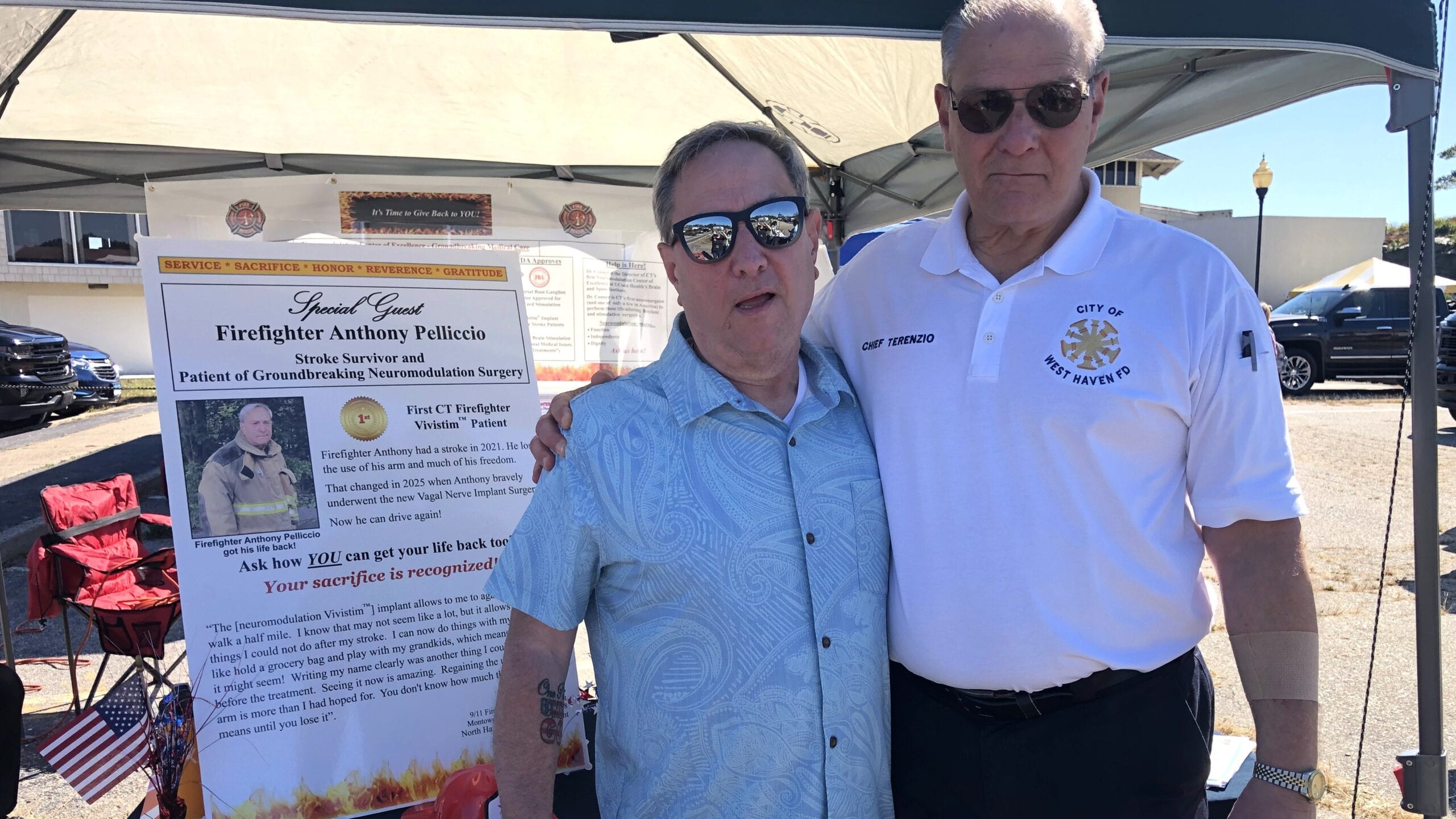
Firefighter and stroke survivor Anthony Pelliccio, left, with Michael Terenzio, Fire Chief at City of West Haven Fire Department-Allingtown. Photo by Veterans with Disabilities Task Force
The real-life story of firefighter Anthony Pelliccio surviving a stroke and then regaining function, independence, and dignity four years later because of neuromodulation treatment
Part 2 of a 5-part series
Read Part 1 here
Driven to Serve
When Anthony Pelliccio moved to North Haven, Conn., he was looking for community and purpose. He found both at The North Haven Montowese Volunteer Fire Department, where he signed up to serve shortly after arriving. “I don’t usually join something simply because other guys are doing it,” Anthony says. He volunteered because he believed he would make a meaningful impact.
For more than a decade, Anthony served the community with pride. Responding to late-night and early-morning calls, conducting meticulous inspections of equipment, and leading the unit through high-risk and unpredictable situations. His favorite part? Driving the truck. When he became foreman, Anthony was responsible for the engine, the crew, and decisions made in the moments that mattered most. The job taught him a simple but difficult truth: “You just go.” When the call comes, there is no room for fear or hesitation. “You say goodbye to your wife and daughter, and you get on that truck.”
Anthony’s leadership extended beyond emergency calls to times that fostered camaraderie and strengthened the wider North Haven community, as well. During the holiday season, the unit dressed in Santa costumes and drove the firetruck around town, delivering Christmas presents to local children. It was always a highlight of the year, and not just for the kids.
A Sudden Turning Point
Anthony’s days were full, balancing service, family, and hobbies, until the fall of 2021, when he suffered two strokes in quick succession. A blockage in a major artery in his neck broke loose and traveled to his brain, interrupting blood flow. Unfortunately, firefighters are at significantly increased risk of ischemic stroke. The profession demands irregular sleep and frequent exposure to smoke and heat, which cause chronic inflammation and ultimately leads to arterial plaque buildup. Over time, the cardiovascular strain firefighters experience can result in life-altering conditions.
After initial surgery and acute care, Anthony spent six weeks at the Gaylord Rehabilitation Hospital before starting intense outpatient rehab to try and recoup the functionality he lost. “He had aphasia and a lot of difficulty with the right side of his body. He couldn’t walk or talk, and had very limited movement in his arm and fingers,” shared Anthony’s wife, Susan. Rehab was a slow and very gradual process.
After suffering a stroke, Anthony Pelliccio completed 18 sessions of occupational therapy.
Photo courtesy of Susan Pelliccio
The Work of Recovery
Susan eventually came across an ad for Vivistim™, a cutting-edge implantable device that sends mild stimulation to the vagus nerve. The stimulation is accompanied by specialized rehabilitation exercises which help the brain strengthen motor pathways, improving recovery after a stroke.
Susan called Dr. Christopher Conner’s team at UConn Health, one of only a few medical centers in the world offering this advanced surgery and technology. As an early adopter of Vivistim, Dr. Conner is at the forefront of bringing this innovative opportunity to patients in Connecticut and beyond.
After speaking with Dr. Conner’s team, who were optimistic and straightforward in explaining the procedure, Susan and Anthony immediately felt hopeful and excited. Anthony became Dr. Conner’s patient and successfully had this groundbreaking surgery.
Treatment with the device proved significantly helpful for Anthony’s recovery. His progress was closely monitored throughout, and Dr. Conner’s team saw measurable improvements in a relatively short period of time.
Anthony completed 18 sessions of occupational therapy, which was a demanding commitment for him and his family. The work was challenging and at times exhausting, yet his evident pride in the progress made it clear the effort was worth it. Along the way, he found himself reflecting on just how closely his effort was tied to the technology supporting his recovery. “If I didn’t have this thing in me,” he says, referring to the device, “would I still have the power I do now?”
His occupational therapist, Rhonda, framed the device not as a replacement for Anthony’s innate strength but as a tool that helped him unlock the type of progress he had been working on for years.
When therapy got especially challenging, Anthony leaned on important lessons he learned in the service. “In firefighting, you go into a space where they just black out your eyes and you gotta find a way out the other side without seeing,” he explains. “I remember that when I’m in a space that’s tough for me.”
Living the Progress
One unexpected lesson to come out of this experience for Anthony has been a redefined relationship with rest. “I would never rest!” he says. “Before this, I couldn’t stop.” He was at the gym five days a week, always reading, and always on the move. He’s since become far more in tune with cues from his body — recognizing that slowing down and taking breaks is part of getting stronger, not a departure from it.
That strength continues to reveal itself. This holiday season, Anthony was able to shovel the driveway again. “That would have been impossible for him to do once upon a time,” Susan notes. He’s carrying more grocery bags each trip, reclaiming everyday tasks that once felt out of reach.
Most significantly, Anthony is back behind the wheel. Learning to drive again has been a process of patience and precision, focusing on the fundamentals and rebuilding muscle memory. “When you’re first going out, it’s like you’re 16 again,” he says. For now, he’s driving locally, and each short trip is a return to his independence and confidence.
Some of the most meaningful parts of recovery, however, have happened off the road. Anthony can finally lift his grandkids into his arms again, and their everyday moments have taken on a new sense of celebration. At home, the Vivistim device can be activated by the patient waving a small magnet over the implant. When Anthony’s grandson, Chase, saw him do it for the first time, he was fascinated. “It gives me superpowers!” Anthony told him. Chase didn’t hesitate to adopt the idea. The kids have turned it into a game, stealing the magnet and warning Anthony, “You’re in for it now, Grandpa!” What began as a tool for recovery has become part of their play, reflecting how recovery can fold quietly into normal life in unexpectedly joyful ways.
This project was started and is supported by the Veterans with Disabilities Task Force, whose primary goal is to support the health, dignity, and wellbeing of veterans with disabilities, including efforts to address the ongoing mental health crisis that contributes to an average of more than 17 deaths by suicide each day.