

A monthly column from the Health & Safety Leadership Alliance in partnership with CRACKYL

Workers’ compensation was built for a different injury than the one this job is going to hand you.
The model behind it is a single event with a date, a witness, and a cause. Something that happened at 10:14 on a Tuesday and fits in one sentence.
Almost nothing this career does to you looks like that.
The system was designed to do three things:
- Pay for treatment of a work-related injury without either side having to prove fault
- Replace part of your wages while you are off
- Close the file and put you back to work
That is the whole design. It was never built to notice a pattern, or to ask what else you have been carrying since your rookie year.
Here is where that design and this job come apart:
- Cumulative injury has no date. The system wants one anyway
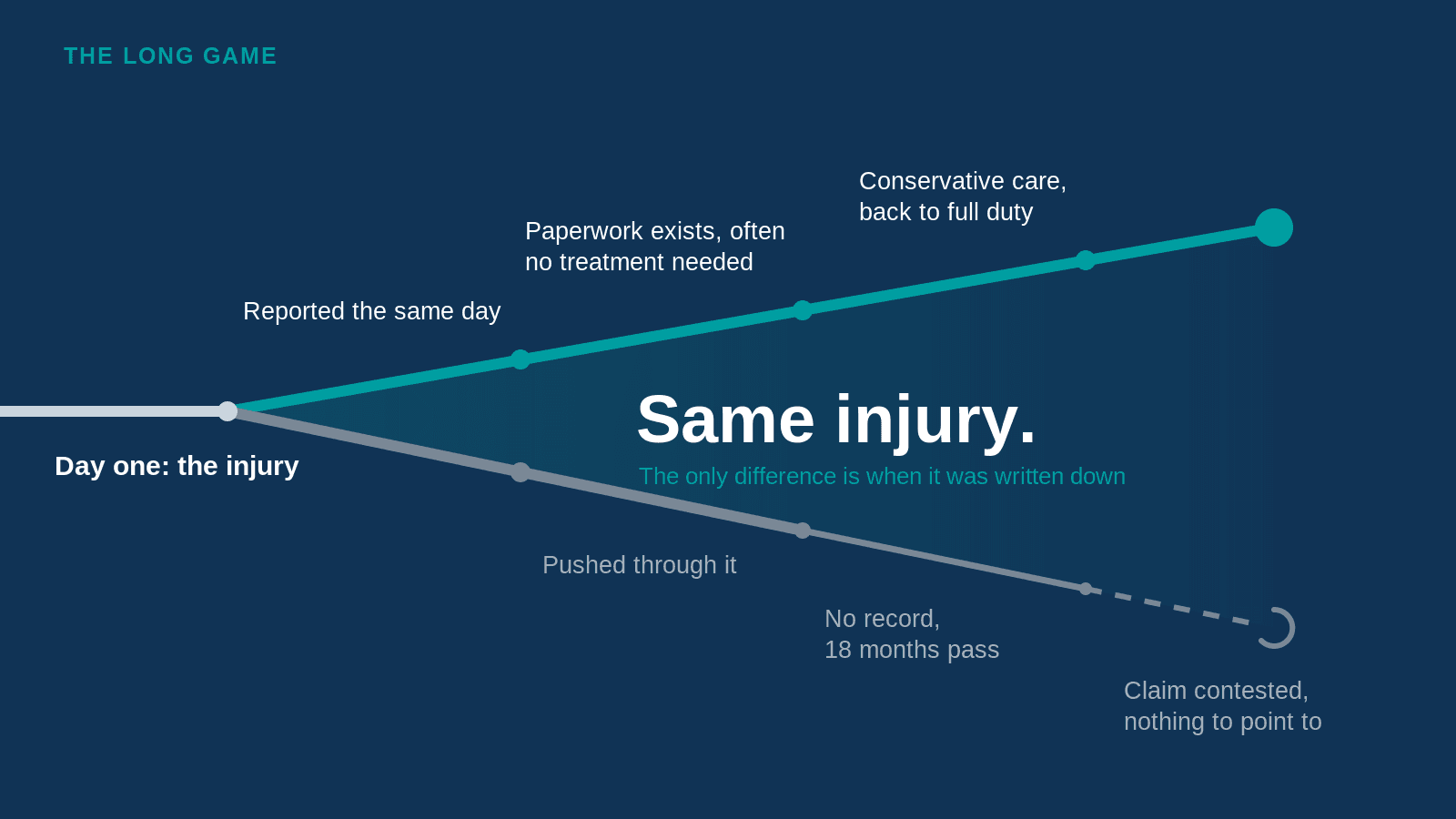
- The strain that cleared in a week and the strain that ended a career look identical in the record, because neither one was written down
- The first document in your file frames everything that follows it. A record created 18 months late has to argue against 18 months of silence
I was the health and safety officer at San Diego Fire-Rescue from 2017 until I retired. I built the program. Thirty-four integrated policies covering prevention, behavioral health, cancer, rehabilitation, and how our people moved through workers’ compensation.
I was never in the claims hearings. My side of it was working with our risk managers on a member’s behalf and building pathways so a member did not have to navigate the system alone. What that vantage point teaches you is timing. Over 10 years, with an increase of 184 full-time firefighter positions, our injury rate per firefighter fell from 32% to 24%, and annual claim counts held steady. When PTSD became presumptive and reported claims across the state jumped roughly 500%, ours did not climb proportionally. Not because our people got hurt less. Because access and coordinated care were already in place before the claim was.
None of that came from me knowing more medicine than the physicians. It came from finding the right experts and putting them in the same room. That is the method, and it is why this column exists.
So I asked one. Dr. Yolanta Petrofsky is a board certified occupational and environmental medicine physician, a qualified medical evaluator, and the occupational medicine and public safety health advisor on the Alliance Advisory Council. She was the Boston Fire medical director. I asked her what is most often missing from a firefighter’s early medical record.
“Hands down, delayed injury reporting, and being afraid to ask for help,” she said. “Firefighters tend to have a ‘push through it’ mindset. As a med-legal evaluator and primary treating physician, I have repeatedly seen problems in injury care or claim acceptance trace back to delayed reporting. There is no ‘punishment’ for reporting an injury when it happens. Many times treatment is not needed, but the paperwork has been completed. Discussing the mechanism of injury early with a provider who treats firefighters can determine the entire claim pathway.”
That is the part the system will never tell you. The paperwork is not the price of admission to treatment. The paperwork is the asset. It is what exists later, if conservative care turns out not to be enough.
Her closing point stands on its own: this is a team response. Let the medical team help.
What To Do Now
- Report the injury the day it happens. Every time, including the ones you are certain are nothing. The report costs you an hour. Its absence costs you the claim, and you will not find that out for 18 months.
- Put the mechanism in the record, in your own words. “Hurt my back” is not documentation. “Lifting a 240-pound patient down a stairwell, felt it go on the fourth step” is. One of those survives a review.
- Ask whether the provider you get sent to has ever treated a firefighter. Ask now, not in the waiting room. Almost nobody asks about it.
- Keep your own copy of everything. Every report, every visit note, every image, in one place you control. Agencies reorganize and carriers change. Your file does not follow you out the door.
- Know what your state presumes and what clock is attached to it. Presumption is not automatic and it is not permanent. Most people learn the deadline after it has passed.
None of that needs a budget, a policy change, or anyone above you to agree first. That is exactly why it is on the list. The things that extend a career are almost never the things that require permission.
Contact HSLA at info@hslalliance.org for examples of agencies closing this gap.