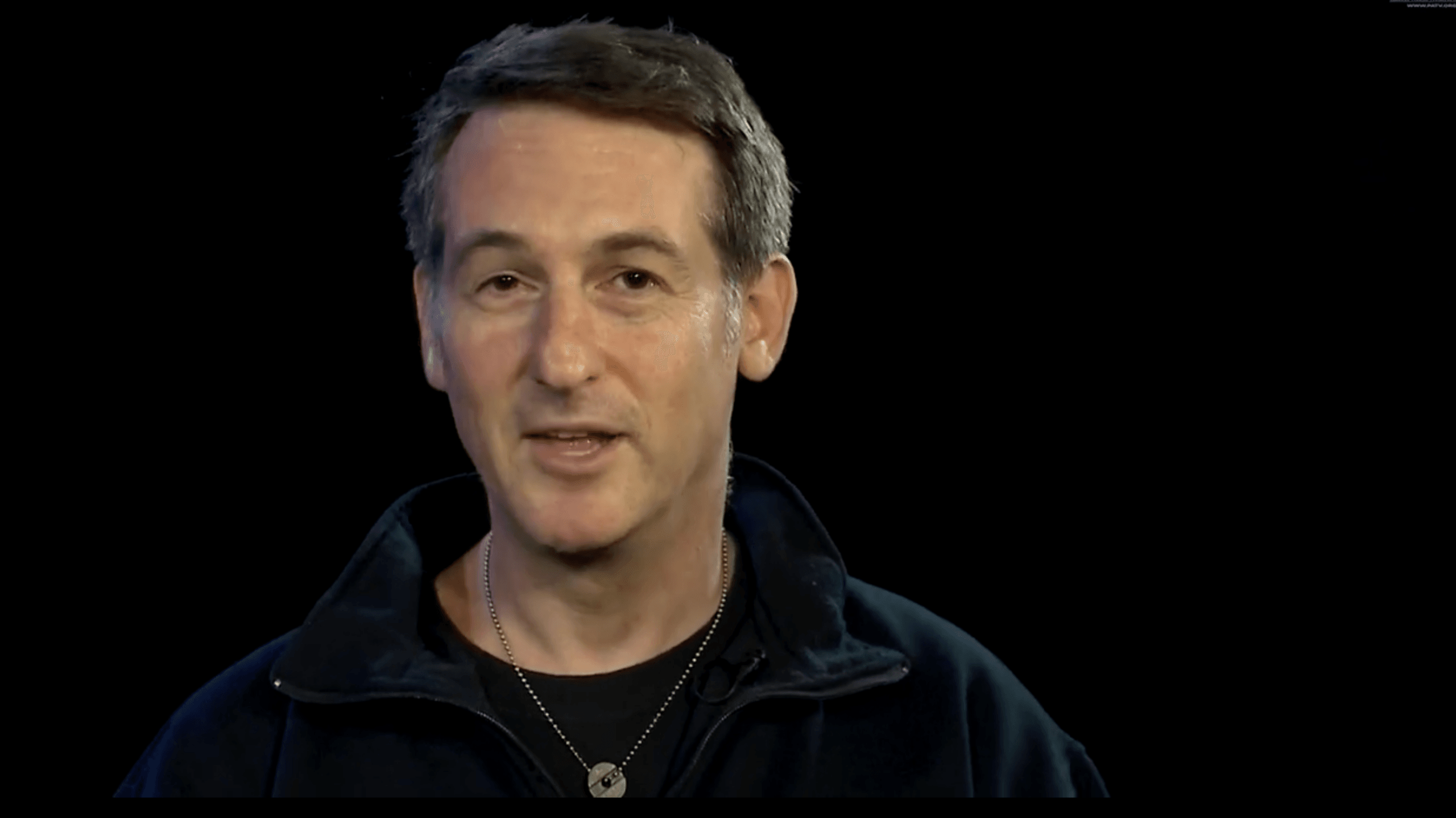
After a stroke stole his words, a paramedic turned aphasia advocate proves that resilience, courage, and a refusal to retreat can rebuild a life of purpose and possibility
Avi Golden doesn’t sit still. He completed his bachelor of science in biology at Towson University, in Maryland. By the time he graduated in 1998, he was well on his way to pursuing a career and a life he loved. In the years that followed, he garnered credentials as an EMT.
This allowed him to work as an emergency medical technician and paramedic in many different and exciting capacities. These included that of a critical care paramedic, a certified flight paramedic, a rescue technician, and in the allied roles of firefighter, hazmat (hazardous materials) operations and weapons of mass destruction technician, and a paramedic with Magen David Adom in Israel. Life was good.
In early June 2007, at age 33, Avi was admitted to Columbia Hospital, in New York, for surgery on a mitral valve prolapse (MVP) repair that was discovered near the aortic valve in his heart. Like many people who go to the hospital for serious, but seemingly routine, surgery, Avi thought he’d be out and recovering in short order. However, that was not to be. During the surgery, Avi experienced a stroke on the left side of his brain, leaving him with right-sided paralysis, and profound aphasia.
Avi remained in Columbia Hospital for two months and then was moved to a rehab hospital in the North Shore – Long Island Jewish Health System – for two more months of intensive in-patient rehabilitation. By early October, he was discharged, and began outpatient therapy at home (which he still receives for his arm and leg).
Rebuilding After Stroke
During his stroke rehabilitation, Avi received “traditional” physical, occupational and speech therapies, but he also utilized a rich mix of non-traditional therapies that included acupuncture, massage, tai chi, yoga, constraint therapy, water therapy, computer games and special speech software. Avi also tried using a Neuromove™ device on his right side.
Avi still has balance problems, and weakness on the right side of his body, but it’s his expressive aphasia that frustrates and confounds him more than any of his other post-stroke residuals. Avi can understand what people are saying to him and he can still read quite well. However, he continues to have a lot of trouble speaking and writing, both of which reflect problems with expressing himself. This can be devastating for any friendly and outgoing person, let alone a certified paramedic who needs to communicate accurately and effectively to do his job.
Avi refuses to let aphasia get in his way. He still works (and volunteers his time) as a paramedic and, more importantly, he’s embarked on a new mission of “aphasia advocacy,” educating others about aphasia and how it impacts a stroke survivor’s day-to-day life.
To make this new goal a reality, Avi has been involved in a lot of aphasia-related projects. Like the myriad of activities in his pre-stroke life, he’s done so many things since his stroke that it’s impossible to list them all.
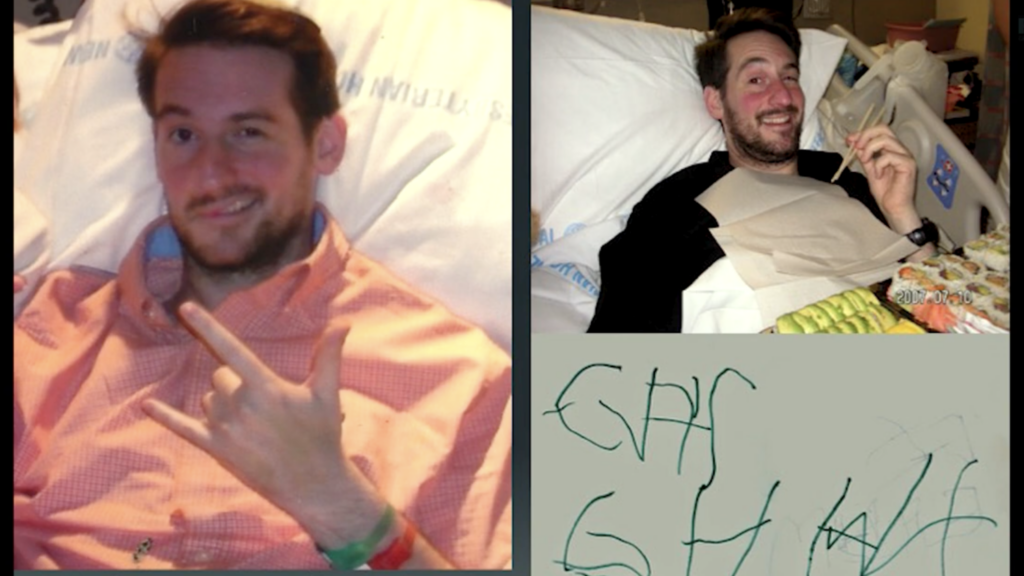 Avi Golden recovers in the hospital after his stroke. The effects of aphasia can be seen in his handwriting.
A New Mission: Aphasia Advocacy
Avi says that his stroke hasn’t fundamentally changed him. He’s still the same sociable, affable, and compassionate person that he was before his stroke. He is eager to help others in need and devoted to his job as a paramedic. He has even more projects in mind for the future. For one thing, he would like to expand on his aphasia awareness efforts by becoming a “motivational speaker” to hospitalized patients in the North Shore – Long Island Jewish Hospital system.
“I tell them anything is possible,” he says.
That philosophy might help explain how — after suffering a stroke during a medical procedure some nine years ago — he was able to graduate from wheelchair to cane to unassisted walking. And if his arm is not back to normal yet, it’s not for lack of trying.
Twice a week, Avi can be found at the Adler Aphasia Center in Maywood, going from activity to activity, distinguished both by his energy and by his kippah. Though he has appeared in each of the center’s theatrical productions, he seems to have cemented his reputation there with a star turn as Tevye in “Fiddler” and the beast in “Beauty and the Beast.”
“I like to perform,” he says.
Finding Strength in Community and Creativity
The center is also where he recruits some of his sports buddies. He doesn’t ask them to do anything he hasn’t done himself.
“After my stroke I was afraid to go to Six Flags Great Adventure theme park,” he says, but he knew he had to go to overcome his fears. Otherwise, he would not be able to ask others to do the same.
Now, when he invites members of the center to go, say, skydiving – he has gone twice – he can tell them his own story. So far, he has enticed dozens of local participants.
“Come stretch your boundaries,” Avi tells them, urging them to “expand your horizons after becoming disabled.”
His outdoors program, which engages in activities from nature walks to white water rafting, is targeted to people who live with a range of disabilities, including those who have had strokes, spinal cord injuries, amputation, or sensory impairments. The program partners with other organizations, and adaptive equipment is available when needed.
Relearning Language
Avi, who was raised in Lubbock, Texas, had been fluent in both English and Hebrew. He is determined to recapture both languages. To do this, he generally spends about 15 hours a day engaged in some kind of speech therapy.
“My mother was born in Jerusalem,” he says. “I still understand Hebrew, but I can’t read, write, or speak it now.”
As for English, “I can understand everything but I can’t get the words out,” he wrote in the PowerPoint presentation he has prepared to help him explain aphasia. He noted that a review of his EMT manual showed that aphasia rates only one mention – not nearly enough, he says.
Avi also is engaged in volunteer work, assisting paramedics at two New York hospitals and visiting stroke patients at North Shore Hospital and Long Island Jewish Hospital. He says that after someone has a stroke, he or she may be tempted to retreat.
“I tell them not to give up,” he says.
Since Avi is still able to enjoy two of his favorite sports, snowboarding and horseback riding, it’s no surprise that he would also like to start a not-for-profit organization (that he’s dubbed “NYC Outdoors Disability”). It would promote snowboarding, horseback riding, hiking, hand cycling, sailing, scuba diving and other outdoor activities for people with disabilities. Based on Avi’s “track record” so far, it’s a sure bet he’ll succeed with both goals.
For more, check out theNo Barriers Summit.