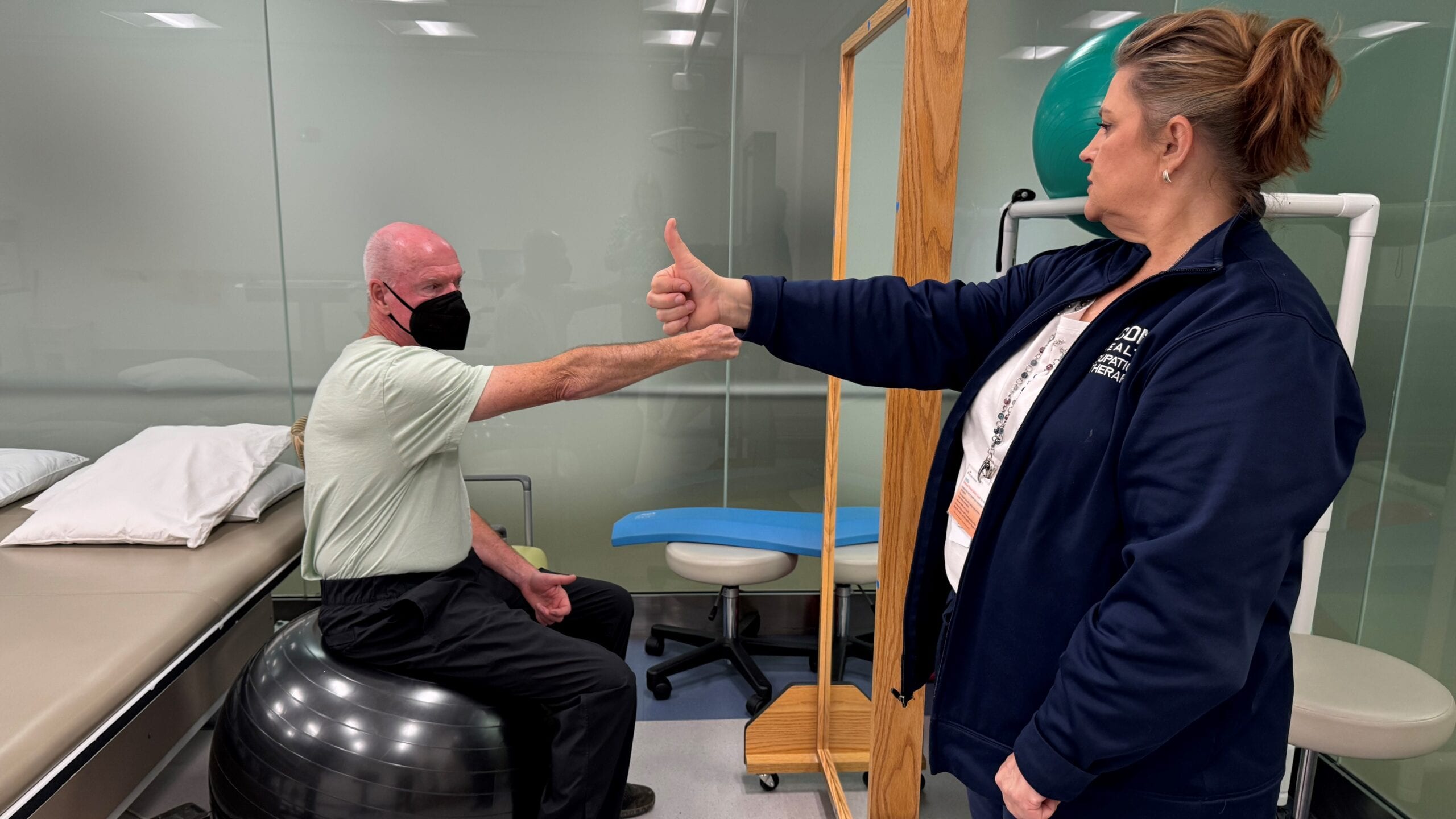
Occupational therapist Rhonda Hickey guides Ernie Quinn after he suffered an ischemic stroke in December 2023. He also underwent the Vivistim procedure, followed by two years of intensive recovery and therapy.
Part 3 of a 5-part series
Read Part 1 here
Read Part 2 here
Care as Commitment
In service-oriented communities, care often extends far beyond formal roles. Responsibility is shared, support is instinctive, and showing up for others is a part of daily life. But even in these environments, caregiving can take on unexpected forms, stretching across years, and demanding more than anyone anticipates.
Linda Blick, a retired investigator, trauma specialist, and Certified Therapy K9 Handler, knows a life dedicated to care firsthand. Today, she serves as a founding member of the Veterans with Disabilities Task Force.* She shared her experience supporting a close friend and colleague, Dr. Alice Quinn, through years of serious health challenges.
The two met more than a decade ago through their shared work supporting first responders, active-duty service members, veterans, and search and rescue teams. They became fast friends through the commonality of their professional work with canines. Linda worked with national security and service canines for decades, and Dr. Quinn is a world recognized PhD human-animal behavioral specialist. After her work with a search and rescue K9 unit at Ground Zero on Sept. 11, 2001, Dr. Quinn began suffering from debilitating headaches and seizures that persisted for years.
Throughout that time, Linda remained a constant source of support. “Both of us work as hard as we can for every person in need, whether they’re related or they’re not,” she says. She explains that when you work in a field that constantly involves emergencies, those around you have to sacrifice, as well. “In our family, my dad was a firefighter for 45 years. He was a chief for 15 years. There’s rarely a dinner, holiday, or celebration where (he wasn’t) called out to help.” This kind of dedication to family, friends, and strangers alike is deeply embedded into the lives of service workers.
When Dr. Quinn’s condition worsened, Linda encouraged her to consult with Dr. Christopher Conner, a Connecticut-based neurosurgeon whose innovative work in neuromodulation offers significant relief to patients with complex neurological conditions. Dr. Conner was able to quickly identify the source of Dr. Quinn’s pain, and recommend a microvascular decompression surgery plan that would significantly improve her quality of life. In the four months since Dr. Conner and Dr. Ketan Bulsara performed the procedure, Dr. Quinn hasn’t had a seizure and her facial pain is gone.
Linda and Alice are fortunate to have the strength of a deep friendship between them, and a shared background that has guided them through all aspects of caregiving, but the work is still a tremendous commitment for everyone involved, no matter what.
Dr. Alice Quinn and Faith outside of the White House when she and Linda Blick, a retired investigator, trauma specialist, and Certified Therapy K9 Handler, were invited to meet with President Barack Obama’s National Security Staff. Photo by Shelley Castle Photography
The Toll on Caregivers
Over the last decade, rates of family caregiving in the United States have increased by 45%. Today, more than 63 million Americans provide medical, personal, financial, and emotional support to loved ones while managing their own jobs, families, and obligations, according to a 2025 report from AARP. Research published in the American Journal of Nursing found that caregivers face a significantly higher risk of adverse health outcomes, including increased mortality linked to chronic psychological strain.
Importantly, this strain most often does not stem from the relationships at the center of care. The weight caregivers carry is primarily due to the scale and complexity of what they are asked to manage, often within systems that offer limited structural support.
Ernie Quinn, a recently retired sales professional from Connecticut, understands this dynamic firsthand. In December of 2023, he suffered an ischemic stroke that abruptly disrupted his daily life. He later underwent the life-giving Vivistim procedure with Dr. Conner’s team, followed by two years of intensive recovery and therapy. Today, he is doing much better.
When Ernie reflects on that period, he speaks vividly about his family’s support. “It was incredible,” he says, recalling the steadiness his wife and sons provided throughout his diagnosis and recovery. He also recognizes how difficult it must have been for all of them to witness such a sudden shift, especially with two of his sons living more than 3,000 miles away.
Ernie describes the emotional toll of no longer being able to contribute in the ways he always had. Recovery and restoring motor function became his focus. For families navigating illness or disability, every regained movement and measured return of strength becomes reassurance. For caregivers, that forward motion is often the main thing they want in return.
Barriers in Healthcare
Yet recovery unfolds within systems that place significant logistical demands on families. Ernie noted that the U.S. healthcare system “has a lot of work to do.” In practice, much of that work was carried by his wife, Terri, who managed appointments, benefits, coverage, and communication across providers.
Terri has professional experience in benefits administration, and even so, navigating these systems was difficult. That difficulty was intensified by staffing shortages and predictable disruptions, such as holiday periods – conditions that place an even heavier burden on patients and caregivers with fewer resources to navigate them.
The Support Network
These challenges are not a reflection of individual clinicians. For many patients, medical professionals are the first to help them understand what comes next.
In Ernie’s case, a sense of understanding was reinforced early on. Once approved for the Vivistim procedure, Dr. Conner’s team provided a six-week training period during which patients and families learn in-depth about the procedure. After a life-altering event such as ischemic stroke, that kind of clarity matters deeply.
Another patient of Dr. Conner’s, Dr. Lisa Donegan, reflects on similar early moments in her own journey after experiencing a stroke at 57. “The medical community was extremely important in helping me understand what happened to me,” she says. From there, she adds, “having a community of both family, friends, and health care practitioners is essential in helping you develop what your new normal is going to be.”
Dr. Donegan’s life has always been shaped by a commitment to curiosity and a drive to engage deeply with the world. She speaks easily about the things that have made her life meaningful – from her work as a scholar and business owner, to hiking, traveling, jewelry-making, and coaching her kids’ soccer teams.
With a doctorate in global education and a master’s in international studies, Dr. Donegan understands these activities not only as personal passions, but as ways to build community, express identity, and create meaning. The lifelong communities and relationships she’s built through these pursuits have proven to be a cornerstone in her recovery.
As Dr. Donegan relinquished control over parts of daily life that she previously managed, her husband and kids took on many responsibilities without hesitation. Recognizing the weight this put on them, their wider community stepped in. Friends in the area organized a meal train and pitched in with rides and other practical support. Dr. Donegan reflected on how frightening this period was for her family, and how essential that extra support was.
Moving Through, Together
Caregiving is ultimately layered, complex, and often heavy, filled with uncertainty and ever-changing responsibilities. Linda emphasizes that support for both patients and caregivers is the most meaningful when it is sensitive and unassuming. Asking, listening, and observing is essential to providing meaningful support.
Despite the challenges, helping someone navigate a path to care can be a profound experience. Linda recalls connecting Dr. Quinn to Dr. Conner’s team: “To be able to tell her that I thought Dr. Conner could help her gave us both hope.” As Dr. Quinn regained her independence and started to resume her life and career after the successful surgery, Linda “cried tears of joy for over a week.”
The feeling Linda describes goes far beyond relief or joy, into perhaps a sense that the patient’s hope and resilience became inseparable from her own. It’s in these moments, when care is shared and outcomes remain uncertain, that caregiving reveals both its weight and its power.
*The Veterans with Disabilities Task Force is committed to preventing veteran suicide and ensuring no veteran is left behind by advancing coordinated, compassionate, and comprehensive approaches that provide hope, healing, and long-term support to those who have served – including expanding access to mental health services, housing stability, employment opportunities, peer support, access to care, and community connection.